Let $X$ be a random variable in $\mathbb{R}^d$ with law $\mu$. We denote by $\mathcal{P}(\mathbb{R}^d)$ the set of all Borel probability measures on $\mathbb{R}^d$.
Assume that $\mu \in ...
Let's practice data science thinking through a probability problem The post Solving the 3Blue1Brown String Probability Problem (Without AI) appeared first on Towards Data Science .
Below is an open problem, an approachable problem, one perhaps you will be the one to solve!
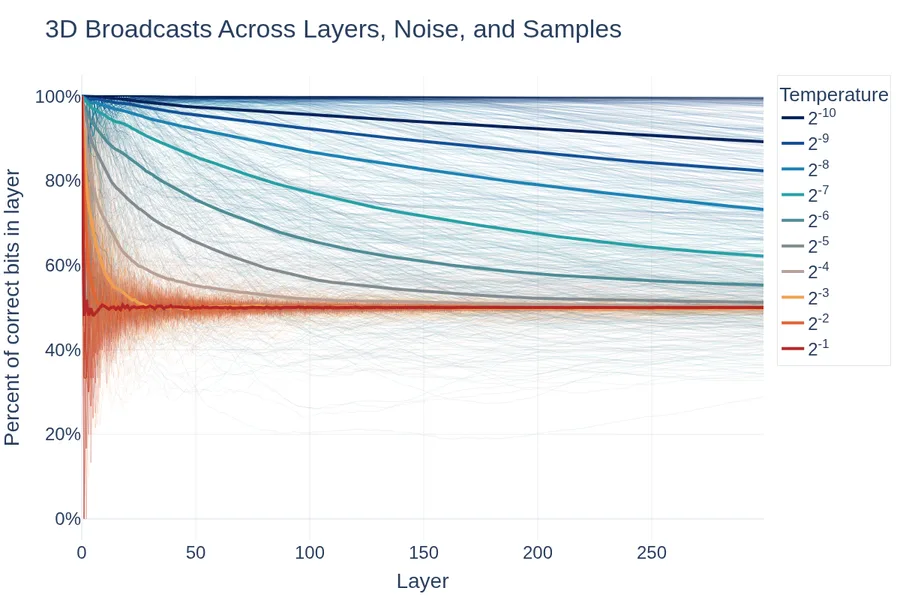
We send a bit over a noisy grid, starting from the origin and propagating out as a wave. Can we recover the original bit when looking at just the wavefront?
This is easy to solve for 1D, mostly solved in 2D, and still open in 3D and above.
Here is the lecture that introduced the problem to me, as well as …
There are a number of approaches to apply category theory to probability and related fields, such as statistics, information theory and dynamical systems.
On one hand, one can study the existing structures in traditional probability theory (such as probability spaces, integration, and so on) using a categorical lens. For instance, the Giry monad models the formation of spaces of probability measu…
A stochastic process describes a dynamical system evolving over a linearly ordered set (“time”), typically taken to be the (positive) integers or real numbers, whose dynamical laws of motion are morphisms in the Kleisli category of the Giry monad (or any other probability monad). By working in the larger category of algebras of that monad, a characterization of a stochastic processes can be model…
Here’s a probability puzzle from a TED-Ed video called Can you solve the frog riddle? by Derek Abbott. It came up recently in this Reddit thread: You’re stranded in a rainforest after accidentally eating a poisonous mushroom. To survive the poison, you need to lick a certain species of frog. Only female frogs produce the antidote. Male and female frogs occur in equal numbers and look identical, b…
Two players start 1 meter away from a target. They simultaneously begin moving towards the target at a same constant speed. If the left player shoots when he is X meters from the target, his shot hit with a probability 1-X... Read more
Question: Let $K$ be a compact Hausdorff space. Is there always a strictly positive Borel probability measure?
Thoughts: If $K$ is metrizable it contains a dense countable subset, so the sum over all ...
How large would the following number be?
The minimum number of digits of $b^{1/b}$ in base $b$ that are necessary for each number from $0$ to $b$ to occur the same number of times.
For example in base ...
Nature, Published online: 01 June 2026; doi:10.1038/d41586-026-00821-4 An experiment with 2,520 participants backs Richard Feynman’s answer to every diner’s dilemma: do I want to try something new?
Physicist Richard Feynman turned a lunch dilemma into a math problem. Researchers finally cracked his notes and found people approximate his solution on their own.
Horsten and Brickhill (2024) propose two methods for constructing non-Archimedean probability
functions on the set-theoretic universe V: the finite snapshot approach and the bootstrapping
approach. The mathematical execution is competent and the results within their framework are
correct. This note raises three foundational concerns that the paper does not adequately address.
First, the proposed …
In This Article The Question The Intuition Trap: The Base Rate Fallacy The Mathematical Proof Python Simulation: 1,000,000 Trials Litigation Application: When Juries Get the Math Wrong The Question A cab was involved in a hit-and-run accident at night. Two cab companies operate in the city: the Green company and the Blue company. You are given the following facts: 85% of the cabs in the city are …
In This Article The Question The Intuition Trap: Why 50/50 Feels Obvious The Exhaustive Case Proof The Bayesian Derivation The Generalized N-Door Problem Python Simulation: 1,000,000 Trials Business Application: Bayesian Updating Under New Evidence The Question You are a contestant on a game show. In front of you stand three closed doors. Behind one of them is a car; behind the other two are goat…
How Knives Out teaches Bayesian thinking (without you realizing it) The post Solving a Murder Mystery Using Bayesian Inference appeared first on Towards Data Science .
The function (1 + cos(x))/2 gives a fair approximation to the Gaussian density exp(−x²) You can make the approximation much better by raising it to a power. The function ((1 + cos(x))/2)4 gives a good lower bound and ((1 + cos(x))/2)3.5597 gives a good upper bound. More on that here. There are other ways of […] The post Another Gaussian approximation first appeared on John D. Cook .
_Sitting with a Mad Mind : A Working Thesis_. forthcomingCaptured Resonance as Structural Law advances three falsifiable cross-scale predictions. The first — that the kinetics of attractor reconstitution following substrate-directed intervention, normalized for substrate-regeneration capacity, show comparable structural signatures across scales — is the prediction on which the cross-scale identit…
I was trying to explain the Monty Hall problem to a sceptical friend. But this led to an issue that has left me a little confused.
I assume that I should describe the Monty Hall problem here, and not ...
I recently encountered the following problem:
You roll a six-sided die and keep track of the sum as you roll, until the sum exceeds 100. What is the probability that the second to last roll is a $2$?
...
Statistical modeling of claim severity distributions is central to actuarial science and risk management, where parameter estimation must balance efficiency and robustness. Maximum likelihood estimation (MLE) is asymptotically efficient under correct model specification but sensitive to extreme observations and perturbations from the assumed distributional form. Robust L-estimators, including the…
mathematicsprobabilitystatistics
research.io
Sign up to keep scrolling
Create your feed subscriptions, save articles, keep scrolling.

















 research.io