econometrics

This article develops a new test to detect changes in generalized autoregressive conditionally heteroscedastic (GARCH(1,1)) processes without imposing a stationary assumption. Specifically, the procedure tests the null hypothesis of a GARCH process with constant parameters, either in (strictly) stationary or explosive regimes, against the alternative hypothesis of parameter changes. We derive the…
The simplest most important idea for time series forecasting The post Measuring Structure Stability of Econometric Models appeared first on Towards Data Science .
This article studies estimation and inference in the autoregressive (AR) models with unspecified and heavy-tailed heteroskedastic noises. A piece-wise locally stationary structure of the noise is constructed to capture various forms of heterogeneity, without imposing any restrictions on the tail index. The new nonstationary AR model allows for not only time-varying conditional features but also u…
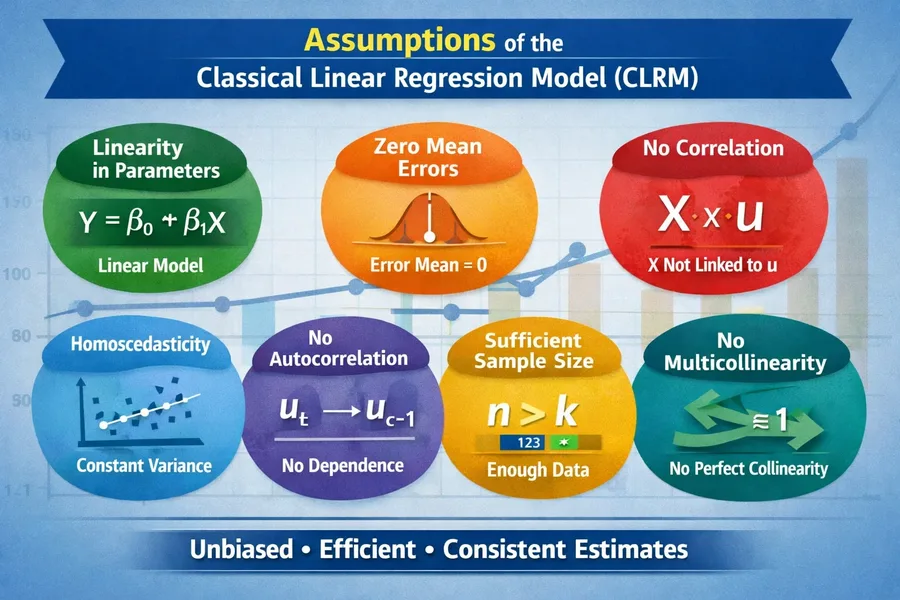
The Classical Linear Regression Model (CLRM) is the foundation of econometrics. It ensures that Ordinary Least Squares (OLS) estimators are BLUE — Best Linear Unbiased Estimators. For this to hold true, certain assumptions must be satisfied. Let’s explore them step by step. 1. Linearity in Parameters 2. Zero Mean of Error Term 3. No Correlation […]
The Missing Intercept: A Demand Equivalence Approach Wolf, Christian K I give conditions under which changes in private spending are accommodated in general equilibrium exactly like changes in aggregate fiscal expenditure. Under such demand equivalence, researchers can use time series evidence on fiscal multipliers to recover the general equilibrium “missing intercept” of shocks to private spendi…
This paper considers linear rational expectations models in the frequency domain. The paper characterizes existence and uniqueness of solutions to particular as well as generic systems. The set of all solutions to a given system is shown to be a finite-dimensional affine space in the frequency domain. It is demonstrated that solutions can be discontinuous with respect to the parameters of the mod…
Today econometrics.blog got a long-overdue update from blogdown to Quarto . Thanks to Claude Code , the transition was seamless: all existing links are preserved, along with the Utterances comment sections. During the upgrade I also corrected an embarrassingly large number of typos across the site and added privacy-respecting site analytics using GoatCounter . To find out whether econometrics has…
Mildly explosive autoregressions have been extensively employed in recent theoretical and applied econometric work to model the phenomenon of asset market bubbles. An important issue in this context concerns the construction of confidence intervals for the autoregressive parameter that represents the degree of explosiveness. Existing studies rely on intervals that are justified only under conditi…
Francesco Bianchi, Marco Del Negro, Giorgio Primiceri and Frank Schorfheide pay tribute to Prof Christopher Sims: Chris Sims, who passed away in March 2026, reshaped modern macroeconomics by insisting that theory and data speak together. A pioneer of vector autoregressions, Bayesian methods, and policy relevant modelling, he transformed how scholars and practitioners analyse economic dynamics and…
Financial time series — asset returns, volatility, intraday prices — exhibit rich temporal structure that the simple i.i.d. model fails to capture. Econometrics provides the statistical and mathematical framework for modeling returns conditioned on historical observations, with two central families of models: mean models (AR, ARMA, VAR, and state-space models via the Kalman filter) that describe …
Suppose data are fitted to some parametric model but that the true model happens to be one with an additional parameter. When a parameter is to be estimated one can use likelihood estimation in the wider model or in the narrow model. Including the extra parameter in the model means less bias but larger sampling variability. Two basic questions are addressed in this article. (i) Just how much miss…
I was saddened to hear of Chris Sims’s passing yesterday. Although I’m not a macroeconometrician, his work has strongly influenced the way I think about econometrics. I covered his famous helicopter tour paper on this blog a while back. Some of my other favorites are unpublished notes or slides from his website , many of them with a philosophical bent. Thinking about instrumental variables is a p…

research.ioSign up to keep scrolling
Create your feed subscriptions, save articles, keep scrolling.