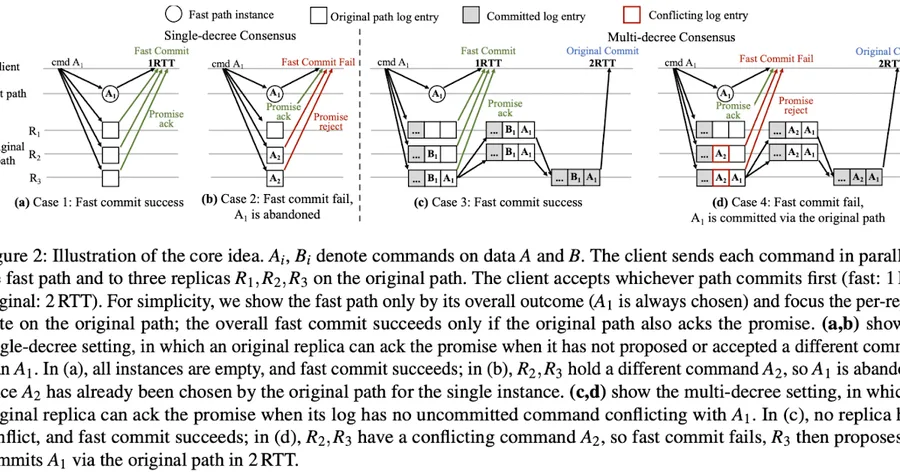
Aleksey and I are back to reading papers live. This paper, Jetpack(OSDI '26), attempts building a universal 1-RTT fast-path framework that bolts onto existing leader-based consensus protocols with minimal modification. Why would we want this? Classic consensus protocols like Raft, Paxos, or Zab require two round-trip times (2 RTT) to commit a command: one RTT from client to leader, and another to…
[ EXECUTIVE TEARDOWN // TL;DR ] In-memory broadcast only reaches the local process — multi-instance real-time needs a shared backplane (Redis pub/sub). Scope subscriptions into rooms so each client receives only the streams it watches, collapsing bandwidth and CPU. Coalesce high-frequency sources on the server to a renderable frame rate before broadcasting. Handle backpressure at the source, not …
Netflix is moving toward the open-source Apache Flink Autoscaler for more than 30,000 streaming jobs across multiple AWS regions. The operator-level approach addresses limitations of Netflix’s cluster level autoscaler for complex, stateful pipelines. Netflix reports a 58% reduction in annualized Flink compute expenditure for one team, saving approximately $1.1 million annually. By Leela Kumili
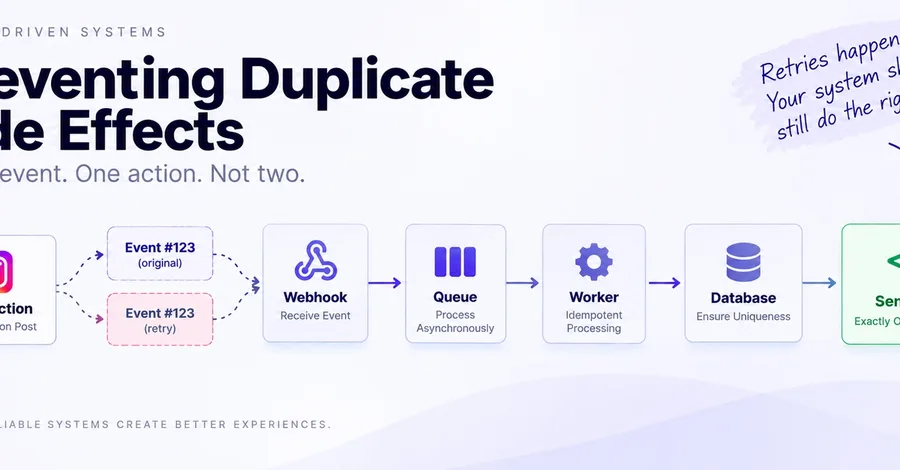
Event-driven systems are good at moving work asynchronously, but they introduce an uncomfortable property: you rarely control how many times an event gets delivered. A webhook can be retried. A queue can redeliver a message when a worker crashes. Two workers can process the same message concurrently. The difficult part is not detecting duplicate events. The difficult part is preventing those dupl…
The Transactional Outbox Pattern: Dual-Write Consistency in Distributed Systems One of the most dangerous anti-patterns in microservices architecture is the Dual-Write Vulnerability : updating a database record and immediately publishing an event to a message broker (e.g., RabbitMQ, Kafka) in the same API call. If the network fails or the broker is unavailable after the database transaction commi…
If you’re a software developer or DevOps engineer, you've probably come across OpenTelemetry. It comes up a lot, especially when talking about observability, monitoring, or debugging distributed syste
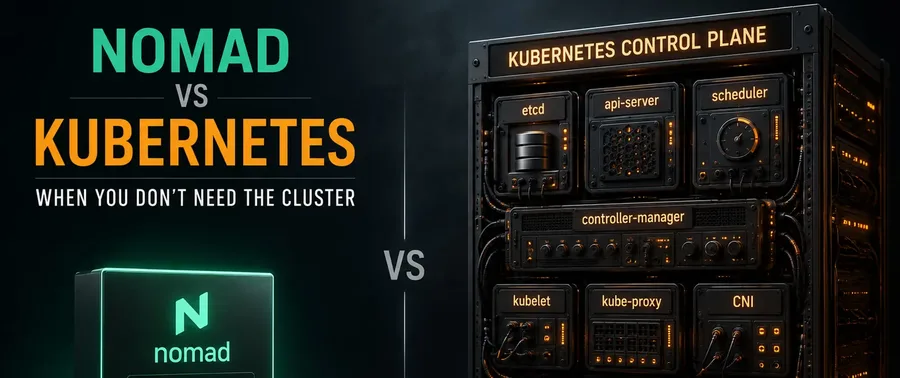
Somewhere along the way, "we need to run some containers" quietly became "so we need Kubernetes," and the second half stopped getting questioned. You stand up a cluster, or pay for a managed one, and now you own a distributed control plane: etcd, an API server, a scheduler, a controller manager, plus a kubelet and kube-proxy on every node, and that's before the CNI plugin, the ingress controller,…
We serve customers primarily in Australia, but we are now expanding to the USA. The timeline for launch is less than 2 months. This is now a race against time to design a multi-region routing system that fits all of our needs. Here is the story. Background Almost all of our customers were based in Oceania. We run our Kubernetes Cluster on GCP in Australia. Go microservices, federated GraphQL, gRP…
Mixnets provide network-level anonymity, traded off with increased communication latency, which consequently limits their applicability to only latency-tolerant applications, shrinking the anonymity set to clients engaged in such use cases. Addressing this issue requires optimizing latency, as recently explored in \lmix (NDSS’24) and \lamp (NDSS’25) through node arrangement and strategic routing.…
The U.S. Department of Justice (DoJ) on Tuesday announced the takedown of a long-standing peer-to-peer (P2P) botnet known as Sality as part of a coordinated law enforcement operation.
The effort was undertaken on August 31, 2026, by authorities from the U.S., Bulgaria, Hungary, and Romania, in collaboration with private industry partners CrowdStrike and the Shadowserver Foundation. To that
Scientific Reports, Published online: 02 September 2026; doi:10.1038/s41598-026-69441-2 Serverless edge intelligence for SLA-aware function placement and resource slicing in wireless networks
In 1999, Eric Brewer made a claim that would shape how distributed systems would be designed for decades. He proposed that any distributed data store can only guarantee two of three properties simulta
Explore key examples of distributed systems and understand their functionality. Discover how they work and their impact on modern technology. Read more!
Sooner or later you hit the same small problem: two services, on two machines, want to touch the same thing at the same moment — append to a shared file, update a row nobody is fencing, call an API that tolerates one caller at a time. One of them has to wait. The usual answers feel heavier than the problem. Put a service in front and serialize everything through it — now you are building a queue,…
For realtime release compatibility in a delivery tracking map, scale event delivery with a durable, ordered log per delivery and treat every browser connection as a disposable projection of that log. Presence can guide fan-out and capacity planning, but it must never decide whether a location update exists. Short answer: release compatibility comes from versioned envelopes, resume cursors, and an…
Discover how distributed computing powers AI and big data. Learn how Hivenet turns everyday devices into a flexible, secure AI cloud—no data centers required.





 research.io