brain-computer-interfaces

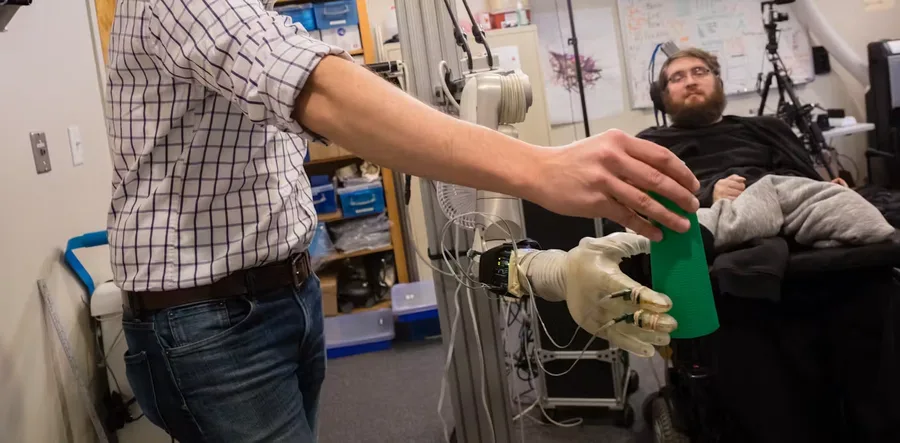
Source: Canadian Broadcasting Company - Top Stories News When Claire Sonnenberg was born with cerebral palsy, her parents were told she would never talk, walk, or do much of anything on her own. Now, the smart and smiley 10-year-old plays video games, bakes, and pores over books using a brain-computer interface—a type of noninvasive technology that allows her to control devices and communicate us…
(Reuters via MSN) – An American scientist convicted of lying to U.S. authorities about payments from China while he was at Harvard University has rebuilt his research lab in Shenzhen to pursue technology the Chinese government has identified as a … Read More

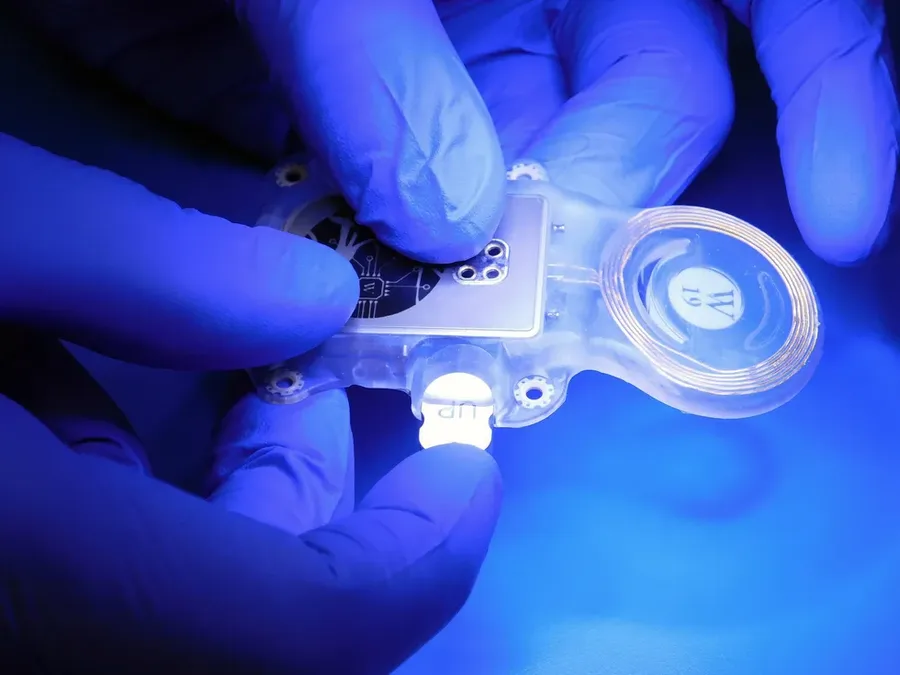
This may sound crazy, but scientists use blood to build soft neural interfaces in the brain, and then control them with light.
Printed artificial neurons can now send lifelike signals that activate real brain cells. This breakthrough could transform both brain implants and energy-efficient AI. Engineers at Northwestern University have developed printed artificial neurons that go beyond simple imitation and can directly engage with real brain cells. These devices are flexible, inexpensive, and capable of producing electri…
BackgroundNeurite orientation dispersion and density imaging (NODDI), an emerging diffusion MRI technique for estimating the microstructural pathology of brain tissue in vivo, has attracted significant research interest. However, a systematic bibliometric analysis of this field remains unexamined. This study aims to perform a bibliometric analysis of the NODDI literature to explore the current re…
(Wired) – While many brain-computer interface companies are focused on helping paralyzed people communicate, Motif Neurotech is targeting mental health disorders. The latest brain-computer interface could help people recover from severe depression. Motif Neurotech announced Monday that the US Food … Read More

The startup specializes in "non-invasive" "mind-reading" tech—a kind of neural data collection that, its CEO hopes, will have all sorts of consumer applications.
Neurable, which makes noninvasive brain-computer interfaces, is licensing its technology and promises a “flood” of new third-party hardware this year and next.
A startup is experimenting with data centers powered by lab-grown human neurons, testing whether living cells can offer a more efficient alternative to traditional computing.
Researchers at Princeton University have created a new kind of computing system that combines living brain cells with advanced electronics. This unusual device works in three dimensions and can be trained to recognize patterns, offering a fresh way to explore both artificial intelligence and the human brain. The study, published in Nature Electronics, takes a […] The post A living computer: Scien…
We can get silicon to "think" but the neuron can't be beat for efficiency. So, researchers worked to imitate it.
Engineers have found a way to fine-tune tiny artificial neurons to fire like real brain cells.
This narrative review critically examines the fundamental principles and clinical applications of Brain-Computer Interfaces (BCIs) in neuroscience and mental health. We searched PubMed, Scopus, and PEDro databases using pre-defined keywords, with inclusion restricted to clinical studies. The manuscript provides an evidence-based assessment of current indications, technological limitations, and em…
Compute-in-memory: State space models; ultra-thin AlScN memory; brain-inspired edge AI. The post Research Bits: Apr. 21 appeared first on Semiconductor Engineering .
This literature review critically examines the design, validation, and application of non-invasive in-ear electroencephalography (ear-EEG) systems as emerging wearable platforms for long-term neurophysiological monitoring and intervention. Following PRISMA guidelines, studies published between 2010 and 2025 were systematically selected from four major databases and organized into four thematic do…
Engineers at Northwestern University have taken a striking leap toward merging machines with the human brain by printing artificial neurons that can actually communicate with real ones. These flexible, low-cost devices generate lifelike electrical signals capable of activating living brain cells, a breakthrough demonstrated in mouse brain tissue.
A dancer with ALS walked onto the stage. She didn't move her arms. She didn't speak. But the performance happened anyway — controlled by her brainwaves, in real time. The neuroscience crowd applauded it. The accessibility people cited it. I saw it scroll through my feed, kept going, then stopped. Went back. Read it twice. Left it open in a tab for the rest of the day. I have something to say abou…
(Wired) – California-based startup Sabi is developing a thought-to-text wearable that could usher in the cyborg future. Speech-to-text capability is now baked into all modern computers. But what if you didn’t have to dictate to your computer? What if you … Read More
research.ioSign up to keep scrolling
Create your feed subscriptions, save articles, keep scrolling.