Metal complexes possess tuneable chemical and biological properties that make them promising candidates for anticancer and antibacterial therapies. They are increasingly explored as alternatives to conventional drugs, particularly in photodynamic therapy (PDT), where light activation induces reactive oxygen species for localised cytotoxicity. In this study, we present a direct-to-biology (D2B) ap…
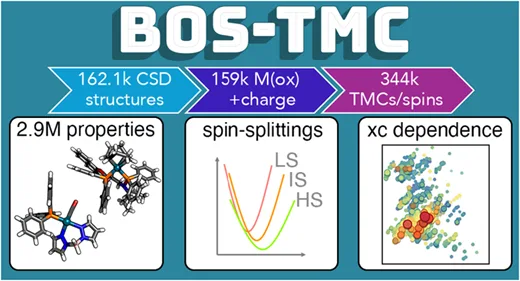
We present the Boston Open-Shell Transition Metal Complex 7 (BOS-TMC) data set, a set of density functional theory (DFT) properties for 159k 8 experimentally characterized mononuclear transition metal complexes (TMCs) in 9 multiple spin states with a range of formal charges derived from the Cambridge Structural Database (CSD). To curate this set, we carried out an iterative procedure to confident…
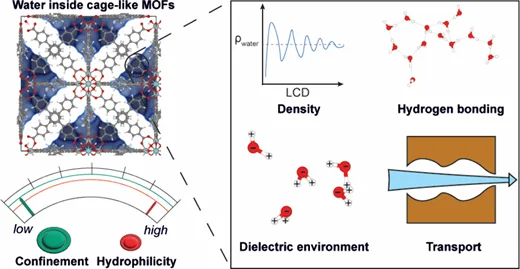
Metal–organic frameworks (MOFs) with cage-like narrow openings and large internal cavities have shown potential for addressing outstanding challenges such as water harvesting and purification. However, a fundamental understanding of water structure and dynamics within these MOFs is essential to achieving high water flux. Here, we take a computational approach to determine the effects of pore conf…
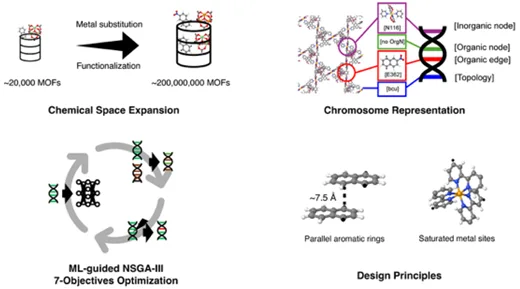
The direct air capture (DAC) of carbon dioxide from the atmosphere requires sorbents that combine strong adsorption at dilute CO2 conditions with resistance to competitive H2O adsorption and robust structural stability. In this work, we present a stability-aware, multiobjective computational framework that integrates machine learning (ML) and evolutionary algorithm (NSGA-III) optimization to iden…
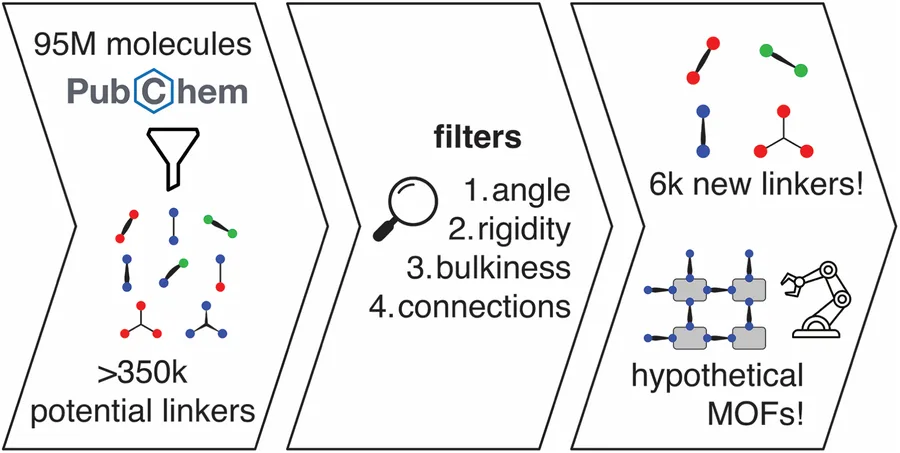
Metal–organic frameworks (MOFs) have attracted significant interest for their diverse applications and tunable properties derived from their organic linkers and inorganic secondary building units. However, the organic linkers historically used in MOFs constitute only a narrow subset of the synthetically realizable small- to medium-sized organic molecules. In this work, we examine the typical char…
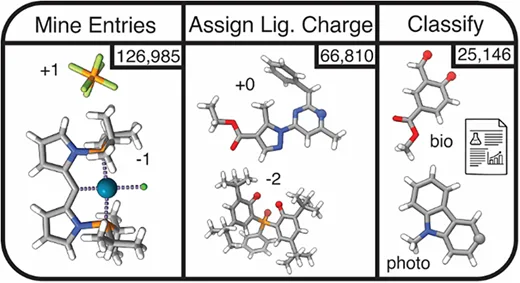
Understanding ligand properties is essential for computational high-throughput screening of transition metal complexes. However, ligand properties such as net charge and other information such as their application area are often absent or inconsistently recorded in crystallographic data sets. Here, we construct a ligand data set from 126,985 mononuclear transition metal complexes curated from the…
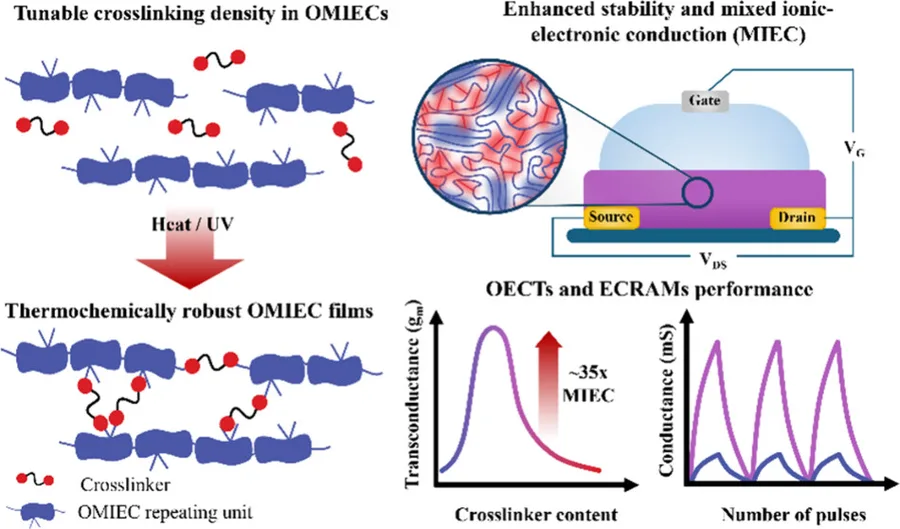
Robust electrochemical modulation and environmental stability remain difficult to co-optimize with performance in organic semiconductors. Using a poly (propylenedioxythiophene) (ProDOT)-based polymer as an amorphous model conductor, we show that carbene-enabled and selective formation of covalent linkages between side-chains enhances thermo-chemical robustness while optimizing device performance.…
Quantum mechanical (QM) cluster models provide an effective framework for mechanistic studies of enzymatic reactions but remain computationally demanding. Neural network potentials (NNPs) offer a promising route to reduce this cost, but enzymes present challenges beyond small molecules, including large system sizes, implicit-solvent environments, substantial polarization, and charge transfer. Her…
Advances in deep learning architectures and representations have enabled ML-driven chemical property prediction, but state-of-the-art (SOTA) models have remained largely confined to independent codebases and lack support for diverse chemical species. This work introduces ElemeNet, a unified, general-purpose software package for molecular machine learning. The ElemeNet software package enables the…
Congratulations to Gigi Wang, Roland St. Michel, Panos Papageorgiou, and Heecheol Jang for receiving fellowships supporting their work in the group! Gigi receieved a Samsung fellowship. Roland received a Fraser fellowship. Panos received an Athans fellowship. Heecheol recieved a ChemE MathWorks fellowship.
A week of defenses has resulted in three new PhDs from the group! Dr. Changhwan Oh will start as a postdoctoral associate at UCLA in the fall. Dr. Husain Adamji will be starting as an ML engineer at Radical AI. Dr. Xiao Huang will be starting as a consultant at McKinsey & Associates
Congratulations to Shuwen (PD ‘23) and Changhwan (PhD ‘26) on the publication of their collaborative work on conductive polymers with the Gumyusenge Lab in ACS AMI! Read more about it here !
Welcome to our newest visitors - Taekgi Lee visiting us from Busan National University, Kimberley Sun from Lawrenceville High school, Sebastian Pujet returning from Wash U for another summer, Joel Pang from Caltech, Ndeye Mbodj from Hunter College, and Amelia England from GaTech! In addition, we are joined this summer by local students Emma Tao, Zheming Zhang, Ryan Jang, and Brian Ma.
Congratulations to Heecheol on his contribution to the latest MONET collaboration on incorporating mechanophores to improve the properties of polymers in Nature! Read more about it here and at MIT News !
Congratulations to Elizabeth Sebastian on receiving a Henry C. (1926) and Frances Keany Rickard Fund Fellowship from the MIT Office of Graduate Education!

 research.io