


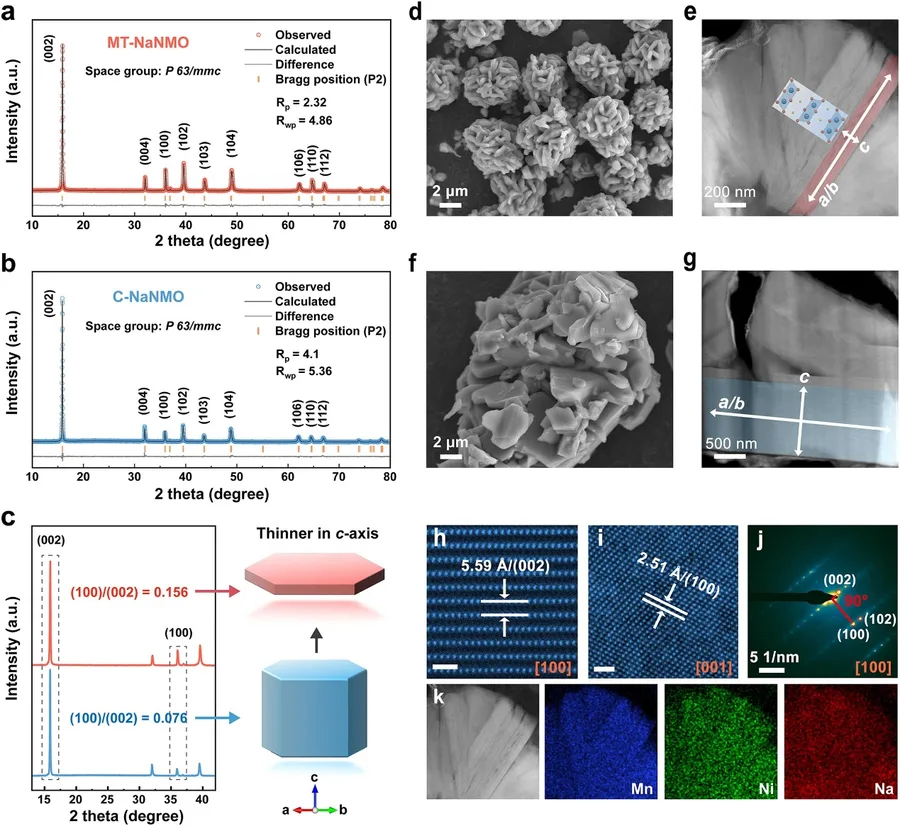
Layered oxide cathodes are among the most promising materials for sodium-ion batteries (SIBs), but their internal grains can crack as sodium ions repeatedly move in and out during cycling. A new study shows that this failure can be reduced by reshaping the crystal grains rather than only changing chemical composition. By tailoring the c-axis dimension of P2-Na0.75Ni0.25Mn0.75O2, the researchers created thinner prism-like grains that release lattice strain more efficiently, reduce stress concentration, and suppress intragranular cracking. The optimized cathode retained 96.7% of its capacity after 300 cycles at 5 C, pointing to a practical design route for more durable sodium-ion battery materials.
Thinner Grains Help Sodium-Ion Batteries Resist Hidden Cracks
Chinese Academy of Sciences