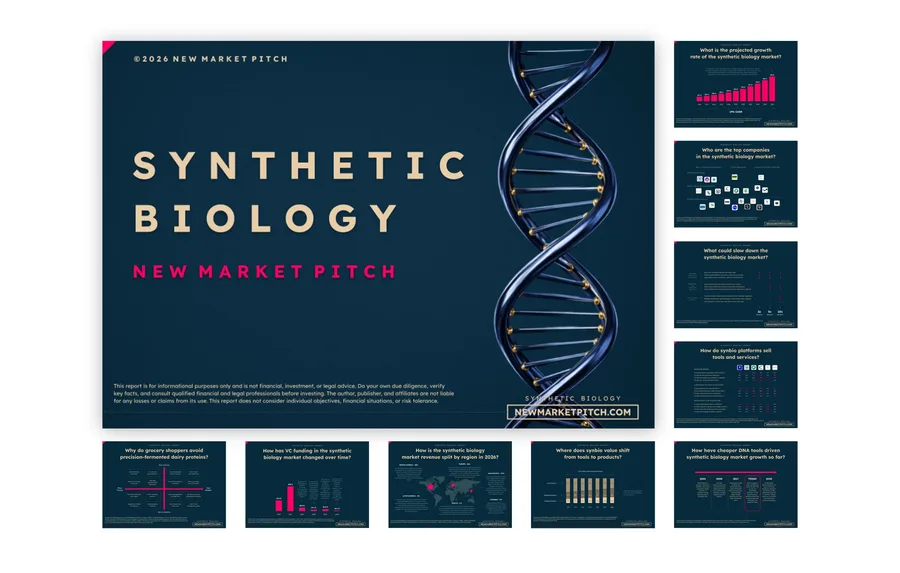
Engineered materials: which startup is ahead? Last updated: 31 July 2026 In our synthetic biology market deck , you will find everything you need to understand the market SUMMARY CuspAI is ahead in engineered materials today, with Lila Sciences the only startup close enough to take the lead quickly. The lead does not come from one model or funding round. CuspAI combines industrial access, category breadth, rapid expansion and the strongest externally confirmed discovery programme in the group. No startup controls the full materials-development loop yet. Citrine is strongest in enterprise software, Chemify in programmable synthesis, Lila in autonomous experimentation and Orbital in open technical models tied to industrial hardware. Citrine’s fourth-place ranking hides an important fact: it has the best proof of repeated commercial use. Its long deployments with materials and chemical companies make it the safest business here, even if it is not the fastest-growing one. Chemify has gone furthest in turning digital designs into routine physical work. Its Glasgow Chemifarm already links route planning, robotic synthesis, testing and analysis inside one operating system. Lila may be building the deepest long-term moat because every experiment can create private data for the next one. The catch is that its strongest discoveries still lack the outside detail needed to compare them properly. Orbital has the clearest reproducible technical evidence and a focused route into data-centre hardware. Its models are unusually open, but large repeat product orders remain unproven. Capital efficiency changes the ranking. Citrine, Chemify and MatNex have produced substantial visible output with far less funding, while Periodic Labs has raised 300 million without showing enough public operating evidence. The whole field still lacks the decisive proof: several AI-designed materials reaching dependable industrial volumes and generating large repeat orders. Until that happens, the leaders are discovery platforms rather than proven materials manufacturers. CuspAI therefore leads, but the position is catchable. Named repeat customers, independently tested materials and reliable production economics would matter more now than another large financing round. This market map, featured in our synthetic biology market deck , highlights top companies and startups in the synthetic biology market Which engineered-materials startups are we really comparing? The useful comparison today is between AI-native startups that can repeatedly design and validate new materials, rather than every company selling one better battery, coating, composite or chemical. We include CuspAI, Lila Sciences, Periodic Labs, Chemify, Citrine Informatics, Orbital Industries and MatNex. Each company is building a platform that can tackle several materials or chemistry problems, rather than betting the whole business on one finished material. Their approaches still differ widely. CuspAI and Citrine work closely with industrial R&D teams. Lila and Periodic are building autonomous laboratories. Chemify connects digital designs to robotic chemical synthesis. Orbital uses its models to develop its own industrial hardware. MatNex turns industrial specifications into protectable material designs. We exclude Sila, Lyten, Boston Materials, 6K and similar startups because they mainly compete within one product market. We also exclude Google DeepMind, Meta, Microsoft and government laboratories because they are not startups. XtalPi is now publicly listed, while younger companies such as Entalpic and Kebotix still disclose too little comparable commercial evidence. Funding figures for private companies are rarely perfect. We use completed and publicly announced rounds wherever possible, with cautious wording when company filings and databases disagree. Startup What it does Publicly traceable funding Why it belongs CuspAI Designs materials with generative AI, simulations and industrial laboratory partners At least 580 million in announced rounds Broadest industrial AI materials platform in the group Lila Sciences Runs AI Science Factories that design, conduct and learn from experiments 550millionBestfundedautonomoussciencechallengerPeriodicLabsBuildsAIscientistsandlaboratoriesforphysicalscienceexperiments550 million Best-funded autonomous-science challenger Periodic Labs Builds AI scientists and laboratories for physical-science experiments 300 million Major new autonomous-lab entrant Chemify Converts molecular designs into chemical code executed by robotic systems At least 93millionClearestlinkbetweensoftwareandautomatedsynthesisCitrineInformaticsProvidesAIsoftwareformaterialsandchemicalproductdevelopmentAbout93 million Clearest link between software and automated synthesis Citrine Informatics Provides AI software for materials and chemical product development About 80 million Longest commercial history in materials informatics Orbital Industries Uses AI-designed materials in cooling and data-centre infrastructure At least 66millionStrongestdirectpathfromAImodelstoindustrialhardwareMatNexDesignscriticalmaterialstospecificationusingAIandphysicsmodelsAround66 million Strongest direct path from AI models to industrial hardware MatNex Designs critical materials to specification using AI and physics models Around 16 million according to recent company evidence Small but unusually productive focused challenger Is one engineered-materials startup clearly ahead today? CuspAI is currently ahead overall, although Lila Sciences remains close enough to make this a real contest. CuspAI combines more capital, a broader industrial network and stronger external project validation than any direct rival. Its AI Materials Foundry has brought together more than 45 organisations across computing, chemicals, semiconductor equipment, manufacturing, scientific data and laboratory testing. The names carry unusual weight. NVIDIA and Meta provide AI infrastructure and models. Applied Materials, Lam Research and Tokyo Electron understand semiconductor manufacturing. Hyundai, 3M, Merck, Mitsui Chemicals, Fujifilm and Oxford PV bring real materials problems and possible routes to market. CuspAI has also completed a six-month discovery project with Kemira. Kemira confirmed that the system screened a vast materials space and produced a small group of candidates for removing PFAS from water. Lila has a different advantage. Its AI Science Factories bring models and experiments under one roof, allowing each laboratory result to improve the next decision. That closed loop could eventually become more powerful than CuspAI’s distributed partner model. The financial gap barely separates them. CuspAI has announced at least 580millionacrossitsmajorrounds,whileLilahasraised580 million across its major rounds, while Lila has raised 550 million. CuspAI leads because it has more named industrial relationships and one externally confirmed programme with detailed outputs. Lila has announced impressive internal discoveries, but less public evidence from paying materials customers. If you want more recent data on this point, please see our latest synthetic biology market report . As this chart shows, and as featured in our synthetic biology market deck , search interest in gene editing has grown significantly Which engineered-materials startup has the strongest commercial traction and customers? Citrine currently has the strongest proof of repeated industrial use, while CuspAI has assembled the most valuable new customer pipeline. Citrine has spent years working inside materials and chemical companies such as Panasonic, LyondellBasell, Eastman, LANXESS, Stepan and Electroninks. Its projects cover semiconductors, formulations, coatings, polymers and specialty chemicals. The Panasonic case remains one of the clearest examples. Citrine helped create four patent-pending organic semiconductor candidates, including one with 25% higher hole mobility than Panasonic had previously achieved. Stepan has described using Citrine models to answer formulation requests more quickly. Electroninks worked with the platform to improve silver inks. These cases show that Citrine can fit into ordinary industrial R&D rather than remaining an experimental tool. CuspAI’s customer and partner roster is more strategically powerful. Applied Materials, Lam Research, Tokyo Electron, Kioxia and imec bring semiconductor expertise. Hyundai and Goodyear bring automotive problems. Merck, Mitsui Chemicals, Resonac, Umicore and Johnson Matthey bring chemistry and manufacturing knowledge. The variety is valuable because materials development requires scientific data, computing, laboratory instruments, process engineers and eventual buyers. CuspAI has pulled all of those groups into one ecosystem. However, membership in the Foundry does not prove that every company is a paying customer. Some organisations may provide data or laboratory access, while others may run joint research or early evaluations. Chemify’s partnership with Zeon carries more weight than a loose innovation agreement. Zeon invested in Chemify and plans to use its design and synthesis system for advanced materials. Orbital’s relationships with AWS and NVIDIA fit its focus on AI data centres, but the company has not disclosed meaningful shipment volumes or repeat orders. Lila has started opening its platform to customers, although named materials clients remain scarce. Citrine wins on proven customer depth. CuspAI wins on the quality and potential value of its industrial network. Which engineered-materials startup is growing fastest and has the most momentum? CuspAI is currently expanding faster than any rival across funding, valuation, hiring, partnerships and international reach. CuspAI started with a 30millionseedround,followedwithaSeriesAofmorethan30 million seed round, followed with a Series A of more than 100 million and recently closed a 450millionSeriesB.Thelatestroundalonewasfifteentimesthesizeoftheoriginalseedfinancing.Itsreportedvaluationmovedfromapproximately450 million Series B. The latest round alone was fifteen times the size of the original seed financing. Its reported valuation moved from approximately 520 million to 2.6billioninlessthanayear,afivefoldincrease.ThatgrowthhasbeenaccompaniedbyoperationsorhiringacrosstheUnitedStates,Singapore,Amsterdam,BerlinandTokyo.ThecompanyisalsoaddingadviserswithexperienceatApple,Google,AMDandmajorindustrialgroups.Itappearstobepreparingtorunseverallargeprogrammesatonceratherthanrelyingononeflagshipproject.Lilagrewalmostasdramaticallywhenitmovedfroma2.6 billion in less than a year, a fivefold increase. That growth has been accompanied by operations or hiring across the United States, Singapore, Amsterdam, Berlin and Tokyo. The company is also adding advisers with experience at Apple, Google, AMD and major industrial groups. It appears to be preparing to run several large programmes at once rather than relying on one flagship project. Lila grew almost as dramatically when it moved from a 200 million seed round to 550millionintotalfunding.Thecompanyisusingthatmoneytoaddinstruments,expanditsScienceFactoriesandopentheplatformtoexternalcustomers.Orbitalhasthestrongestmomentumamongthesmallerstartups.Itslatest550 million in total funding. The company is using that money to add instruments, expand its Science Factories and open the platform to external customers. Orbital has the strongest momentum among the smaller startups. Its latest 50 million Series B was more than three times larger than its earlier 16millionSeriesA.IthasalsoannouncedworkwithNVIDIA,releasedOrbMolv2andfocuseditscommercialstrategyondatacentrecoolingandmodularinfrastructure.Chemifyhashadaproductiverecentperiodaswell.Zeoninvestedandbecameamaterialspartner,thecompanyaddedmorediscoveryprogrammes,anditslatestfinancingsupportsaplannedSiliconValleyfacility.CitrineslaunchofCatalystandApexshowsthattheolderstartupisstillshippingmeaningfulproducts.LilahasdeepeneditsworkwithNVIDIAsscientificagentinfrastructure,whileMatNexhaspublishednewresearchonmagneticsimulationsandsuperconductordesign.Periodiccontinuestohireandbuild,butithasreleasedlittleevidenceofwhatitslaboratorieshaveproduced.CuspAIhasthestrongestoverallmomentum.Orbitalsrecentmovesarenarrowerbutunusuallyconsistentaroundonecommercialmarket.Ifyouwantmorerecentdataonthispoint,pleaseseeourlatestsyntheticbiologymarketreport.Thischart,featuredinoursyntheticbiologymarketdeck,illustratesyearlyVCfundingforsyntheticbiologystartupsWhichengineeredmaterialsstartuphasmovedfurthestintotherealworld?Chemifyhasmovedfurthestintodailyphysicaloperations,whileCuspAIhascompletedthestrongestrecentindustrialdiscoveryprogramme.Chemifyoperatesa£12million,approximately21,500squarefootautomatedchemistryfacilityinGlasgow.TheChemifarmconnectsmoleculardesign,routeplanning,roboticsynthesis,testingandanalysisinsideoneoperatingsystem.ApartnercanaskChemifyforamoleculeandreceiveaphysicalcompoundratherthanstoppingwithadigitalstructure.Chemifysaysitsautomatedprocesscanshortenthepathfromaninitialideatosynthesisbyroughlytentimes,althoughtheresultdependsheavilyonthemolecule.CuspAIsworkwithKemirashowsanotherformofmaturity.Theprojectbeganwithapproximately300trillionpossiblemetalorganicframeworkstructuresforPFASremoval.CuspAIgeneratedmorethan5,000designsandreducedthesearchtoaround20prioritycandidateswithinsixmonths.Thosecandidatesstillneedtobemanufacturedcheaply,surviverepeateduseandbeatexistingfiltrationmaterials.Evenso,CuspAIhasalreadytakenanindustrialproblemmuchfurtherthanageneralAIdemonstration.LilasScienceFactoriesappeartoofferthestrongestautonomousexperimentationsystem.Itsmodelsgeneratehypotheses,chooseexperiments,operateinstrumentsandlearnfromtheresults.LilanowsellsaccessthroughitsCatalystproductandalaboratoryasaservicemodel.MatNexprovidesausefulsmallerscaleexample.ThecompanydesignedandphysicallyproducedMagNex,arareearthfreepermanentmagnet,withtheUniversityofSheffieldandtheHenryRoyceInstitute.MatNexsaystheworktookaboutthreemonthsafterscreeningmorethan100millionpossiblecompositions.Nocompanyhasyetshownthewholeprocessrepeatedly,fromAIdesigntodependablemassproductionandlargerepeatorders.Thatisstillthemissingpiece.WhichAImaterialsstartuphasthebesttechnicalevidence?OrbitalIndustriescurrentlyofferstheclearestreproduciblemodelevidence,eventhoughCuspAIandLilaaretacklingbroaderscientificproblems.OrbitalopensourceditsoriginalOrbmodelandpublishedresultsagainstrecognisedmaterialsbenchmarks.Thecompanyreportedsimulationsthreetosixtimesfasterthanpreviousuniversalinteratomicpotentialsanda3116 million Series A. It has also announced work with NVIDIA, released OrbMol-v2 and focused its commercial strategy on data-centre cooling and modular infrastructure. Chemify has had a productive recent period as well. Zeon invested and became a materials partner, the company added more discovery programmes, and its latest financing supports a planned Silicon Valley facility. Citrine’s launch of Catalyst and Apex shows that the older startup is still shipping meaningful products. Lila has deepened its work with NVIDIA’s scientific-agent infrastructure, while MatNex has published new research on magnetic simulations and superconductor design. Periodic continues to hire and build, but it has released little evidence of what its laboratories have produced. CuspAI has the strongest overall momentum. Orbital’s recent moves are narrower but unusually consistent around one commercial market. If you want more recent data on this point, please see our latest synthetic biology market report . This chart, featured in our synthetic biology market deck , illustrates yearly VC funding for synthetic biology startups Which engineered-materials startup has moved furthest into the real world? Chemify has moved furthest into daily physical operations, while CuspAI has completed the strongest recent industrial discovery programme. Chemify operates a £12 million, approximately 21,500-square-foot automated chemistry facility in Glasgow. The Chemifarm connects molecular design, route planning, robotic synthesis, testing and analysis inside one operating system. A partner can ask Chemify for a molecule and receive a physical compound rather than stopping with a digital structure. Chemify says its automated process can shorten the path from an initial idea to synthesis by roughly ten times, although the result depends heavily on the molecule. CuspAI’s work with Kemira shows another form of maturity. The project began with approximately 300 trillion possible metal-organic framework structures for PFAS removal. CuspAI generated more than 5,000 designs and reduced the search to around 20 priority candidates within six months. Those candidates still need to be manufactured cheaply, survive repeated use and beat existing filtration materials. Even so, CuspAI has already taken an industrial problem much further than a general AI demonstration. Lila’s Science Factories appear to offer the strongest autonomous experimentation system. Its models generate hypotheses, choose experiments, operate instruments and learn from the results. Lila now sells access through its Catalyst product and a laboratory-as-a-service model. MatNex provides a useful smaller-scale example. The company designed and physically produced MagNex, a rare-earth-free permanent magnet, with the University of Sheffield and the Henry Royce Institute. MatNex says the work took about three months after screening more than 100 million possible compositions. No company has yet shown the whole process repeatedly, from AI design to dependable mass production and large repeat orders. That is still the missing piece. Which AI materials startup has the best technical evidence? Orbital Industries currently offers the clearest reproducible model evidence, even though CuspAI and Lila are tackling broader scientific problems. Orbital open-sourced its original Orb model and published results against recognised materials benchmarks. The company reported simulations three to six times faster than previous universal interatomic potentials and a 31% reduction in error on the Matbench Discovery benchmark. Orbital has continued releasing new versions. Orb-v3 extended simulations toward larger physical systems, while newer OrbMol models target molecular chemistry. Orbital recently claimed that OrbMol-v2 beat a widely cited chemistry method, although that comparison still comes from the company. The open releases allow outside researchers to inspect and challenge Orbital’s work, giving its claims more weight than results that remain entirely inside a private laboratory. Citrine has a stronger application-level result. Panasonic’s four patent-pending candidates and 25% improvement in hole mobility relate directly to a property that could influence semiconductor performance. Lila reports carbon-capture materials with better capacity, thermal stability and binding speed than leading products. It also says its laboratories found lower-cost catalysts that avoid platinum-group metals. These results could matter more than Orbital’s benchmark lead, but Lila has not released enough experimental detail for a proper comparison. MatNex has lately published more of its research. Its work on magnetic machine-learning potentials aims to simulate defects, temperature effects and complex spin states at close to quantum-level accuracy but far lower computational cost. Another project used reinforcement learning to explore new superconductor families. CuspAI has shown that it can search enormous design spaces. The remaining test is whether the resulting materials consistently perform better when made and tested. If you want more recent data on this point, please see our latest synthetic biology market report . This chart, featured in our synthetic biology market deck , shows how Twist Bioscience is capturing share in synthetic biology Which engineered-materials startup has the clearest way to make money at scale? Citrine has the clearest route to recurring revenue, while CuspAI and Orbital could eventually build larger but less predictable businesses. Citrine sells enterprise software that becomes part of a company’s materials-development process. Licences, implementation, additional users and expansion into more departments create a familiar recurring model. Software can also reach another customer without building another laboratory. Citrine recently launched Catalyst and Apex, two tools that turn a product goal into suggested experiments and improve predictive modelling behind the workflow. The products make the platform easier for materials teams to use without becoming machine-learning experts. CuspAI can probably charge through long-term research programmes, platform access, milestone payments and possibly rights linked to valuable discoveries. A successful semiconductor material or industrial catalyst could support a very large contract. The company has not explained which revenue structure will dominate. Lila now has a more visible offer. Catalyst gives companies access to its scientific agents, experts and Science Factories. Its laboratory-as-a-service model lets customers buy experimental capacity without constructing their own autonomous facility. Chemify can earn money from molecular design, synthesis and manufacturing services. Its next challenge is replication. The Glasgow Chemifarm needs to stay busy, and the planned Silicon Valley hub must reproduce the same automated processes reliably. Orbital sells physical products rather than access to a discovery platform. Cooling fluids, thermal systems and modular infrastructure can produce large order values, especially as AI data centres consume more power. The model also brings factories, inventory, installation, warranties and maintenance. Citrine has the safest and most scalable business model today. CuspAI has the largest potential contract value, while Orbital has the clearest path to substantial hardware revenue. Which engineered-materials startup uses its funding most effectively? Citrine and Chemify currently show the best visible output per dollar, while Periodic has the most to prove. Funding efficiency remains difficult to measure because these startups do not disclose revenue, cash burn or research spending. We can still compare capital raised with operating facilities, external customers, validated outputs and commercial products. Citrine has spent roughly a decade building enterprise deployments on about 80 million. Its latest product release shows that the company is still improving the platform rather than relying only on old case studies. As seen above, Chemify already operates a large automated facility and is preparing a second hub after raising at least 93million.Itsscientificpapers,strategicinvestmentfromZeonandnewdiscoveryagreementssuggestthattheinfrastructureisbeingused.Orbitalhasraisedatleast93 million. Its scientific papers, strategic investment from Zeon and new discovery agreements suggest that the infrastructure is being used. Orbital has raised at least 66 million and produced open models, commercial infrastructure products and strategic work with AWS and NVIDIA. The real test will come from customer shipments. MatNex has created a physical material and published new technical work with much less capital. Its recent company evidence puts total funding around 16million,althoughpublicinvestmentdatabasesoftenshowloweramounts.CuspAIhasannouncedatleast16 million, although public investment databases often show lower amounts. CuspAI has announced at least 580 million. That money has produced a broad industrial platform and a detailed discovery programme, but expectations are now far higher. Lila has raised 550millionandbuiltworkingScienceFactories.Itsscientificclaimsareambitious,yetexternalcustomerevidenceremainslimited.Periodicraised550 million and built working Science Factories. Its scientific claims are ambitious, yet external customer evidence remains limited. Periodic raised 300 million at launch. The company may be building substantial laboratories behind closed doors, but outsiders currently see almost no customer work, benchmark, material or operating milestone. Startup Approximate funding Best visible output from that capital Current judgment Citrine About 80millionLongcustomerhistory,patentgeneratingprojectsandamaturesoftwareplatformStrongestcommercialefficiencyChemifyAtleast80 million Long customer history, patent-generating projects and a mature software platform Strongest commercial efficiency Chemify At least 93 million Operating Chemifarm, external programmes and expansion plans Strong Orb