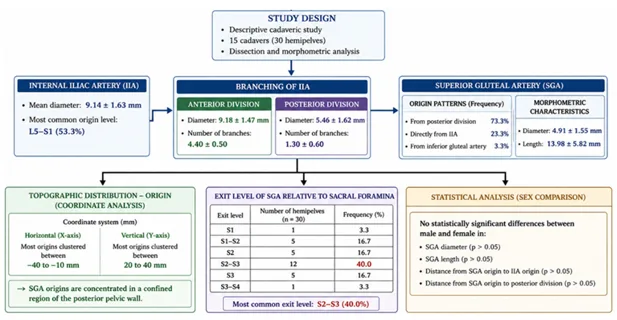
The internal iliac artery (IIA) and superior gluteal artery (SGA) are major vascular structures of the pelvis and gluteal region. Anatomical variations of these vessels may influence pelvic surgery, reconstructive procedures, and endovascular interventions. However, detailed anatomical data in the Vietnamese population remain limited. This study aims to describe the origin, branching patterns, morphometric characteristics, and topographic anatomy of the internal iliac artery and superior gluteal artery in Vietnamese cadavers. A descriptive cadaveric study was conducted on 30 hemipelves obtained from 15 formalin-fixed Vietnamese cadavers. The IIA, its anterior and posterior divisions, and the SGA were dissected and analyzed. The mean diameter of the IIA was 9.14 ± 1.63 mm. The most common vertebral level of IIA origin was L5–S1 (53.3%). The anterior division demonstrated a significantly larger diameter and greater number of branches than the posterior division (p < 0.001). The SGA most frequently originated from the posterior division (73.3%), followed by direct origin from the IIA (23.3%). The mean diameter and length of the SGA were 4.91 ± 1.55 mm and 13.98 ± 5.82 mm, respectively. Most SGA origins were concentrated within a limited region of the posterior pelvic wall, and the most common pelvic exit level was S2–S3 (40.0%). The IIA and SGA exhibit consistent anatomical patterns with notable variations in origin and branching configuration. These findings provide population-specific anatomical data that may serve as useful anatomical references for surgical planning and future clinical studies involving pelvic, gluteal, and reconstructive procedures.