


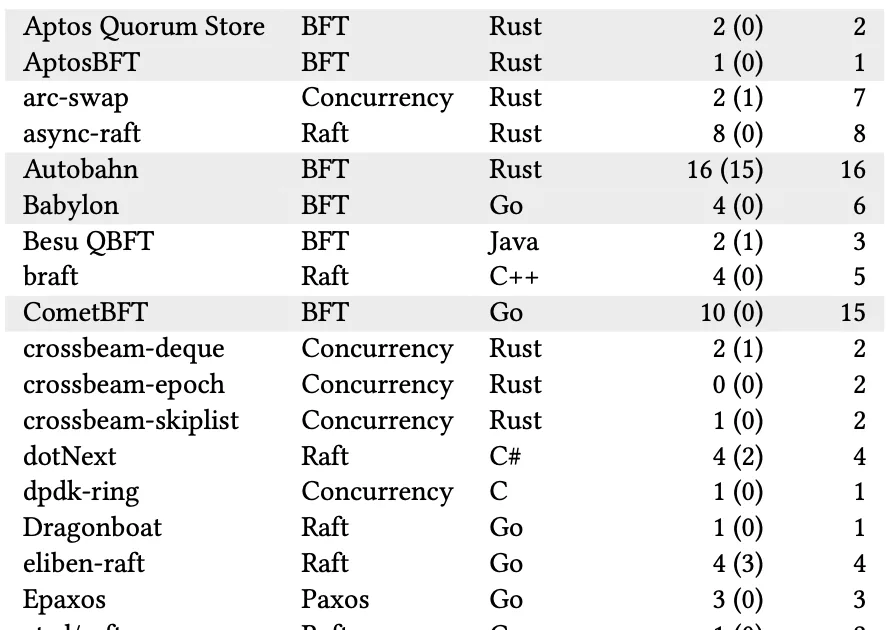
Specula is an agentic system that automates the process of software bug finding through authoring and model-checking a spec for the code. It derives TLA+ specifications automatically from the code, checks code-spec conformance through trace validation, model checks the spec to find concurrency bugs, and reproduces the bug at the code layer by writing integration tests with precise timing. I remember reading the Daikon paper "Quickly detecting relevant program invariants" in 2000 and getting impressed by it, and here we are after 26 years, solving the end-to-end problem much better than I ever thought would be possible in a push-button manner in the year of our lord 2026. But somehow, I am still somewhat unsatisfied with the paper. This may be me being hypercritical and trying to get more out of the paper by arguing with it . So bare with me until I resolve (or learn to accept) these problems over time. I know many of the authors of the Specula work, and respect them, and I know they won't take my critiques about the larger problem in a wrong way... I am trying to make sense of the terrain myself. So, let's look at what Specula gets right, its major contributions, and then dive into my unresolved questions and existential thinking about the terrain. Why is Specula an Impressive Achievement Specula is run on "slices of" 48 complex open-source distributed and concurrent systems including MongoDB, Microsoft's SONiC network OS, GCC's libgomp, Etcd, and RabbitMQ's ra. It found 249 bugs, 207 of them new. The 48 systems span 7 languages, from C to Erlang to Rust. This is very impressive, and it earns the "scaling" claim in the title of the paper. Hand-crafting TLA+ specifications may take weeks (especially for unfamiliar code bases), and Specula completes end-to-end checks in 1.4 to 9.8 hours at a median token cost of 59 per bug instead of $16. Swap in Haiku-4.5 and it finds nothing at all, and keeps declaring the task done before it is done. The gap shows up in the spec-quality scores: Haiku still writes 95% correct TLA+ syntax, but scores 17% on invariants. But look at how fast that part moved. When I reviewed SysMoBench, the benchmark from this same group (which came on Jan 2026), the authors had handed LLMs invariant templates and asked it only to map them onto its own variable names, because invariants are the most signal-heavy part of a spec. Specula now has agents deriving invariants from commit history unaided. The Big Picture Specula is a great pragmatic idea, and it works for what it does. My critiques are mostly about naming the contributions/mechanisms more precisely, plus a last ditch effort to get the ad hocness out of the methods. And I should be honest about where that effort is coming from. When we get around to writing our own paper on agentic specification-based development, I am certain we will reach for the same kind of heuristics, and I will find myself defending them with the same hand-waving I am complaining about here. That is what is really bugging me. I do not know what the non-ad-hoc version of this paper would even look like. All this being said, there is still plenty is to address even on the pragmatic front, because Specula skirts the real hard problem: composition. Specula steers away from authoring and reasoning with compositional specs for multi-service codebases. There is no compositional verification or assume-guarantee reasoning employed when writing specs, as they are monolithic cross-slices of a system. For a system with multiple services, like SONiC's 5 distinct daemons, Specula builds one model per module and mocks the cross-service interactions inside the scenario models. So it cannot say anything about whether the per-module guarantees add up to a system-level guarantee. Unfortunately, the failures you actually fear in distributed systems are the cross-boundary ones , especially for recovery related failures. PS1 : TLA+ for the win!! I got so wrapped up in my own thinking around Specula that I forgot to pat TLA+ on the back. Full disclosure, I am part of the TLA+ Foundation , which recognized and provided some funding for Specula. It is a great addition to the TLA+ ecosystem, and you should go try it: https://github.com/specula-org/Specula PS2 : Here is the link to my marked up copy of the paper. Even with the availability of LLMs, I still believe in deep manual reading , and illustrating one's thought-processes to teach/train others.
Specula: Scaling formal specifications for autonomous model checking of system code
Murat (noreply@blogger.com)