


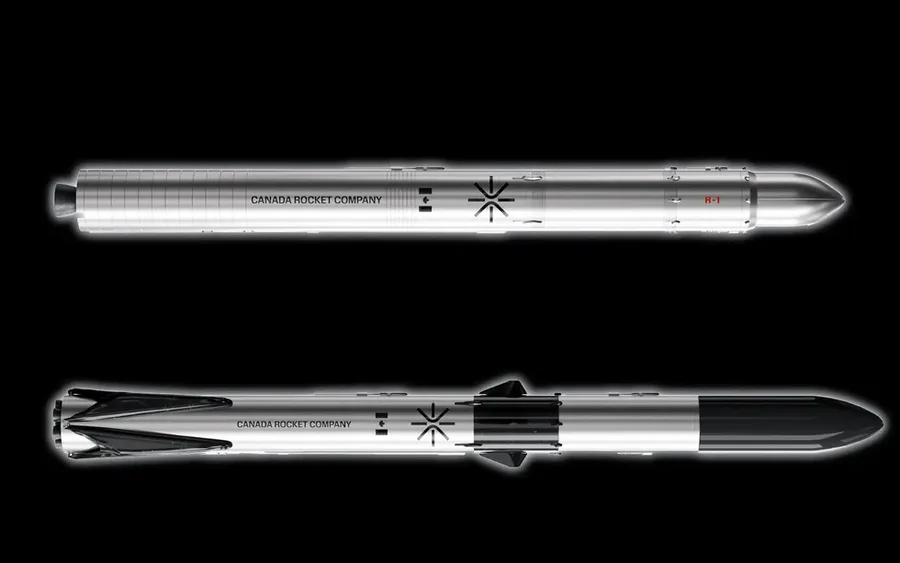
In 1962 Canada’s Alouette 1 , a 145 kg satellite designed to study the ionosphere, was launched on board NASA’s Thor-Agena launch vehicle. Its launch made Canada the third country in history to have a satellite in orbit. Canada’s presence in space remains strong to this day; Artemis II’s crew included Canadian Jeremy Hansen , and MDA Space ’s robotic Canadarm became iconic aboard the Space Shuttle and the International Space Station. And yet, Canada never developed a domestic launch capability. It remains entirely reliant on allies, a situation that’s becoming less comfortable amid trade disputes with its southern neighbor and a growing list of nations with launch capabilities . “Canada claims to be a space-faring nation,” says Andre Dupuis , CEO at Space Strategies Consulting, L td. “Some would argue you’re not a space-faring nation if you can’t actually put anything in space.” Now, a group of scrappy Canadian startups, bolstered by CAD 8.3 million each) from Canada’s Launch the North program. Why Canada Wants its Own Spacelaunch Capabilities Dupuis speaks from familiarity. He served as the Director of Space Requirements in Canada’s Department of National Defence from 2009 through 2014. He says the Canadian government and aerospace industry have “been talking about sovereign launch for the better part of 10 to 15 years.” “Sovereign launch” is the industry term that indicates a country’s ability to launch its own spacecraft into orbit. Canada’s renewed desire for domestic launch is rooted in geopolitical shifts over the past ten years. Tensions between the U.S. and Canada, largely over trade, are perhaps the most obvious example. In addition, Russia’s invasion of the Ukraine, as well as the increased militarization of space, has some Canadians worried. “When you look at the Ukraine conflict, the Iran conflict, even Venezuela, a lot of the first shots were disabling GPS, PNT, and communications from space, as well as Earth observation imaging,” says Hugh Kolias , co-founder of the Canada Rocket Company . (PNT, or Positioning, Navigation, and Timing, refers to the general class of orbital assets that includes GPS satellites.) Joe Varner , deputy director at the Conference of Defence Associations , gave Canada’s Enhanced Satellite Communications Project-Polar (ESCP-P) as an example. The project aims to launch a constellation of communication satellites, built by Canada’s MDA Space and Telesat , to provide satellite communications for Canada’s defense establishment as well as coverage for underserved northern latitudes . Launch opportunities, meanwhile, are rooted in the surge in demand for low-earth-orbit (LEO) satellites. The number of satellites in orbit now is around 18,000 , but it’s expected to reach 100,000 in 2030 , driven sharply by the growth of LEO networks for communications and other purposes. That growth, paired with SpaceX’s intention to stop booking Falcon 9 launches past 2028 due to capacity constraints and the company’s shift towards Starship, leaves an opening for other launch companies, in Kolias’s view. He says the Canada Rocket Company changed course when it became clear that SpaceX was falling behind demand. The company originally planned to focus on the R-1, a light-lift launch vehicle designed to deliver up to 700 kg to LEO. But the company has moved its focus to the R-2, a medium-lift reusable launch vehicle powered by seven of the company’s E-1 methalox engines. It’s now projected to deliver 12,000 to 15,000 kg to LEO. “We’re one of the very few that are skipping light lift and going straight for the larger one,” says Kolias. “Telesat, Canada’s largest commercial constellation, requires 12,000 to 15,000 kg to sun-synchronous orbit. I really don’t think the government wants to invest in a launch vehicle that can’t take Telesat” into orbit. Canada’s Two Advantages for Space Launch Canada, a country of 41 million people, would be a relatively small—but not the smallest—country with sovereign launch capability. Israel, population 10.24 million, and North Korea, population 26.6 million, are among the smallest countries capable of launching their own satellites. What sets Canada apart, its space advocates insist, are human resources and geography. “We’ve hired 30 people in the last six months,” says Kolias, listing recruits from ArianeGroup, SpaceX, Blue Origin, and Rocket Lab. It’s a reversal of the usual path. “Many Canadians end up leaving to SpaceX, Rocket Lab, and so on, out of our schools.” Now, the domestic space industry can make a compelling case for them to come back. Geography may also work in Canada’s favor. Varner argues that Nova Scotia is an ideal site for some payloads. “You can launch LEO, polar, and sun-synchronous orbital satellites from Nova Scotia. It would be out over an area of ocean where there’s really not a lot going on,” he points out. The country currently has two sites in development: NordSpace’s Atlantic Seaport Launch Complex in Newfoundland and Labrador and Spaceport Nova Scotia , run by Maritime Launch Services . Of the two, only Spaceport Nova Scotia has hosted suborbital tests , though the Barracuda launch vehicle was not produced by a Canadian company but instead a company based in the Netherlands. In March 2026, the Canadian government announced a 10-year, CAD $200M lease agreement with Maritime Launch Services for a dedicated launch pad at Spaceport Nova Scotia. NordSpace had planned to launch its own Taiga rocket from the Atlantic Seaport Launch Complex in August 2025, but the test was aborted due to mechanical issues. A second attempt is pending . Minister of Transport Steven MacKinnon introduced the Canadian Space Launch Act in April, 2026, to create a licensing regime for launches from Canadian soil. The Department of National Defence’s Launch the North initiative is separately providing the funds for launch vehicle development; as mentioned, the Canada Rocket Company, NordSpace , and Reaction Dynamic s were the first recipients. While Canada’s domestic launch build-out appears to have momentum, there’s still a lot of work to do before the country can achieve its goals. The launch vehicles themselves are several years away from orbital testing. Canada Rocket Company anticipates a fully assembled engine ready for static-fire tests in late 2027. Reaction Dynamics Labs and NordSpace are both targeting 2028 for an orbital launch. As mentioned, NordSpace’s first sub-orbital attempt was unsuccessful. “Clearly, a successful orbital launch is the next significant milestone,” says Dupuis. “Everybody who’s building a rocket is driving towards that.”
Canada Wants to Join the “Sovereign Launch” Club
Matthew S. Smith