


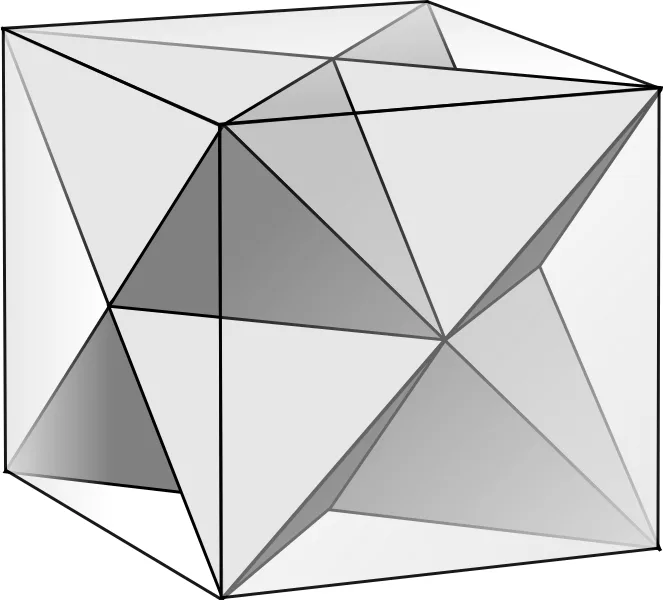
The E6 Root Polytope Posted by John Baez I’ve been thinking about the exceptional Lie algebra E6, as a spinoff of my project on E7, so I want to get a good mental picture of the E6 root polytope. This is 6-dimensional polytope with remarkable symmetry. Let’s climb up to the E6 root polytope starting with some of its 4-dimensional faces, which are called 4-demicubes because you get them by taking a 4-dimensional cube, or tesseract, and removing every other corner. The 3-demicube is just a tetrahedron, since you can fit two tetrahedra in a 3-dimensional cube like this: The 4-demicube builds on this fact in a surprising way. I’m going to use the technology of Dynkin diagrams, or technically Coxeter diagrams: they’re closely related, and the difference is invisible here. I won’t explain them, just use them. I explained them here: • Symmetry and the fourth dimension: part 3, part 4, part 5, part 6. Let’s dive in! The 4-demicube lives in 4 dimensions. It has 8 vertices. You get it from a 4-dimensional cube, which has 24 = 16 vertices, by keeping every other vertex, throwing away half. That leaves 8. What are its top-dimensional faces, aka ‘facets’? Surprise: there’s only one kind! All of them are regular tetrahedra. In higher dimensions the demicube has two kinds of facet. You get a simplex-shaped facet from every other vertex, formed when you remove it. And you get a demicube-shaped facet from each of the cube’s facets. But in 4 dimensions the two kinds happen to be the same shape! Eight of them are tetrahedra. These appear at the 8 corners you sliced off: one per removed corner. Eight more come from the 8 faces of the 4-dimensional cube. These are 3-demicubes. But as we’ve seen, the 3-demicube is also a tetrahedron! So the 4-demicube is especially symmetric: it has 16 tetrahedral facets. You can find coordinates where its vertices are It’s actually one of the 4-dimensional regular polytopes, sometimes called the 4-orthoplex. It’s also called the 16-cell because it has...
The E6 Root Polytope
john (baez@math.ucr.edu)
6 min readEquations