


The field of solidification has evolved from metallurgical alchemy to a predictive science over the past century. Our particular focus is on metals and their alloys, whose thermophysical properties tend to differ distinctively from that of organic systems. Rapid advances in modeling efforts and real-time experiments have yielded a wealth of new and quantitative information across relevant length- and time scales, thereby expanding our understanding of the liquid-to-solid phase transition. The articles in this issue highlight some important recent developments in the field, including solidification at extreme rates, as well as the state-of-the-art computational and experimental techniques that allow us to probe the otherwise improbable. In light of this progress, we identify critical issues and open questions that point to future research directions in solidification science.
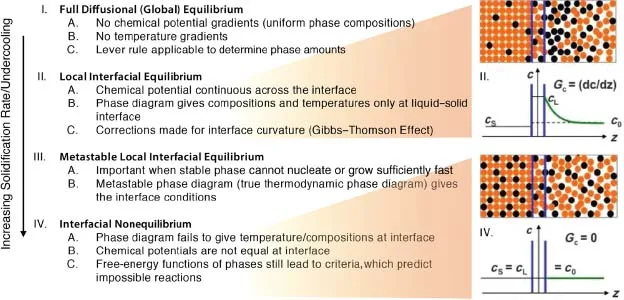
Processing metallic materials far from equilibrium
Clarke, Amy J.