geophysics
Astronomical cycles have long been proposed as potential modulators of seismicity, yet their influence remains controversial due to inconsistent results and methodological limitations. In this study it was tested whether the 18.6-year lunar nodal cycle, expressed in Earth rotation through length-of-day (LOD) variations, is detectable in global seismicity using independent earthquake catalogs (ISC…
Receiver grouping strategies for hybrid geometric-mean reverse time migration Bai, Tong; Lyu, Bin; Williamson, Paul; Nakata, Nori Geometric-mean reverse time migration (GmRTM), a powerful crosscorrelation-based imaging method, generates higher resolution source images and is more robust to noise compared with conventional time-reversal imaging. The price to pay is the higher computational costs. …
Shallow covered karst collapse is a prevalent geological hazard in Fuchuan County, Guangxi, China, posing severe threats to local engineering construction and human safety. To accurately identify subsurface karst structures and delineate collapse hazard zones, high-density electrical resistivity tomography (ERT) with Wenner, Schlumberger, and their combined array configurations was applied in a t…
Earth’s magnetic north pole has a new official position. The updated World Magnetic Model 2025, released by the National Centers for Environmental Information (NOAA) and the British Geological Survey, confirms the pole is drifting closer to Siberia. That matters well beyond geophysics. The model keeps military and civilian planes, ships, submarines, and GPS units aligned with the planet’s changin…
Join us for a live webinar focused on accelerating and optimizing magnetometer data processing using GeoHammer. In this session, we will demonstrate practical workflows for transforming raw magnetic data into clear, interpretable results — faster and more efficiently.
A giant weak spot in Earth’s magnetic field is now half the size of Europe Earth’s magnetic field is on the move — and one giant weak spot over the Atlantic is getting dramatically bigger. - Date: - February 25, 2026 - Source: - European Space Agency (ESA) - Summary: - Earth’s magnetic shield is shifting in dramatic ways. New data from ESA’s Swarm satellites show that the South Atlantic Anomaly —…
Researchers have recreated the eerie sound of Earth’s last magnetic pole flip using real ESA satellite data. Discover what our planet’s magnetic chaos really “sounded” like.
Data from Axial, the most-monitored underwater volcano, are helping geophysicists hone eruption predictions. For Axial, 2026 is their next bet.
Aurorae such as the southern lights, seen here over Antarctica, show the geomagnetic field in action. Some areas of the field, which shields Earth’s surface from charged solar particles, are stronger than others. Credit: D. Michalik/NSF/SPT , ©ESA
Post provided by Josefine Umlauft. We are a group of geophysicists, mathematicians, and ecologists who normally speak quite different scientific languages. This project brought us together through a shared curiosity: could the instruments and analytical tools originally developed for studying earthquakes also help us understand how trees move in the wind? The result, The Seismic Fingerprint of Wi…
New satellite data reveals alarming changes in Earth's magnetic field, highlighting a rapid weakening that could disrupt satellites and global technology.
Geophysicists have modeled how Earth’s magnetic field could form even when its core was fully liquid. By removing the effects of viscosity in their simulation, they revealed a self-sustaining dynamo that mirrors today’s mechanism. The results illuminate Earth’s early history, life’s origins, and the magnetism of other planets. Plus, it could help forecast future changes to our planet’s protective…
See how UgCS enabled a 10 km² aeromagnetic survey with constant 35m AGL terrain following, unlocking precise geophysical mapping for graphite deposits.
A hidden shift in Earth’s gravity went unnoticed for years—until satellites revealed a deep, mysterious change beneath the surface. Now, scientists think something unusual happened near the planet’s core, possibly altering more than just mass.
New sensors being installed across the UK are helping us understand the effects that extreme magnetic storms have on technology and national infrastructure. The post UK scientists in awe-rora as national coverage of magnetic field complete for the first time appeared first on British Geological Survey .
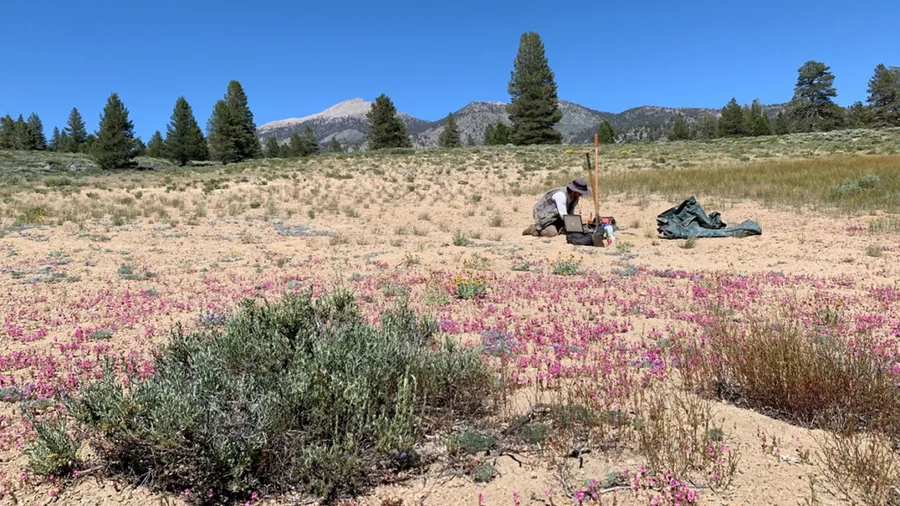
When it comes to peering beneath the Earth’s surface, geophysicists have an arsenal of high-tech tools at their disposal. But what happens when you need to track something as elusive as underground ice forming and melting in real time? Enter borehole Ground-Penetrating Radar (GPR), the underground detective that helped Peter Jung and his colleagues image frozen subsurface volumes in an experiment…
Juliane Huebert took in the fascinating sights of Beppu, Japan, while at a geophysics conference that uses electromagnetic fields to look deep into the Earth and beyond. The post Electromagnetic geophysics in Japan: a conference experience appeared first on British Geological Survey .
4 October 2024–Julian Lozos describes his job—modestly—as “making fake earthquakes on his computer.” But the associate professor of geophysics at California State University, Northridge was also a fan of volcanoes from a young age. During his last visit at his parents’ home, “my mom found a book that I had … Continue Reading » The post At Work: Julian Lozos first appeared on Seismological Society…
An underground instrument known as ‘G’ uses laser beams to measure Earth’s rotation — a gauge of day length — with extreme precision.
research.ioSign up to keep scrolling
Create your feed subscriptions, save articles, keep scrolling.