In this derivation, I can understand the formulas stated for 1D diffraction for both x andy (with the phase difference $\delta= ksin\theta y$ ) in the far-field limit, but how can we just sum the phases from both the x and y components in such a simple manner? I would expect a formula like pythagoras would be needed instead of just $\delta = k(sin(\phi) x + sin(\theta)y)$ .
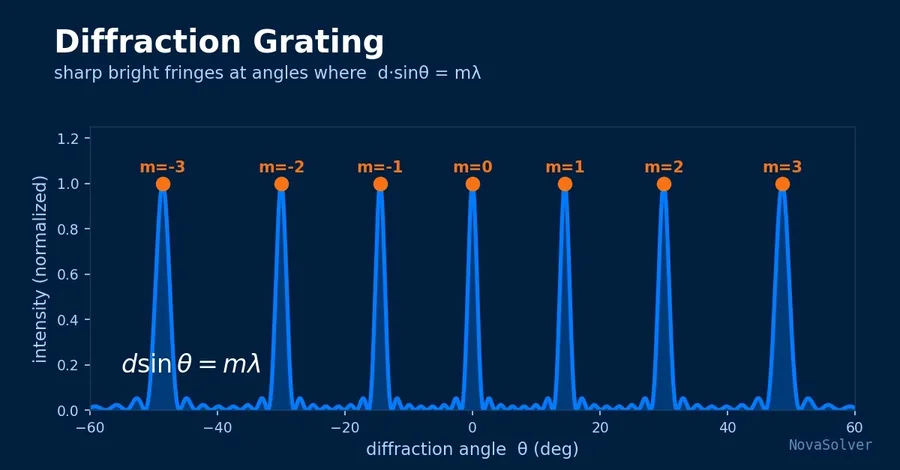
Tilt a CD or DVD under a desk lamp and a band of color sweeps across its surface. The disc is not painted; it is a spiral of microscopic pits, packed so tightly that they act on light the way a finely ruled scientific instrument does. Each wavelength of white light leaves the surface at its own angle, and your eye sees the result fanned out as a rainbow. That is a diffraction grating at work. The…