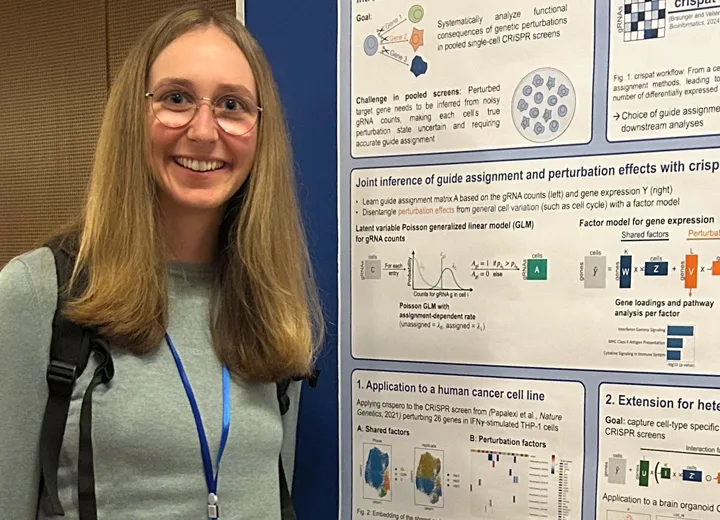
Jana Braunger is developing machine learning methods to better understand how genes shape cellular behaviour. She shares her path into computational biology. Der Beitrag Women in Research #LINO75: Jana Braunger erschien zuerst auf Lindau Nobel Laureate Meetings .
Biofilms are organized groups of microbes surrounded by an extracellular polymeric substance (EPS) matrix. This structure helps microbes survive, creates metabolic differences, and makes them less sensitive to antimicrobial treatments. Because biofilms can block antimicrobials and help microbes adapt, they often cause chronic and recurring infections that are hard to treat with standard methods. …
Nature Microbiology, Published online: 01 September 2026; doi:10.1038/s41564-026-02472-7 MetaCAT is a computational framework to assess host–microbiome interaction via a combination of high-accuracy and efficient microbial genome reconstruction and metagenome-wide association studies with the host physiology using metagenomics data.
IntroductionCharacterizing microbial dynamics and their potential health impacts under space microgravity and radiation conditions remains a major challenge in space biology. The complexity of microbial adaptation, host associated microbiome variation, and heterogeneous multi omics responses requires computational methods that can jointly model temporal dynamics, biological interactions, and pred…
For Stacey Finley, PhD, Professor of Biomedical Engineering and Quantitative & Computational Biology and the inaugural holder of the Nicole A. and Thuan Q. Pham Professorship at the University of Southern California , mathematical oncology addresses some of cancer research’s most complex questions through quantitative tools.
It is not yet approved, and this does not mean we have “cured cancer.” But it is an extraordinary proof of concept: sequencing + AI/computational biology + mRNA + immunotherapy can be combined to create a treatment tailored to the genetic fingerprint of an individual patient’s tumor. Moderna and Merck said on Wednesday that a […]
The new approach, backed by experimental evidence from an interdisciplinary team at UChicago, identified central disease-driving genes, most not previously linked to asthma.
In cell biology, computational models of biological systems range from minimal representations with a handful of parameters to whole-cell simulations tracking thousands of molecular species across a complete cell cycle. While these models span a continuum of detail, increasing complexity changes what they capture and are able to explain, what they can predict, and how they can fall short. A model…
Researchers at Columbia University Mailman School of Public Health, in collaboration with investigators at the University of Chicago, have developed a new computational framework that helps scientists identify genes that play central roles in diseases such as asthma but are often overlooked by existing genetic analysis methods.
dc.title: Two studies in molecular and computational biology: ATM loss driving transcriptional disruption, and the practical limits of zero-shot evolutionary models
dc.description.abstract: This dissertation contains two independent bodies of work in molecular biology and computational biology.
The first investigates the mechanistic basis of cerebellar neurodegeneration in Ataxia-Telangiectasia (…
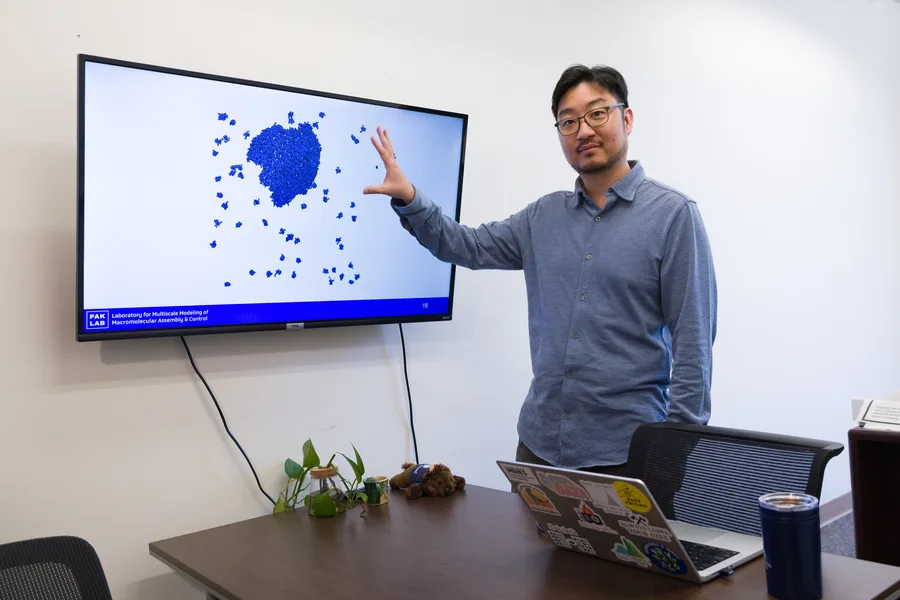
Wistar announces the appointment of Guangfeng Zhou, Ph.D., as assistant professor in the Center for Advanced Therapeutics (CAT). Zhou develops computational methods that combine physics-based molecular modeling with artificial intelligence (AI) to predict how small molecules bind to protein targets.
McGinnis is a computational biologist and cancer immunologist who integrates immunology expertise and single-cell genomics to inform his research into how tumors interact with the immune system in the context of metastasis.
Coarctation of the aorta (CoA) is a common congenital cardiovascular lesion that presents as a localized narrowing of the proximal descending aorta. While improvements in surgical and catheter-based techniques have increased short-term survival, there is a high long-term risk of hypertension and a reduced average lifespan despite correction. Computational models can be used to estimate aortic rem…
AI is helping scientists uncover the hidden molecular structure behind water’s famously strange behavior. Water covers most of Earth’s surface, yet it continues to puzzle scientists because it behaves differently from almost every other liquid. One of its best-known quirks is that it expands instead of shrinking when it freezes. Researchers have long connected these [...]
Artificial intelligence is rapidly becoming an indispensable research partner in the life sciences. But while many AI tools excel at writing code or summarizing papers, scientific discovery demands much more—it requires integrating literature, analyzing complex datasets, running computational workflows, and generating testable hypotheses. That’s where Claude Science enters the picture. Claude Sci…
The new dean will build a life sciences division around large health datasets and models designed to predict disease, simulate treatments and generate research hypotheses. MBZUAI has appointed Eran Segal as Dean of its Division of Biological and Life Sciences to lead research combining AI with large-scale human health data. Image credit: MBZUAI Mohamed bin Zayed University of Artificial Intellige…
Nature Communications, Published online: 29 June 2026; doi:10.1038/s41467-026-74487-x Here, the authors examine whether combining multiple molecular data types improves drug discovery models, finding multimodal approaches boost predictions with effective fusion, and even simple late-fusion methods can reach state-of-the-art performance.






 research.io