If real random variables X, Y (with cdf's FX and FY) are each defined on a probability space (𝛀,ℬ,P), they are defined to be independent precisely when their joint cumulative distribution F(s,t) = ...
When I say "Advanced Probability", I mean for a person acquainted with the measure-theoretic foundations of probability theory, that wants to learn about Stochastic Processes from there, in discrete and continuous time (including martingales in discrete and continuous time, martingale convergence theorems, brownian motion). I have a set of lecture notes I am reading but would appreciate some alte…
My favourite introduction to stochastic processes and stochastic calculus is the book Stochastic Calculus by Paolo Baldi. It is very clear yet precise at the same time, and comes with hundreds of exercises with full solutions prepared. It hits all the important topics - conditional probability, Markov processes, martingale theory, stochastic calculus with respect to Brownian motion, and SDEs. If …
The oldest person in the world, Kane Tanaka of Japan, died in April 2022 at 119 years. The record of Jeanne Calment of France, who died at 122, has stood for almost 25 years. Will it be beaten?
Matrix concentration for Markov chains was initiated in the expander-walk setting by Garg, Lee, Song, and Srivastava'18 [GLSS18]. However, the constant obtained in [GLSS18] is quite loose, and it is natural to ask whether a tighter proof can yield the same constant as in the independent matrix concentration setting. In this paper, we provide a positive answer to this question. Our Hoeffding expon…
The solution to today’s puzzle Earlier today I set you a new twist on the Monty Hall problem, which is (according to AI) the most discussed recreational maths puzzle in history. The standard Monty Hall problem is as follows: Continue reading...
Take this puzzle by the horns Today’s puzzle is a new twist on The Monty Hall problem, arguably the greatest maths puzzle of all time. (According to Gemini, who trawled the internet for me, it is the most discussed and debated recreational maths puzzle of all time.) Continue reading...
Error correcting codes are most simply described in terms of the errors they can certainly correct. For example, the Hadamard code used for the Mariner 9 probe to Mars encoded each 6-bit pixel to a 32-bit codeword in such a way that the original pixel could be recovered if no more than 7 bits were […] The post Probability of correcting errors first appeared on John D. Cook .
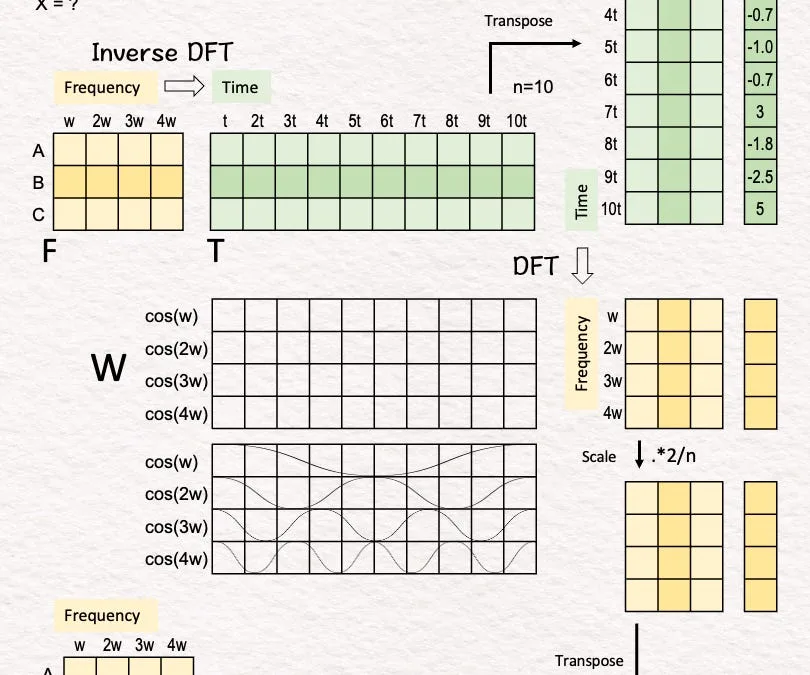
Discrete Fourier Transform by Hand ✍️
Calculating AI by Hand: 19 of 28
In signal processing, the Discrete Fourier Transform (DFT) is no doubt the most important method. But the math involved is extremely complex, literally, involving a summation over a complex number term e^(-iwt), where e is the Euler number, i is the imaginary unit, w is the angular frequency, and t is time.
I developed this ex…
New research demonstrates that Petz-Rényi channel information can be strictly superadditive for α between 1/2, 1, enhancing entanglement-assisted communication reliability.





 research.io