Good Thoughts

Richard Y Chappell
13d ago

Google Mosquitoes Debugging Florida I was excited to learn recently that Google has plans to debug Florida and California by releasing millions of “good bugs”—male mosquitos (which can’t bite or spread disease) that “have a naturally-occurring bacteria called Wolbachia which makes them unable to have offspring with wild female mosquitoes.” It’s an intervention with demonstrable efficacy from past…

biologyecologyentomology
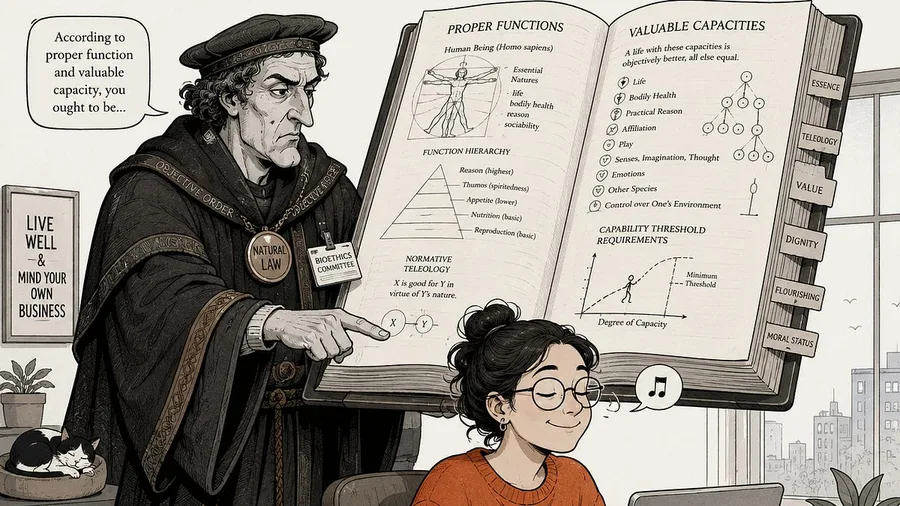
Against Paternalistic Claims of "Degradation" And other purely metaphysical harms One of the trickier questions in ethics is when (if ever) we’re justified in paternalistic judgments that another person has misidentified their own best interests. As an objective list theorist about well-being, I do think that people can be mistaken about what’s intrinsically good or bad for them: “Some things (su…

ethicsphilosophy
Richard Y Chappell
5/7/2026

What is Unjust Discrimination? A systematic account Many people assume that “disparate impact” (across different demographic groups) suffices for unjust discrimination. I think this is mistaken, and we should instead accept an account that’s tied to treating people unfairly (failing to give equal consideration to their interests compared to others’ interests of a similar magnitude). It’s entirely…

ethicsphilosophy
Richard Y Chappell
4/25/2026

Buttons, Blenders, and Coordination Framing effects make a big difference Every now and then, a Red vs Blue Button poll goes viral on Twitter: Everyone in the world has to take a private vote by pressing a red or blue button. If more than 50% of people press the blue button, everyone survives. If less than 50% of people press the blue button, only people who pressed the red button survive. Which …

cognitive-psychologydecision-makingpsychology
Richard Y Chappell
1/5/2026

The Basic Argument for AI Safety High-stakes uncertainty warrants caution and research When I see confident dismissals of AI risk from other philosophers, it’s usually not clear whether our disagreement is ultimately empirical or decision-theoretic in nature. (Are they confident that there’s no non-negligible risk here, or do they think we should ignore the risk even though it’s non-negligible?) …

aiai-safety
Richard Y Chappell
11/25/2025

Who should direct social spending? Individuals, Corporations, or Governments? Suppose that a fixed 10% of GDP was to be spent altruistically. Who would you want directing this process? Compare three salient (though non-exhaustive) alternatives: The government (via higher taxes). Corporations (via higher prices). Individuals (via their savings from lower taxes and prices; or high taxes that are re…

behavioral-economicseconomics
Richard Y Chappell
11/24/2025

Philosophical Pattern-Matching The struggle to replace philosophical stereotypes with substance One of the hardest things in philosophy is to get readers to update their preconceptions about a view (especially if they are unsympathetic to begin with). Any academic will have horror stories about journal referees whose comments address a straw man while completely ignoring the section of your paper…

philosophyphilosophy-of-mind
Richard Y Chappell
11/7/2025

Moral Self-Indulgence On Helping vs Expressing As social creatures, we care a lot about others’ attitudes towards us. And since we lack direct access to others’ minds, we care a lot about what their outward behavior expresses or reveals about their underlying attitudes. Since others are likewise apt to be hypervigilant about the expressive significance of our behavior, it can be to our social adv…

emotionpsychologysocial-psychology
Richard Y Chappell
10/21/2025

Rule High Stakes In, Not Out Asymmetries in Significance given Model Uncertainty Scott Alexander argued that we should rule some things (e.g. thinkers) in, not out. Ord et al (2010) explain how, when a model or argument seeks to establish a tiny probability as the best estimate of some high-stakes event (e.g. human extinction), the estimated probability may be “dwarfed by the chance that the argu…

ethicsphilosophy
Richard Y Chappell
10/19/2025

In Defense of Stakes-Sensitivity Do more good, all else equal TL;DR: Stakes-sensitive beneficence is compatible with individually-directed concern (even for future individuals—see fn 2). Also, we can have reasons to optimize that are decisive for good practical reasoning even if we do not call the resulting act a matter of “duty”. Good people are concerned to act well, not just to discharge their…

Richard Y Chappell
10/7/2025

Inconsistent Anthropocentrism Animals < Humans < Nature? Teaching undergrads, I often come across the following curious combination of views: Speciesism: We should strongly favor humans over non-human animals, to such an extent that we should donate to human charities over animal charities even if the latter turn out to be orders of magnitude more cost-effective at relieving suffering. Ecological…

ethicsphilosophy
Richard Y Chappell
9/27/2025

Human Misalignment An immediate danger from AI: getting what we want? I have very mixed feelings about AI. I find it fun to play around with, and sometimes useful. Uncertainty about future developments (and their social effects) feels extremely unsettling. But much current discourse on the topic is pretty frustrating, simultaneously dismissively neglecting the significance of worst-case scenarios…

aiai-ethics
Richard Y Chappell
9/3/2025

Inviolability and Importance Kamm vs Kagan on Maximal Moral Status In her 1992 ‘Non-Consequentialism, the Person as an End-in-Itself, and the Significance of Status’, Frances Kamm defends and motivates deontic constraints by appeal to the “moral status” she takes to be associated with “inviolability”: If we are inviolable in a certain way, we are more important creatures than violable ones; such …

Richard Y Chappell
8/29/2025

From Autonomy to Utility Deontology as Defection; or The Case for Waiving Non-Utilitarian Rights [An excerpt from Beyond Right and Wrong.] Some rights can be expected to promote overall well-being. Utilitarianism endorses these. Other rights lack this utilitarian property: they protect people against harmful interventions, but at greater cost to others who miss out on helpful interventions as a r…

Richard Y Chappell
8/25/2025

How to Think about Collective Impact Universalizability Done Right When thinking about big social problems like climate change or factory farming, there are two especially common failure modes worth avoiding: Neglecting small numbers that incrementally contribute to significant aggregate harms. (The rounding to zero fallacy) Catastrophizing any actions that contribute (however trivially or justif…

Can Songs Philosophically Convince or Illuminate? You tell me! For those of us who love philosophy, philosophical songs—e.g. from the 21st Century Monads or Hannah Hoffman—can be a lot of fun. Since I’m not in a position to compose such works myself, one of my favorite uses of Suno is to play around with having it add musical backing to philosophical lyrics, with results like my Idealism Theme So…

ethicsphilosophy

Only Aggregationists Respect the Separateness of Persons Separate people have independent value I often find myself thinking that the conventional wisdom in moral philosophy gets a lot of things backwards. For example, I’ve previously discussed how deontology is much more deeply self-effacing (making objectively right actions, and not just bungled attempts to act rightly, lamentable) than consequ…

ethicsphilosophy
Richard Y Chappell
8/6/2025

Home Education Resources For Gifted Kids My wife Helen is slightly obsessed with education. One of her childhood hobbies was designing optimal syllabi. Now, when she’s not exploring grand metaphysical systems better than Berkeley’s, she’s planning and researching how to better educate our crazy smart, neurodiverse 8-year-old. I think a lot of the stuff she’s found is rather awesome, so figured I’…

educationlearning-science
Richard Y Chappell
8/4/2025

Thinking Clearly about Reasons Why practical reasons for belief are like reasons for chocolate I recall being baffled, as an undergraduate student, by the debates over epistemic vs practical reasons for belief: “If the fate of the world depended on it, who could deny that having the world-saving belief was more important than having an epistemically rational belief?” I only later realized that of…

epistemologyphilosophy
research.ioresearch.io

Sign up to keep scrolling

Create your feed subscriptions, save articles, keep scrolling.

Already have an account?