Good news for engineering and operations teams: following overwhelming interest in the Global Drone Operations Awards 2026, SPH Engineering is extending the nomination window to September 11, 2026.
IRD researchers flew 303 autonomous UgCS missions over 50 ha of French Guiana rainforest with three DJI drones, holding 5 cm GSD for a 4-year tree phenology record.
How drone power line inspection actually works in the field. Sensors, mission planning, LiDAR workflows, reporting, and where drones still aren't the right call.
Can drone aeromagnetic surveys improve the geomagnetic reference for MWD directional drilling? How local crustal-field data and In-Field Referencing (IFR) could sharpen wellbore azimuth, and when a drone survey is worth considering.
CSIC researchers flew a hyperspectral drone survey over a Livingston Island glacier, using UgCS terrain following to hold 6.5 cm/px across 80 m of sloping ice.
SPH Engineering and Romvesen invite drone and survey professionals to a two-day field demonstration in Førde, Norway, focused on drone-based geophysical and hydrographic sensor workflows.
SPH Engineering, a leading developer of drone-based solutions for surveying, inspection and mapping, today announced the opening of applications for the Global Drone Operations Awards 2026. The international recognition program is designed to recognize advanced drone operations that solve complex field challenges in industrial, scientific, and engineering environments.
How much does GPR cost? See real pricing ranges for equipment, surveys, UAV-mounted GPR, and what affects price. Includes cost comparison tables and decision guidance.
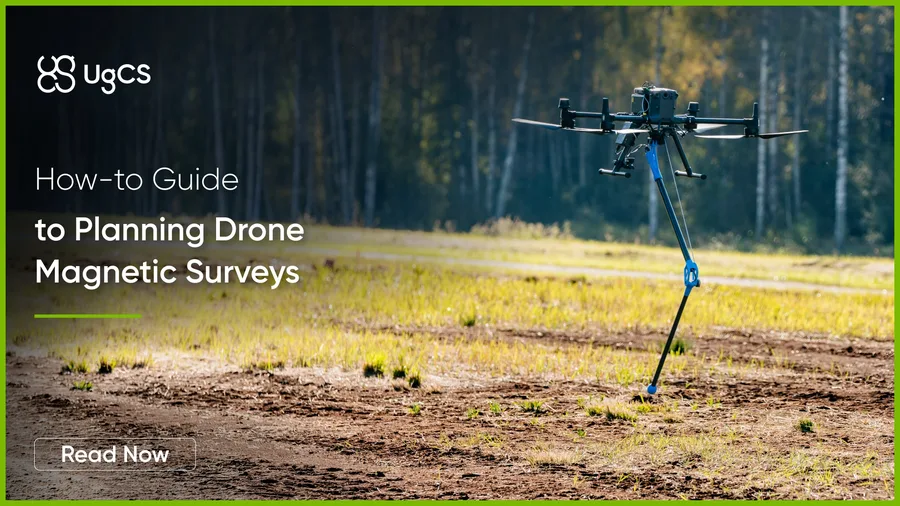
Step-by-step guide to planning drone magnetometer surveys, from terrain models and line spacing to sensor-specific overshoot settings for MagNIMBUS, MagArrow, and SENSYS systems.
Live missions, real field conditions, the complete technical stack behind commercial drone operations shown end to end: from mission planning to payload to processed data. This is where you see how it works, talk to the people who build it, and compare notes with operators solving the same problems you are.
University of Queensland used UgCS to plan repeatable low-altitude drone flights for 3D crop phenotyping. See how consistent missions enabled 0.85 mAP panicle detection.
Patriot Environmental used a drone-based echo sounder to measure frac pond water volume in West Texas, delivering a 3D bathymetric model and volumetric strap chart.
How construction, mining, agriculture, environmental, and hydrographic teams use drone mapping and aerial surveying to collect better data, faster, with documented case studies for each industry.
Drone inspections only produce value when missions are planned for consistent GSD, repeatable flight paths, and structured reporting. Learn how to plan inspection missions across buildings, powerlines, pipelines, and industrial assets.
For the very first time in Japan, SkyLink Japan and SPH Engineering are collaborating to bring you a groundbreaking series of live, hands-on demonstrations showcasing next-generation drone surveying and environmental sensing technologies.
UgCS 6.0 introduces Large Area Splitting, tie lines, historical line matching, and per-sub-area flight time for multi-km² drone magnetic surveys. Available in Expert and Enterprise.
research.io
Sign up to keep scrolling
Create your feed subscriptions, save articles, keep scrolling.



 research.io