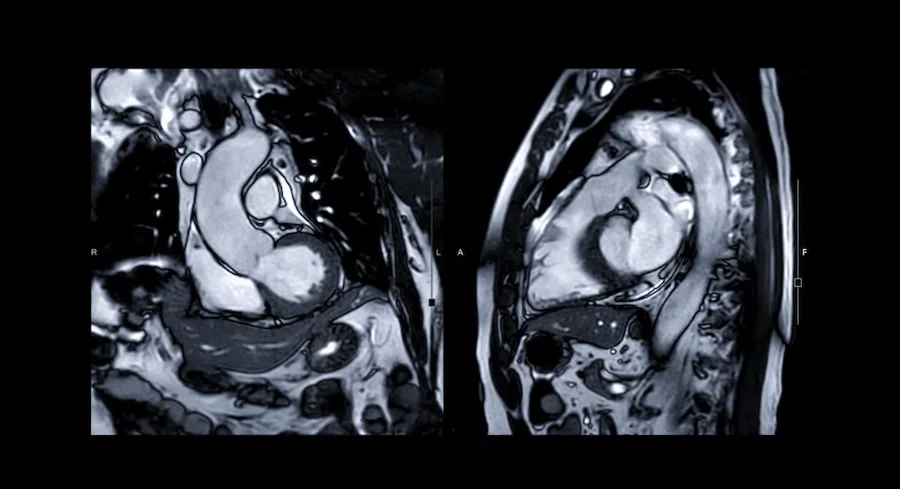
The gold standard for spotting myocardial scarring requires injecting gadolinium contrast during cardiac MRI, which adds time, cost, and a barrier for patients who can’t receive it. Now a new study suggests AI may replace that injection in some cases. Researchers collected CMR data from two independent sites in the U.K. and China with each […] The post No Gadolinium Contrast? No Problem with VNE …
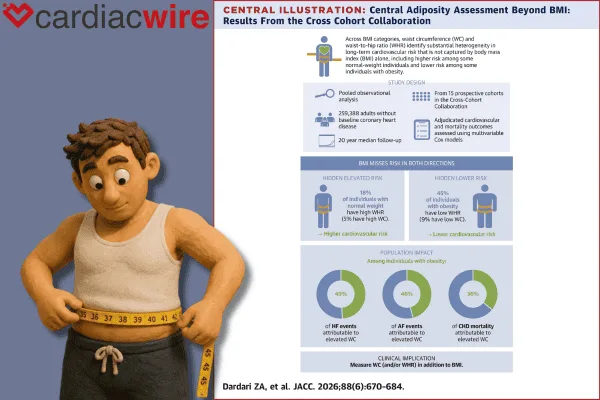
We all know BMI is pretty useless for predicting CV risk, and a new JACC analysis puts hard numbers on just how much it misses, including a high-risk group hiding in plain sight among “normal weight” patients. If you’re up to date, you already know that visceral fat contributes directly to cardiovascular risk. This association […] The post Just How Bad is BMI at Predicting CVD Risk? appeared firs…
The old adage that “built capacity gets used” applies to cardiology too. A Lown Institute study found that regions with the most PCI-performing physicians lead to a disproportionately higher share of patients receiving stents they’re unlikely to benefit from. So how does provider density correlate with overuse? Researchers analyzed 100% of Medicare fee-for-service and Medicare […] The post More I…
iRhythm, best known for its Zio cardiac monitoring wearables, is moving to expand well beyond its 14-day-patch roots by acquiring wearable biosensor company VitalConnect for $287.5M. iRhythm’s strategic logic is about widening what it can monitor and where. VitalConnect’s FDA-cleared monitoring platform already spans several cardiac modalities plus multi-vitals capabilities built for hospital and…
Cardiovascular inflammation has been the talk of the town in cardiology, and while Novo Nordisk was wise to pursue treating it, results from the ZEUS trial have led to a thunderous debate on whether or not it ever played a role in ASCVD. To test the inflammatory hypothesis directly, ZEUS enrolled more than 6,300 patients […] The post ZEUS Tells Us Inflammation Might Not Be the Answer appeared fir…
Cardiology is one of the most data-driven medical specialties a physician can pursue. So why is the source of that data – cardiac academia – declining in both workforce and prestige? A new JACC State-of-the-Art Review aims to tackle that question while offering some ways to turn the tide on the rising troubles with academic […] The post How to Make Cardiologists Love Academia Again appeared firs…
As the ATTR-CM market gets more crowded, medications will have to prove their place, and a sub-analysis of the ATTRibute-CM trial shows BridgeBio’s Attruby (acoramidis) has the efficacy to remain competitive. That’s where this secondary analysis comes in. The original Phase 3 trial randomized 611 patients with ATTR-CM to Attruby or placebo. Now, researchers are […] The post Another Look at Attrub…
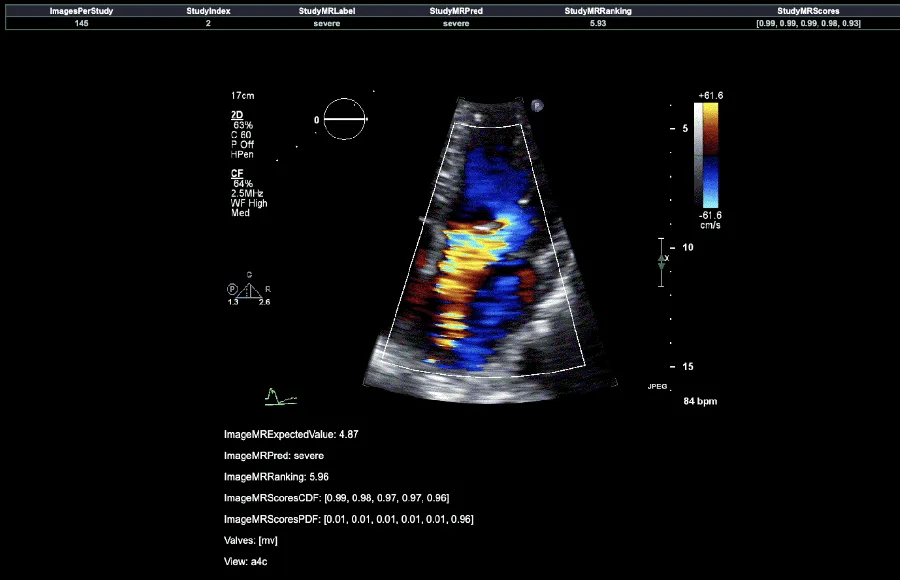
A common question in structural heart cardiology is “when do we know to intervene?” and recently released 25-year mitral regurgitation data might just have given us an answer. Using ERO as a North Star, researchers followed 449 asymptomatic degenerative MR patients for a median of 26 years, and used the metric to determine the severity […] The post Knowing When to Intervene in Mitral Regurgitatio…
Picture this – you graduate medical school (not easy), you do a three-year internal medicine residency, then a three-year general cardiology fellowship, and another year of fellowship, but you’re paid less than your peers in other subspecialties – congrats, you’re an advanced heart failure cardiologist (AHFTC). With all that effort, it’s no surprise a new […] The post The Career Perceptions of He…
New price transparency data reveals how wildly insurance payments, reimbursements, and facility fees for cardiology swing across insurers and states, which underscores the complexity of U.S. healthcare costs. Researchers analyzed the negotiated allowed amounts by CPT code, grouping services into diagnostic imaging, electrophysiology, interventional cardiology, and stress testing, then compared pr…
PCSK9 inhibitors are some of the most effective LDL-lowering drugs out there, but they’ve all required injection, and some even refrigeration. That just changed, however, with the FDA’s approval of Merck’s Lipfendra (enlicitide), the first ever oral PCSK9i. Budding from the CORALreef trial series, including the Lipids and HeFH readouts, Lipfendra’s approval rests on a […] The post An Oral PCSK9i …
Sponsored by Abbott Written by Dr. Sandip Zalawadiya, Medical Director of the Ventricular Assist Device Program and Director of Remote Patient Management Devices in Nashville, Tenn. Heart failure continues to place a significant burden on patients and the healthcare system, with nearly 7 million Americans living with heart failure, with prevalence expected to reach nearly […] The post How Earli…
One year after its FDA approval for HF treatment, a new FINEARTS-HF substudy shows Bayer’s Kerendia (finerenone) isn’t just impervious to BP differences, it could actually give a small leg up to patients with hypertension. A FINEARTS-HF refresher: The trial randomized 6k patients with HFmrEF/HFpEF to treatment with either Kerendia or placebo. Now this substudy […] The post Can Kerendia Handle th…
The power of a zero CAC score is facing fresh scrutiny after new plaque analysis data presented at SCCT 2026 shows just how much noncalcified plaque confers its own cardiovascular risk, despite the software’s financial barriers. To test whether quantitative plaque assessment can address this, researchers analyzed 3.7k PROMISE patients who were evaluated with CCTA […] The post Zero CAC And The Cos…
The ATTR-CM drug race almost got another contender, but AstraZeneca and Ionis’ Wainua unexpected Phase 3 trial failure might have actually simplified the field. Initially intended to support FDA approval, the Phase 3 CARDIO-TTRansform study enrolled 1,432 patients and randomized them to Wainua or placebo plus standard of care, with results showing that… The most […] The post CARDIO-TTRansform and…
Guideline-directed heart failure therapy works, but the biggest hurdle is getting patients to actually take it and fresh results in Nature from the POLY-HF trial suggest a polypill approach could be the answer. Researchers then randomized 212 patients to receive either a single polypill or the same three medications taken separately once daily, finding that… […] The post POLY-HF and the Possibili…
Freshly published data from LivaNova’s pivotal ANTHEM-HFrEF trial hinted that vagal nerve stimulation might help patients with HFrEF, but the company’s early termination decision left some questions unanswered. To test the device, researchers randomized 532 HFrEF patients to receive VNS + GDMT or GDMT alone, tracking their CV health for a median of 16.9 months, […] The post Uncertainty Lingers on…
We already know that passive EHR alerts improve severe aortic stenosis management, but the DETECT AS II study now suggests a more forceful “opt-out” approach could substantially increase how many patients get timely valve replacement. Moving beyond standard passive notifications, DETECT AS II’s investigators built a valve care pathway that automatically screened transthoracic echocardiograms for…
Whether or not to intervene early in asymptomatic aortic stenosis was answered by EARLY TAVR in 2024, and new 5-year data presented at NYV 2026 now suggests that the benefit of early intervention is driven by reductions in death and stroke rather than just heart failure. To assess durability of the early-intervention strategy, investigators extended […] The post EARLY TAVR 5-Year Data Answer Some…
Advanced practice providers have long been viewed as support staff in cardiology, but MedAxiom’s new 2025 APP Compensation and Utilization Report suggests they’ve moved well beyond that role. To track how APP roles are evolving, MedAxiom benchmarked deployment, compensation, scheduling, and productivity across care settings, finding that… The report also found that APP deployment is […] The post …











 research.io