In today's post, Carme Isern-Mas (University of the Balearic Islands) discusses the potential harms of everyday self-help discourse in contexts of systemic oppression. Carme worked on this topic with Sally Latham (The Open University) and Manuel Almagro (University of Valencia). Carme Isern-MasWhen I was a teenager, Rhonda Byrne’s The Secret took everyone by storm. For some time,
In this follow-up to last week's post, Sorin Baiasu (University of Liverpool) and Luke Jordan (NHS Compass Manchester) continue introducing their interdisciplinary project on philosophy and mental well-being.Luke JordanWe currently face a particularly serious problem: a global mental health crisis combined with the psychiatrisation of society and medicalisation of mental disorders. To contribute
In today's post, and next week's follow-up, Sorin Baiasu, Professor of Philosophy and Director of the Liverpool-Oxford-St Andrews Kantian (LOSAK) Research Centre at the University of Liverpool, and Luke Jordan, Clinical Lead at NHS Compass Manchester (Later Life CERN Pathway) and an MBT, SCM and RO-DBT practitioner, introduce their new interdisciplinary project on philosophy and mental
Currently on display at Birmingham Museum & Art Gallery is Christopher Samuel's Watch Us Lead. The exhibition explores themes of stigma, belonging and agency while encouraging conversations about under-representation, autonomy and the lived experience of disability. In this post, Kate Lynch reflects on the exhibition and the role museums can play in shaping whose stories are heard.One of the
This week's post is by Benedetta Cogo from the University of Wollongong. Her interests lie in mental disorders and rationality and in narrative practices in mental health. Benedetta is the author of “Making Room for Narrative Practices in Mental Health” (published in Topoi), coauthored with Daniel Hutto.Benedetta CogoThis post is about rationality, persons, and mental disorders. Intuitively,
Today's post is by Max F. Kramer, an Assistant Professor of Bioethics at Geisinger College of Health Sciences, and Clinical Ethicist at Geisinger Health System, on his recent paper Depressed, Not Disordered: Fittingness and Pathologies of Emotion, published in the Journal of Medicine & Philosophy. Max F. KramerA once-prevalent view in philosophy – and possibly a
Today's post is by George Chapman, an academic psychiatrist-in-training currently based at the University of Oxford, and Robert Howard, Professor of Old Age Psychiatry at University College London and Honorary Consultant Psychiatrist at the North London NHS Foundation Trust. George ChapmanRobert HowardDelusions are classically described as ‘fixed’ false beliefs.
Today's post is by Alessandro Fiorello, an adjunct philosophy professor at the University of Ottawa, where he also received his PhD in 2025. His main research interests are in free will, narrative views of personal identity, ethics, and related topics in the metaphysics of death and philosophy of religion.Alessandro Fiorello &
This post is by Maria Silvia Salvatori, a Master’s degree student in Philosophy, already holding a Bachelor’s degree in Philosophical Sciences from the University of Bologna, with a background in classical studies, editorial communication, and cognitive sciences. Currently working as a professional educator in primary education, with academic interests in philosophy of mind, delusions, and human
This week's post is by Joshua Sealy (Macquarie University) on his recent paper Redefining disability and pathology as both developmental and relational: the ‘phenomenological congruence and flexibility’ approach to disability in Phenomenology and the Cognitive Sciences. Joshua SealyA popular sentiment in the deaf community is that deafness is not a disability, it is a ‘
In Athens, you can visit the site of Plato's Academy. A few steps away, you find a Digital Museum of Plato's Philosophy. In this post, Lisa Bortolotti talks about her visit to the Museum and how the curators have made Plato's philosophy fun and relevant.Plato's Academy Digital MuseumPlato founded his Academy in 388 BCE. Some people call this the very first university, as it was a place where
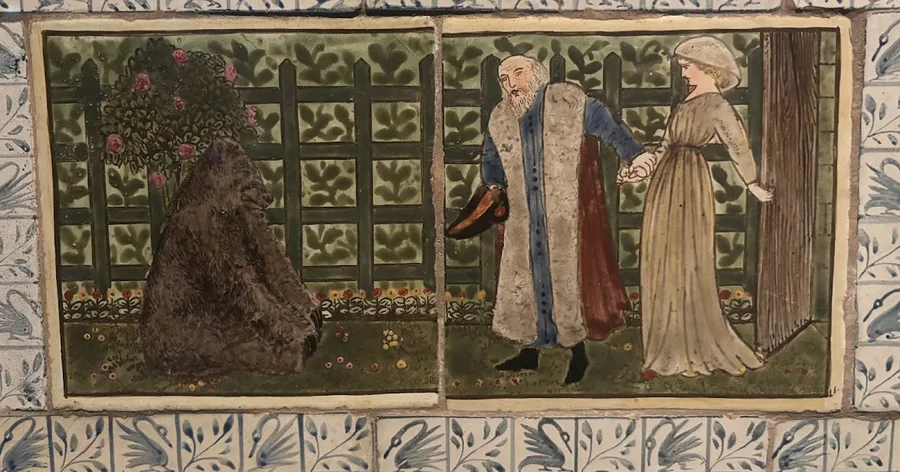
The British Library hosts an exhibition on fairy tales, which brings to the fore the common elements of folk tales across cultures, such as the fable as a way of advising the reader about how to live their lives, the plot as the battle between good and evil, magical powers as a way to transcend the limitations of human agency, and transformations as a reflection on identity.The Beast, Belle and
On 20th March 2026, at the Exchange in Birmingham, we held a workshop on Hearing Voices, Suicidality and AI psychosis, during Philosophy Fortnight. It was supported by University of Birmingham QR funding, the EPIC project, the Royal Institute of Philosophy, and the Birmingham network for Phenomenology and Mental Health. Here we report here from the morning talks, which were all on
This post is by Nathália de Ávila (University of Cologne).Nathália de ÁvilaWritten kisses don’t reach their destination, rather they are drunk on the way by the ghosts. It is on this ample nourishment that they multiply so enormously. […] The spirits won’t starve, but we will perish.(Franz Kafka in a letter to Milena Jesenská)In 2025, the journal Innovations in Clinical Neuroscience
This week's post is by Floriane Brunet (Service de pédopsychiatrie, CH de Saint Nazaire) and Christophe Gauld (Service de Psychopathologie du Développement de l’Enfant et de l’Adolescent, Hôpital Femme Mère Enfant – Hospices Civils de Lyon). Floriane Brunet Christophe GauldToday, growing attention is being directed toward self-diagnostic practices among teenagers, a trend that may
In this blog post, Lisa Bortolotti presents a special issue of Philosophical Psychology on Daniel Dennett's philosophy.Daniel DennettIt is difficult to think of a philosopher whose influence has been so pervasive as Daniel Dennett's. This is amply demonstrated by the fact that the terms he coined, the metaphors he created, and the thought experiments he devised have become instant classics, are
This post is by Martina Rosola. Martina is a researcher in Philosophy of Language. Her main interest is the role of language in systems of injustice and how it can serve to either perpetuate or dismantle them. Within this perspective, she specialized in gender-fair language.Martina RosolaEvaluating gender-fair strategies in ItalianDo you want to avoid the masculine generic and struggle to
This post is by Grace Lockrobin, Co-director of Thoughtful.Resources for Philosophy for ChildrenOver the past few years, the charity established in 1992 as SAPERE, has undergone a metamorphosis. Our members and stakeholders agreed that we needed a new name that captures our commitment to the kind of dialogue that takes ideas seriously and treats interlocutors sensitively. In short, thoughtful
This week's post is by Enara Garcia, Marie Skłodowska-Curie Actions Postdoctoral Fellow at Department of Psychology, University of Southern Denmark. Enara Garcia In recent years, psychotherapy has become a central cultural reference point for understanding ourselves and regulating our distress. Yet the more therapy saturates public discourse, the more urgent it becomes to ask
This week's post is by Shao-Pu Kang, an assistant professor at National Tsing-Hua University, Graduate Institute of Philosophy, his recent publication Against an Epistemic Argument for Mineness in Review of Philosophy and Psychology. Shao-Pu Kang Suppose you see a sunrise. You are thrilled, feel a chill in the air, hear your inner voice saying “that’s magnificent,” imagine





 research.io