A new study by researchers at UC Berkeley’s Center for Global Healthy Cities published in the Journal of the American Medical Association Network Open found that the California city of Richmond’s Office of Neighborhood Safety (ONS) was responsible for a 61% reduction in that city’s firearm homicides and injury shootings over the last 14 years.
This is one of the only studies in the country to do…
Can we work together to build a better country if we don’t share the same religious values? Graduate students show us how to use curiosity and patience to find a path forward.
What if getting older doesn’t have to mean losing your memory? Learn how neuroplasticity, healthy habits, and simple memory exercises can help keep your brain strong at any age.
Some forms of distress at work are easy to recognize because they interrupt someone’s daily performance and the work of those around them: For example, a person on your team becomes visibly exhausted, they are irritable, or they’re frequently absent. But other forms of distress are harder to see precisely because the work continues uninterrupted.
It’s common to talk about burnout at work and to …
When I’m producing a documentary, one of my favorite parts of the process is the moment when a bit of our footage sticks to me. Permanently. I never know when it will happen, but it always does. The sticky bit could be a snippet of dialogue or a quote from an interview. After watching the footage over and over again, the bit becomes part of me.
Often it’s a funny line—a perfect, punchy distilla…
When the Stanford Center on Longevity launched in 2007, founding director Laura Carstensen spent a lot of time correcting misperceptions. “The initial response people had was, ‘Like the Methuselah Foundation? You are going to extend life?’” Carstensen was clear that the center’s aim was not to increase lifespans—which had nearly doubled during the 20th century—but rather to build societies that a…
Parenting a teen can sometimes make you nostalgic for the early years, when you could still scoop up a frustrated toddler and redirect her with bubbles. In the teen years, sweet hugs can provoke eye rolls; a well-intentioned “How was your day?” may be misconstrued as meddling.
That’s just your teens becoming independent. Decades of research finds that portraying adolescence as a period of “stor…
Buddhist meditation teacher, Anushka Fernandopulle, guides us through a practice of Mudita, or appreciative joy, to help us share in the happiness of others.
Finding love is big business (a multi-billion–dollar industry), and artificial intelligence is transforming that business. Dating apps are increasingly outsourcing user matching to AI. Recent examples range from Overtone, an AI-powered matchmaking service started by the former chief executive officer of Hinge, to SciMatch, a dating app that aims to use AI to detect compatibility from a single sel…
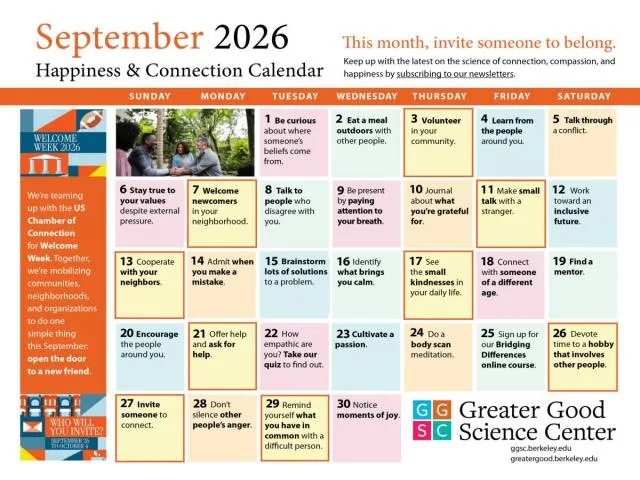
Our monthly Happiness Calendar is a day-by-day guide to well-being. This month, we’re offering a special Happiness & Connection Calendar in partnership with the US Chamber of Connection—and we hope it inspires you to invite someone to belong.
To open the clickable calendar, click on the image below. (Please note: If you are having trouble clicking on calendar links with the Chrome browser, …
Over the past two decades, my doctoral students and I have focused on studying love, care, kindness, and compassion in urban settings. Why? Because social science research on life in America’s cities is desperately incomplete. Much like the vision of urban life that permeates most of American popular culture, social science research imagines urban areas as sites of overwhelmedness, disengagement,…
Polarization is a fact of political life in the U.S. today. Gen Z, however, is less inclined than older generations to view it as a permanent fixture in American politics, according to research by students in the Stanford political science course Democracy in the Balance: Polarization and the Road Ahead. Students found that Gen Z is more optimistic than any other age group about the possibility o…
We often underestimate how much small talk can impact our wellbeing. Research shows that even brief conversations with strangers can boost our happiness and sense of connection, but fear and anxiety often keep us from reaching out.
Liz Cahill was born and raised in Philadelphia. Her whole family is from Philadelphia, going back generations. One day, she was offered an internship in the Bay Area and decided to make the leap, despite not knowing anything about it or anyone there.
“I said goodbye to everything I knew and loved in Philadelphia and came to the Bay. Not knowing a soul.”
When she arrived, it hit her. “I was like…
Imagine you’re on a plane and suddenly hear an explosion. The whole plane rattles, and you see the left engine is on fire. After another loud noise, you realize there’s a hole in the side of the aircraft. As air rushes out, the plane is rapidly descending—over 20,000 feet in less than five minutes.
If you faced what passengers of Southwest Airlines 1380 experienced, you would probably do what t…
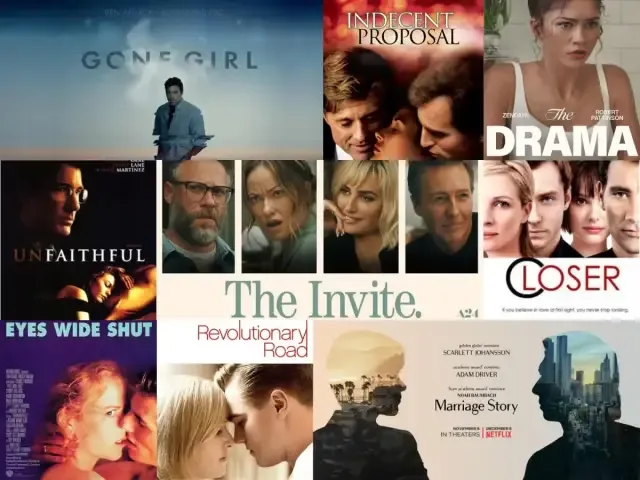
Movie date nights have long been a ritual of romance, from first dates to married couples’ standing nights out. You can probably name movies that leave you feeling warm, hopeful, excited, stimulated, and sometimes a little more in love with your partner.
But sometimes, the movies we watch become more than that—they become conversation starters, litmus tests, or unexpected mirrors of our own rela…
Join yoga and meditation teacher Jonathan Relucio for a trauma-informed practice combining mindful movement and breathing to reduce tension and build resilience to stress.
research.io
Sign up to keep scrolling
Create your feed subscriptions, save articles, keep scrolling.












 research.io