


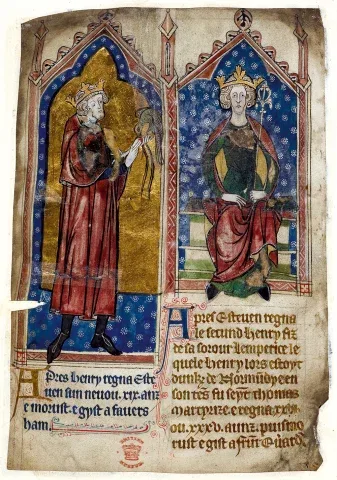
Following the death of Henry I, medieval England was plunged into a civil war that reduced the country to a charred ruin. With the barons split between rival claimants, the people suffered. In the summer of 1153 a broken man agreed to disinherit his son, in order to end a war that had splintered England into pieces for 19 years. The English reign of King Stephen (1135-54) was a disaster from start to finish, a time of such chaos that it was later dubbed ‘the Anarchy’. The background to the conflict is well known: Henry I, having lost his only legitimate son in the wreck of the White Ship in 1120, named his daughter Matilda as his heir. She was at the time residing in Germany as the wife and consort of Emperor Henry V, but his early death in 1125, leaving Matilda childless, allowed her to return to Normandy and then England in order to position herself as heir to the English throne in her own right. Designating a woman as his successor was such an unprecedented action that Henry felt obliged to compel his nobles, barons and churchmen to swear an oath of allegiance to Matilda. All of them did so, although some complied with greater reluctance than others. Henry’s death in December 1135 cannot really be classed as unexpected, given that he was in his late sixties at the time, but it was sudden enough that Matilda was not at his bedside and did not even know of it for at least a couple of weeks, by which time her cousin Stephen (a younger son of Henry’s sister Adela, dowager countess of Blois) had rushed to England, seized the royal treasury and had himself crowned. There was barely a murmur from any of those who had sworn to uphold Matilda’s hereditary rights, which was entirely due to her being female: had Henry left the crown to a 33-year-old, intelligent, well-educated, politically experienced son, such a situation would not have arisen. Hampered by pregnancy – her third by her second husband, Count Geoffrey of Anjou – and a lack of means, Matilda could at first do...
The Succession Crisis That Tore England Apart
Catherine Hanley
16 min read