


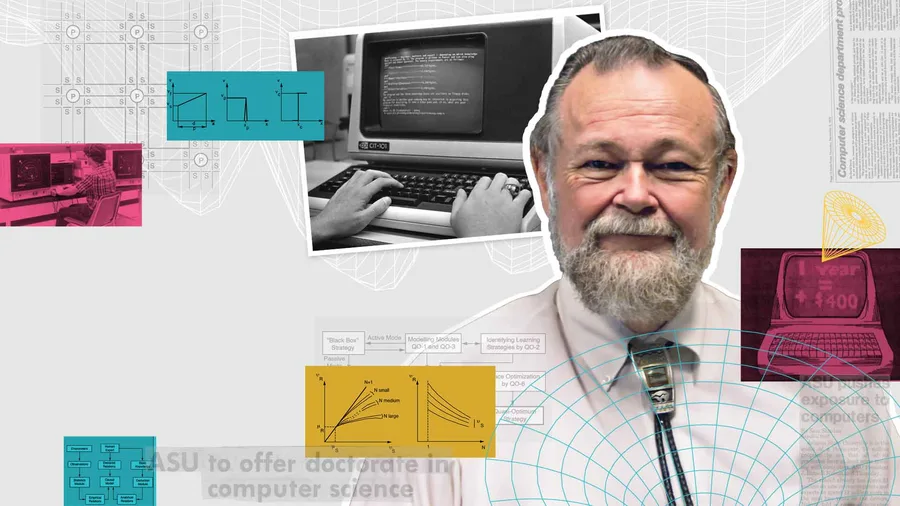
"Computer science is having a bit of an identity crisis at the moment." William E. Lewis doesn't say it with alarm. The professor emeritus says it with the calm assurance of someone who has seen this movie before. Lewis joined Arizona State University in 1965 after earning his doctorate at Northwestern University, arriving as computer science was emerging as an academic discipline. When ASU established its Department of Computer Science in 1980, Lewis became its founding chair, tasked with creating an academic home for a field that barely existed in the public imagination. Forty-five years and several reorganizations later, that department has grown into what is now the School of Computing and Augmented Intelligence , part of the Ira A. Fulton Schools of Engineering at ASU, educating thousands of students working at the frontiers of artificial intelligence, robotics, cybersecurity and computing. The technology has changed almost beyond recognition. But the issues in play haven't. Every generation seems convinced that computers are about to fundamentally reshape society. Every generation is right. Every generation is also convinced that their particular revolution is unprecedented. Lewis has lived through enough of them to know better. In 1981, years before Amazon, smartphones or Wi-Fi, Lewis was already describing a future that sounded, at the time, like science fiction. "You'll never carry a grocery cart in the store," he predicted in a 1981 interview with The State Press. Instead, Lewis told reporters that shoppers would order groceries through a computer panel at home, with stores either delivering purchases or having them ready for pickup. In the 1970s and ’80s, home computers were exotic machines selling for hundreds or thousands of dollars . Most people saw them as expensive toys. Lewis saw something much larger unfolding. Within a decade, he predicted, computers would become everyday household tools for shopping, banking, education, record-keeping and home management. Not every prediction landed exactly as imagined. Nobody ended up ordering groceries from a panel mounted on the kitchen wall. But the larger vision was remarkably accurate. Today, millions of people order groceries with a few taps on their phone. More than machines Lewis was never captivated by the machines themselves. He was interested in what they would allow people to do. He recognized that every technological leap comes with trade-offs. In that same interview, he warned about the potential "loss of the personal touch" as computers increasingly made decisions that had once been handled by people. Four decades later, amid debates over AI replacing human creativity and judgment, the concern feels strikingly familiar. In 1980, the personal computer revolution was only beginning. IBM wouldn't introduce its first PC until the following year. The internet remained largely confined to researchers. Arizona's technology sector was still emerging. Yet Lewis was convinced demand for computer scientists would explode. So was industry. Almost immediately after the department was established, Lewis began pushing to expand collaborations between ASU and the emerging Arizona technology sector. He helped forge some of ASU computer science's earliest industry partnerships with companies including General Electric, Intel, Honeywell and IBM, bringing research opportunities, advanced technology and graduate support to campus while giving industry a direct role in shaping the next generation of computing talent. As the decade progressed, IBM invested heavily in engineering education at ASU, helping expand computing resources and strengthening ties between the university and the state's growing technology industry. Lewis saw those partnerships as far more than corporate sponsorships. He argued that advanced computing degrees were essential to attracting and retaining high-technology companies in Arizona. In return, those companies provided students with leading-edge equipment, research opportunities and direct connections to the problems shaping the future of computing. "We're extremely fortunate," Lewis said at the time. "The local business community and the engineering college have been very good to us." Where ideas become infrastructure The department Lewis helped build wasn't merely reacting to technological change. It was helping create it. During Lewis' tenure, he transformed a fledgling department into a research enterprise. ASU launched its computer science doctoral program, established an early AI laboratory under researcher Nicholas Findler, and attracted faculty investigating expert systems, intelligent transportation, simulation and computer-assisted decision-making. Having watched the field evolve from those early experiments, Lewis finds today’s anxiety over AI oddly familiar. Every major computing breakthrough has arrived wrapped in predictions that jobs would disappear, society would be transformed or humans would become obsolete. This time, the predictions center on programmers themselves. Can AI write software? Will companies need fewer computer scientists? Lewis believes the questions miss a fundamental point. History repeats itself "AI can't eliminate computer science jobs, because AI is a branch of computer science," he says. "AI will change the future of work and research in ways that are hard to quantify now." That perspective comes from someone who has watched computer science repeatedly reinvent itself. Programming once meant punch cards. Then mainframes. Then personal computers. Then the internet. Then mobile computing. Now generative AI. Each wave looked like an ending. Instead, each became the foundation for something bigger. "If we're problem-solvers," Lewis says, "then we should be overjoyed that AI tools are becoming more powerful, because we can solve bigger, more complex problems." So, Lewis says computer science is again outgrowing its old definition. Today, it touches nearly every discipline, from medicine and transportation to national security and scientific discovery. AI is simply the latest chapter. The department Lewis helped build has evolved into a school where students are preparing for jobs and technologies that don't yet exist. Lewis retired from ASU in 2008 after more than four decades, but he remains convinced that the next generation of computer science students will solve the field's identity crisis by expanding what's possible. Related people Featured topics The post Bill Lewis has been here before appeared first on Engineering News .
Bill Lewis has been here before
Kelly deVos