


Agents can generate code. Getting it right for your system, team conventions, and past decisions is the hard part. You end up wasting time and tokens in the correction loops. More MCPs, rules, and bigger context windows give agents access to information, but not understanding. The teams pulling ahead have a context layer to give agents exactly what they need for the task at hand. Join us for a FREE webinar on Sep 2 to see:
- Where teams get stuck on the AI maturity curve and why common fixes fall short
- How a context layer solves for quality, efficiency, and cost
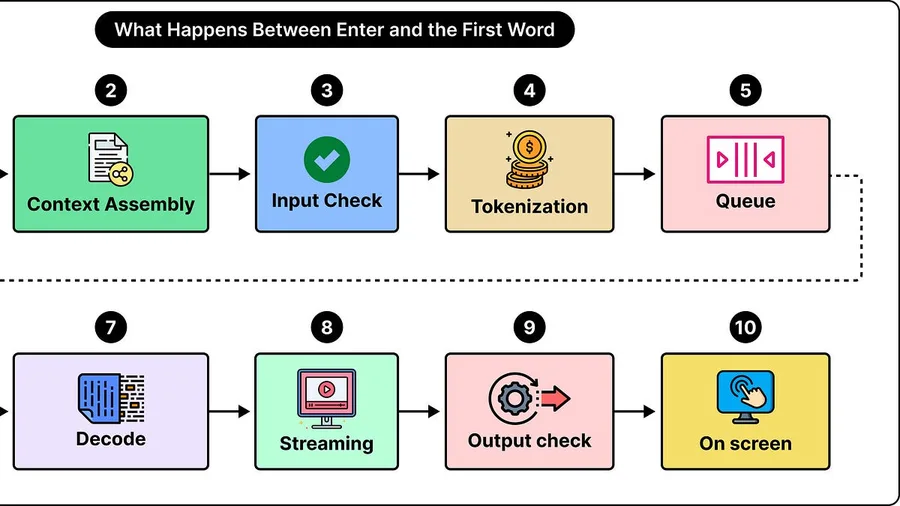
- Live demo: the same coding task with and without a context layer If you want to maximize the value you get from AI agents, this one is worth your time. When you type a follow-up question into an AI chat and press Enter, nothing happens for a second or two. Then the answer appears in a quick succession of words. It appears much faster than what the initial pause indicated. This pause is not dead time. In a typical LLM, a single message passes through roughly a dozen distinct stages before a reply starts to appear. Two very different kinds of computing work happen in the background to make this possible. Some key points about this journey are as follows:
- The model never receives the message as it was typed.
- It has no memory of the conversation. The history on screen is rebuilt from scratch every turn.
- It shares a machine with strangers, and the group it lands in can affect the reply.
- Once a word has been sent, the model cannot take it back. In this article, we are going to look at this entire journey in detail. Here’s what we will cover:
- How is the input to the model assembled?
- Why is every input message to the model independent?
- Performing safety checks on the input
- How does the model understand the words?
- How is the model shared across multiple conversations?
- Prefill and decode steps
- Caching the existing calculations
- Streaming and guardrails
- How does the model run various...