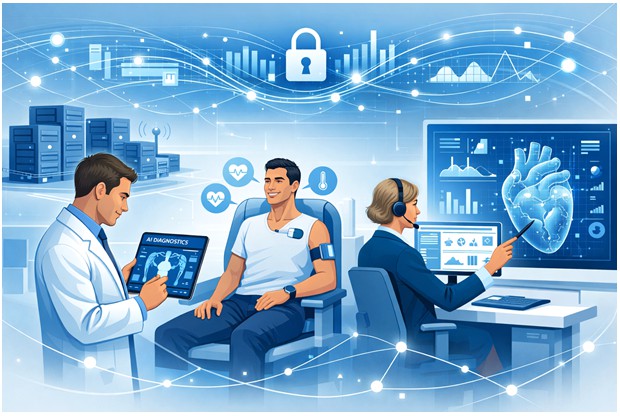
Background: Healthcare systems worldwide are undergoing rapid digital transformation driven by emerging technologies such as the Internet of Things (IoT), artificial intelligence (AI), machine learning (ML), blockchain, edge computing, digital twins, and big data analytics. These innovations are reshaping clinical workflows, patient engagement, healthcare administration, and medical research, resulting in new opportunities and challenges for modern health systems.Aim: This review aims to evaluate the impact of advanced digital technologies on key stakeholders in healthcare—including practitioners, patients, administrators, and researchers—and to analyse how these technologies influence healthcare delivery, data management, workforce dynamics, and clinical outcomes.Methods: A comprehensive narrative review was conducted using content from up to date scientific and industry reports. The article synthesizes findings on technological applications, benefits, risks, and projected market trends across multiple digital health domains.Results: IoT technologies enhance continuous patient monitoring and chronic disease management, while AI and ML improve diagnostic accuracy, predictive analytics, and clinical decision support. Blockchain strengthens data security, interoperability, and administrative transparency. Edge computing improves real time data processing, particularly in remote or resource limited settings. Digital twins and big data analytics enable personalized medicine, predictive modeling, and advanced research capabilities. Across stakeholders, these technologies improve efficiency and enable more proactive, data driven healthcare, though challenges remain in ethics, interoperability, cybersecurity, and digital inequity.Conclusion: Digital transformation is reshaping healthcare delivery by strengthening clinical precision, improving access, enhancing operational efficiency, and expanding research potential. However, strategic implementation and strong governance frameworks are required to address ethical, technical, and organizational challenges.