

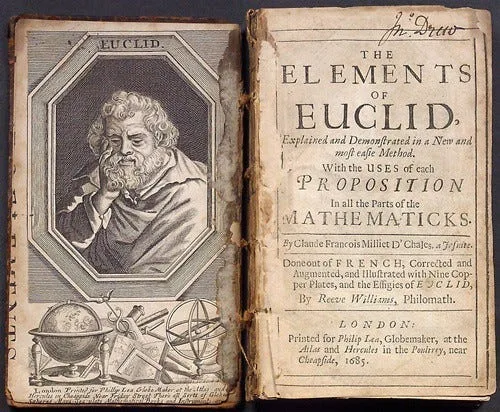

We’ve all learned about prime numbers in grade school. A prime number is a number which is divisible by 1 and itself. A basic question you can ask about primes is: how many primes are there? The answer is: There are infinitely many primes. This theorem quite ancient: it was proven in Euclid’s Elements (among other places). Let’s add a twist … You might think that we got off easy. But if you take this theorem and modify it slightly, it goes from being easy to being ridiculously hard. Let's look at the following statement: There are infinitely many primes that are two apart. (For example, 11 and 13, or 29 and 31.) This turns out to be a very famous unsolved problem called the Twin Prime Conjecture. Why is the twin prime conjecture so much harder than showing that there are infinitely many primes? Because they are about fundamentally different things.
- The infinitude of primes asks us the question: "how many primes are there?"
- Whereas the twin prime conjecture asks the much more fine-tuned question: "how are the primes spaced out?" This is tricky to answer because the primes are famous for their unpredictable distribution. What do we know about the conjecture? Until recently, the twin prime conjecture remained hopelessly out of reach. Consider the following question: Does the gap between successive primes go to infinity? That is, as you go further out in the number line, does the space between each prime and the next one go to infinity? The twin prime conjecture says that this should not be the case. It predicts that there should be infinitely primes that are two apart, so the gap between successive primes cannot go to infinity. But until recently, even this weaker claim was beyond the reach of modern techniques! This all changed in 2014, when Yitang Zhang proved the following groundbreaking result: there are infinitely many pairs of primes that differ by at most 70 million. In particular, the gap between successive primes does not go to infinity. In 2015, James...