


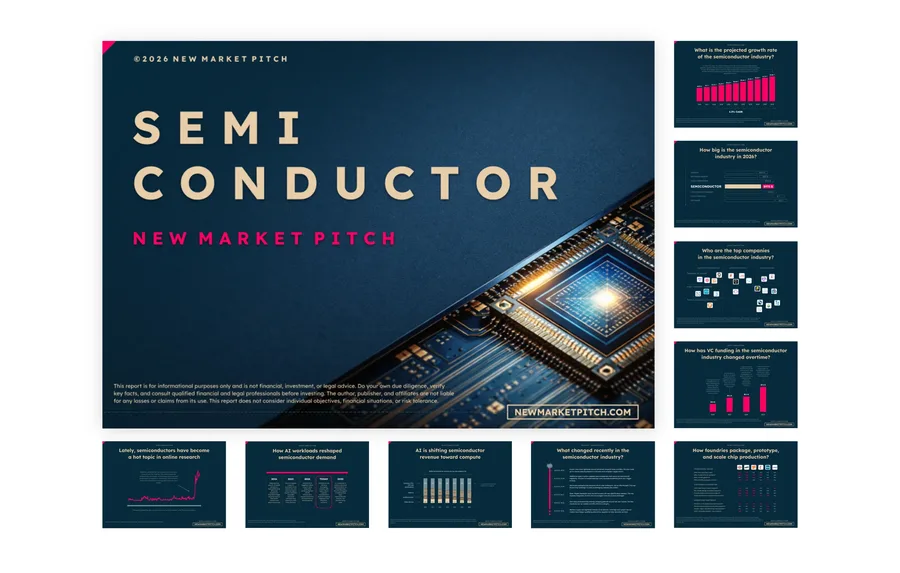
Optical interconnects: which startup is ahead? Last updated: 31 July 2026 In our semiconductor industry deck , you will find everything you need to understand the market SUMMARY Ayar Labs is currently ahead in optical interconnects, with Lightmatter close behind and Ranovus a credible third. The lead is commercial rather than purely technical. Lightmatter owns the largest single-platform bandwidth figure, but Ayar asks chip designers to change less and has connected its optical chiplets to accelerator designs, packaging partners and complete AI racks. The gap between the top two is small. Ayar and Lightmatter have each raised about 850 million, while no other independent company in this comparison has publicly raised much more than 870 million Preparing for volume production Lightmatter Photonic interposers, optical engines and laser systems 120 million Customer evaluation stage Xscape Photonics Multi-wavelength comb lasers About 77 million Evaluation kits and foundry-qualified production path Ranovus Integrated CPO and NPO optical engines About 45 million First 32-port product launched Quintessent Quantum-dot lasers for silicon photonics About 515 million before acquisition Acquired by Marvell Nubis Communications Compact optical engines About 870 million and Lightmatter 4.4 billion, compared with 500 million round is intended to expand production and testing rather than fund another basic technology demonstration. The company has also built operations in Taiwan, close to the advanced semiconductor-packaging supply chain. Wiwynn gives Ayar a route from the chip package to the finished rack. The manufacturer says it has shipped general and AI servers to more than 750 data centers. Ranovus has demonstrated a 6.4 Tbps ODIN engine with an integrated laser and engaged Jabil to support mass production. It is also expanding its Ottawa operations through an investment of more than 37 million in funding and launched FalconX, an external module producing as many as eight wavelengths. The product followed an earlier sixteen-wavelength demonstration. SCINTIL has also entered customer evaluation. Its LEAF Light kit provides access to a single-chip DWDM laser source, and Tower Semiconductor has validated the company’s process. Salience Labs introduced its 32-port OC-32M optical switch, named Tower as its manufacturing partner and worked with Keysight on testing. Avicena’s LightBundle kit is another meaningful step because customers can now evaluate microLED links in their own systems. Ayar has the best deployment momentum. Lightmatter has the fastest product-development pace, while Xscape is making the clearest jump from specialist prototype to sellable module. If you want more recent data on this point, please see our latest semiconductor industry report . Did Celestial AI already win the optical interconnect race by selling to Marvell? Celestial AI won the optical interconnect exit race, but Marvell’s revenue timetable shows that the technology had not reached volume sales. Marvell agreed to pay about 5 billion if the business reaches specific revenue targets. Celestial had raised at least 500 million annualized run rate near the end of that year and $1 billion near the end of the following one. The performance-based payments reflect the remaining commercial risk. Customer designs still need to become products and then reach volume. Nubis provides a smaller comparison. Ciena acquired the company after it developed compact 1.6 Tbps optical engines and has since introduced a 6.4 Tbps product based on Nubis technology. Celestial’s sale proves that optical scale-up technology can command a multibillion-dollar price before large revenue appears. It does not prove that Celestial had already beaten Ayar or Lightmatter in commercial shipments. This chart, featured in our semiconductor industry deck , shows annual funding in semiconductor startups Can optical interconnect startups survive Nvidia, Broadcom and Marvell? Optical interconnect startups can survive Nvidia, Broadcom and Marvell, but most will do so as suppliers or acquisition targets rather than full-stack giants. Large semiconductor companies already control many of the chips, lasers, foundries and customer relationships needed to bring optical interconnects into AI systems. Nvidia sells co-packaged optical networking products and has opened NVLink Fusion to outside chip designers. Ayar and Lightmatter have both joined that program. Broadcom already ships high-volume networking silicon and has years of silicon-photonics experience. Marvell now combines custom AI chips, networking products and Celestial AI’s Photonic Fabric. Ciena followed the same path by acquiring Nubis and using its technology inside compact optical products for AI data centers. Startups still have room where new technology moves faster than the incumbents’ internal roadmaps. Celestial and Nubis were acquired because larger companies wanted technology they did not already have. Ayar can remain independent by supplying chiplets across several processor architectures. Ranovus can operate as a specialized optical-engine supplier. Xscape, SCINTIL and Quintessent can sell lasers across competing platforms. Startups relying on one impressive demonstration are more exposed. Those already connected to foundries, packaging companies and AI-chip programs have a realistic place in the market. If you want more recent data on this point, please see our latest semiconductor industry report . Who leads each optical interconnect segment today? Optical interconnects currently have several specialist leaders, but Ayar Labs is the only independent startup near the front across most of the stack. Ayar leads modular optical I/O for accelerators and switches. Lightmatter leads in large photonic interposers. Ranovus has the strongest position in tightly integrated optical engines containing electronics, photonics and laser technology. Avicena effectivel
Optical interconnects: which startup is ahead?
NewMarketPitch Team