


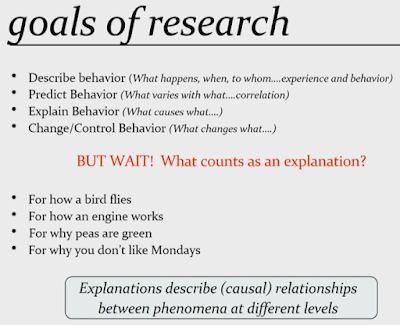
Every now and then, it's refreshing to remember how little we know about “how the brain works.” I put that phrase in quotes because the search for the Holy Grail of [ spike trains , network generative models , manipulated neural circuit function , My Own Private Connectome , predictive coding , the free energy principle (PDF), or a computer simulation of the human brain promised by the Blue Brain Project] that will “explain” how “The Brain” works is a quixotic quest. It's a misguided effort when the goal is framed so simplistically (or monolithically). First of all, whose brain are we trying to explain? Yours? Mine? The brain of a monkey, mouse, marsupial, monotreme, mosquito, or mollusk? Or C. elegans with its 306 neurons? “Yeah yeah, we get the point,” you say, “stop being so sarcastic and cynical. We're searching for core principles, first principles.” What does “core principle” mean? — Andrew Pruszynski (@andpru) October 8, 2020 In response to that tweet, definitions of “core principle” included: Basically: a formal account of why brains encode information and control behaviour in the way that they do. Fundamental theories on the underlying mechanisms of behavior. [Maybe “first principles” would be better?] Set of rules by which neurons work? Let's return to the problem of explanation. What are we trying to explain? Behavior, of course [ a very specific behavior most of the time]: X behavior in your model organism. But we also want to explain thought, memory, perception, emotion, neurological disorders, mental illnesses, etc. Seems daunting now, eh? Can the same core principles account for all these phenomena across species? I'll step out on a limb here and say NO , then snort for asking such an unfair question. Best that your research program is broken down into tiny reductionistic chunks. More manageable that way. But what counts as an “explanation”? We haven't answered that yet. It depends on your goal and your preferred level of analysis (à la three levels of David Marr): computation – algorithm – implementation from Krakauer et al. 2017 Again, what counts as “explanation”? A concise answer was given by Lila Davachi during a talk in 2019, when we all still met in person for conferences: “Explanations describe (causal) relationships between phenomena at different levels.” from Dr. Lila Davachi (CNS meeting, 2019) The Relation Between Psychology and Neuroscience (see video , also embedded below) UPDATE April 25, 2021: EXPLANATION IS IMPOSSIBLE , according to Rich, de Haan, Wareham, and van Rooij (2021) , because "the inference problem is intractable, or even uncomputable": "... even if all uncertainty is removed from scientific inference problems, there are further principled barriers to deriving explanations, resulting from the computational complexity of the inference problems." Did I say this was a “refreshing” exercise? I meant depressing... but I'm usually a pessimist. (This has grown worse as I've gotten older and been in the field longer.) Are there reasons for optimism? Ari ( @arisbenjamin ) and myself are actually super optimistic about the future of neuroscience and are working on paper about why. Why are you optimistic about the future of the field? — KordingLab 👨💻🧠∇🔬📈,🏋️♂️⛷️🏂🛹🕺⛰️☕🦖 (@KordingLab) October 8, 2020 You can follow the replies here , and additional replies to this question in another thread starting here . I'd say the Neuromatch movement (instigated by computational neuroscientists Konrad Kording and Dan Goodman ) is definitely a reason for optimism! Further Reading The Big Ideas in Cognitive Neuroscience, Explained (2017) ... The end goal of a Marr-ian research program is to find explanations, to reach an understanding of brain-behavior relations. This requires a detailed specification of the computational problem (i.e., behavior) to uncover the algorithms. The correlational approach of cognitive neuroscience — and even the causal-mechanistic circuit manipulations of optogenetic neuroscience — just don't cut it anymore. An epidemic of "Necessary and Sufficient" neurons (2018) A miniaturized holy grail of neuroscience is discovering that activation or inhibition of a specific population of neurons (e.g., prefrontal parvalbumin interneurons ) or neural circuit (e.g., basolateral amygdala → nucleus accumbens ) is “necessary and sufficient” (N&S) to produce a given behavior. Big Theory, Big Data, and Big Worries in Cognitive Neuroscience (from CNS meeting, 2018) Dr. Eve Marder ... posed the greatest challenges to the field of cognitive neuroscience, objections that went mostly unaddressed by the other speakers. [paraphrased below]: How much ambiguity can you live with in your attempt to understand the brain? For me I get uncomfortable with anything more than 100 neurons If you're looking for optimization (in [biological] neural networks), YOU ARE DELUSIONAL! Degenerate mechanisms produce the same changes in behavior, even in a 5 neuron network... ..so Cognitive Neuroscientists should be VERY WORRIED Nightmares for Cognitive Neuroscientists: Modulation of a Single Neuron Has State-Dependent Actions on Circuit Dynamics (Gutierrez & Marder) https://t.co/trAHVbIFd4 #CNS2018 pic.twitter.com/nsYHiS5dxv — The Neurocritic (@neurocritic) March 25, 2018 The Neuromatch Revolution (2020) “A conference made for the whole neuroscience community” An Amicable Discussion About Psychology and Neuroscience (from CNS meeting, 2019) the conceptual basis of cognitive neuroscience shouldn't be correlation but what if the psychological and the biological are categorically dissimilar?? ...and more! The video below is set to begin with Dr. Davachi, but the entire symposium is included.
How the Brain Works
The Neurocritic (noreply@blogger.com)