


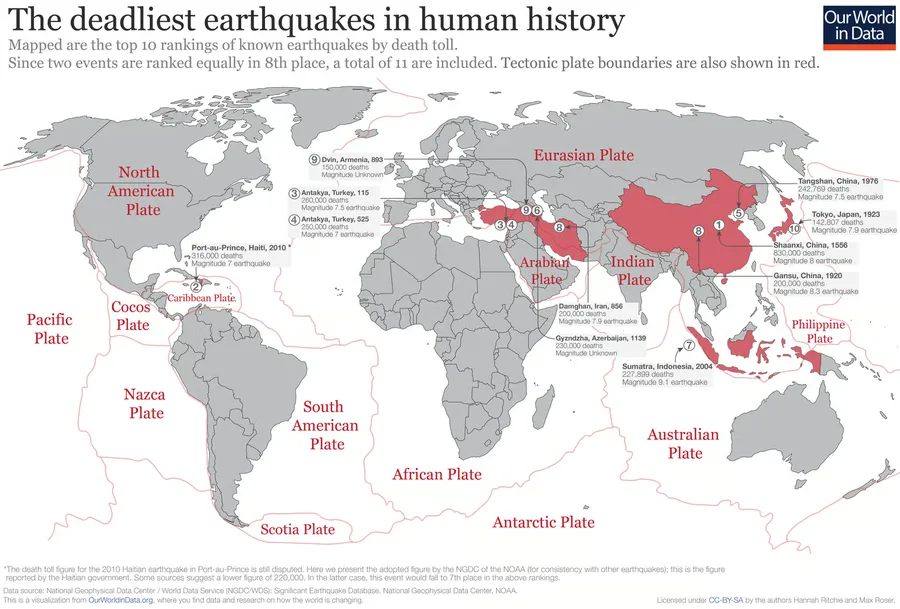
The number of people dying in natural disasters is lower today than it was in the past; the world has become more resilient. Earthquakes, however, can still claim a large number of lives. Whilst historically, floods, droughts, and epidemics dominated disaster deaths, a high annual death toll in recent years often results from a major earthquake and possibly a tsunami caused by them. Since 2000, the two peak years in annual death tolls (reaching hundreds of thousands) were 2004 and 2010. Earthquake deaths accounted for 93 percent and 69 percent of disaster deaths, respectively. Both events (the Sumatra earthquake and tsunami of 2004 and the Port-au-Prince earthquake in 2010) are in the deadliest earthquake rankings below. What have been the most deadly earthquakes in human history? In the visualization, we have mapped the top 10 rankings of known earthquakes, which resulted in the largest number of deaths.1 This ranking is based on mortality estimates from the NOAA's National Geophysical Data Center (NGDC).2 Clicking on the visualization will open it in higher resolution. This ranking is also summarized in table form. The most deadly earthquake in history was in Shaanxi, China in 1556. It's estimated to have killed 830,000 people. This is more than twice that of the second most fatal: the recent Port-au-Prince earthquake in Haiti in 2010. It's reported that 316,000 people died as a result.3 Two very recent earthquakes — the Sumatra earthquake and tsunami of 2004 and the 2010 Port-au-Prince earthquake — feature amongst the most deadly in human history. But equally, some of the most fatal occurred in the very distant past. The third deadliest was the earthquake in Antakya (Turkey) in 115 CE. Both old and very recent earthquakes feature near the top of the list. The deadly nature of earthquakes has been a persistent threat throughout our history.
What were the world's deadliest earthquakes?
Hannah Ritchie
2 min read