


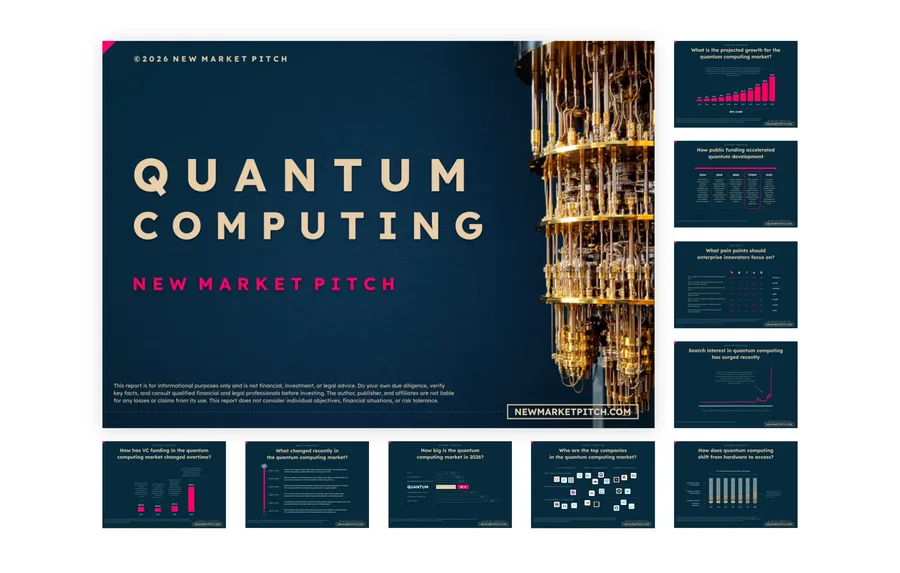
Photonic quantum computing: which startup is ahead? Last updated: 31 July 2026 In our quantum computing market deck , you will find everything you need to understand the market SUMMARY PsiQuantum is ahead in photonic quantum computing today, with Xanadu the only startup close enough to make it a real two-company race. PsiQuantum leads because it has connected the hardest parts of the scaling problem: semiconductor manufacturing, unusually strong component performance, large physical facilities, deep financing and milestone-based government scrutiny. Xanadu has the stronger public proof that a complete modular photonic computer can work. Aurora operated across 35 chips and four server racks, while its logical-qubit work goes closer to error correction than PsiQuantum’s published system results so far. The split between the top two is unusually clear. PsiQuantum has the better industrial route to a very large machine; Xanadu has the more inspectable computer, the more transparent financial record and the stronger software ecosystem. Quandela leads the usable universal-hardware market. Its 12-qubit systems can be accessed through the cloud or alongside European supercomputing infrastructure, giving outside users something real to run today. ORCA and QuiX are the strongest deployable challengers, but for different reasons. ORCA has repeated installations and a simple rack-mounted model, while QuiX has a large DLR contract and a newer universal architecture that still needs commissioning proof. The best performance numbers are not directly comparable. PsiQuantum’s fusion fidelity, Quandela’s gate fidelity and Xanadu’s logical-qubit results describe different operations, and photon loss remains the shared problem that can undo impressive component results. Manufacturing is where PsiQuantum has the widest lead. A 300-millimeter GlobalFoundries process and more than one million tested devices are far harder to reproduce than a laboratory prototype, though the company still has to turn those parts into an operating full system. Xanadu owns the software layer through PennyLane. That gives it influence, developer reach and revenue opportunities before large-scale hardware arrives, even though the platform’s hardware-neutral design also helps competitors. Funding does not map neatly to delivered hardware. PsiQuantum has raised at least 1.665 billion across disclosed private rounds Xanadu Modular continuous-variable and GKP photonic computers, plus PennyLane software More than 77 million Quandela Quantum-dot photon sources and universal gate-based photonic QPUs About €65 million, including mixed financing QuiX Quantum Silicon-nitride processors and measurement-based universal photonic systems At least €20.5 million disclosed ORCA Computing Rack-mounted photonic systems for machine learning and optimisation At least 125 million to test whether the company can reach utility scale. Xanadu is stronger where a reader can actually inspect a complete machine. Aurora linked 35 photonic chips across four server racks and 13 kilometres of fibre to operate a 12-qubit modular system. Nature published the architecture, giving Xanadu a level of full-system evidence that PsiQuantum has not yet matched publicly. The next group leads in smaller, more practical products. Quandela has connected a universal system to European supercomputing infrastructure. ORCA has repeatedly installed rack-mounted machines in government, university and enterprise settings. QuiX has delivered the core hardware for a universal system to the German Aerospace Center. If you want more recent data on this point, please see our latest quantum computing market report . As this chart shows, and as featured in our quantum computing market deck , search interest in quantum computing has grown significantly Which photonic quantum startup has built a computer people can actually use? Quandela currently leads the universal photonic quantum product race, while ORCA leads the market for compact, specialized systems that customers can install quickly. Quandela’s Lucy and Belenos machines both use its 12-qubit MOSAIQ platform. Lucy is coupled to the Joliot-Curie supercomputer at France’s CEA, and Belenos is available through the cloud. These machines are still research tools, but outside users can submit real workloads rather than waiting for a future prototype. ORCA’s PT-2 takes a different route. The 40-mode system fits inside a standard 19-inch rack, works at room temperature and is designed around machine learning and optimisation. ORCA said seven PT-1 systems had already been deployed before the PT-2 launch, then added installations at the UK National Quantum Computing Centre, Montana State University and a Japanese enterprise customer through Toyota Tsusho. QuiX has moved much closer to these two companies lately. Carina combines photon generation, multiplexing, cluster-state generation, detection and fast feed-forward control in one room-temperature stack. The DLR machine is still going through integration, commissioning and validation. Aegiq’s Artemis system is running at the UK National Quantum Computing Centre and now uses Nvidia’s Ising models to automate calibration, although Aegiq discloses little about qubit count, fidelity or user activity. Which photonic quantum startup has the strongest technical and performance proof? Xanadu currently has the strongest proof that a complete modular photonic quantum computer can operate, while PsiQuantum has published the best industrially manufactured component results. Aurora addressed the messy engineering that component papers often leave aside. Xanadu coordinated photon generation, optical processing, detection, networking and classical control across 35 chips and four separate racks. The system only ran 12 qubits, yet it operated as one distributed computer for hours. Xanadu’s earlier Borealis experiment adds a second kind of evidence. Borealis used 216 squeezed-light modes for a sampling task that the researchers argued was beyond the practical classical methods tested at the time. The 216 modes should not be read as 216 universal qubits, but the experiment showed control over a much larger optical system. PsiQuantum’s Omega paper in Nature reported 99.98% state preparation and measurement fidelity, 99.50% two-photon interference visibility, 99.22% two-qubit fusion fidelity and 99.72% chip-to-chip transmission fidelity. Those are exceptional component numbers from a semiconductor manufacturing platform rather than a hand-built optical bench. There is a big catch in the Omega results: the percentages are conditional on detecting the photon, leaving total photon loss outside the calculation even though missing photons can ruin the computation. PsiQuantum has proved that its building blocks are very good. It still has to show that enough photons survive when those blocks are connected at system scale. Quandela provides the clearest specifications on a deployed universal product. Lucy reports 99.6% one-qubit gate fidelity, 99.0% two-qubit fidelity and 99% readout fidelity. These figures come from Quandela rather than a common independent benchmark. The measurements cannot be compared directly. A 99.22% fusion fidelity and a 99.0% two-qubit gate fidelity describe different operations, source assumptions and success probabilities. Loss remains the shared test: the strongest architecture will be the one that preserves high fidelity while scaling source efficiency, detection and end-to-end transmission. This chart, included in our quantum computing market deck , illustrates yearly VC funding for quantum computing startups Who is closest to fault-tolerant photonic quantum computing? PsiQuantum is currently closest to attempting utility-scale fault-tolerant photonic quantum computing, while Xanadu has shown more direct experimental progress on logical qubits and error correction. PsiQuantum’s advantage comes from the whole engineering plan. The company has a foundry process, high-performance sources and detectors, fast switches, chip-to-chip links, large facilities and a detailed fusion-based architecture. DARPA’s latest agreement carries unusual weight because payments depend on milestones and the agency is evaluating technical performance, manufacturability and economics rather than sponsoring a loose research collaboration. PsiQuantum has yet to operate an integrated logical qubit publicly inside its planned machine. The published work covers the ingredients and industrial route; the error-corrected system itself remains under construction. Xanadu reported 12 GKP-encoded logical qubits with real-time error-correction decoding in its 2025 results. GKP encoding stores information in continuous properties of light and can make certain small errors easier to identify. That experiment is closer to the core error-correction problem than another high-fidelity physical component, though it remains far from a useful fault-tolerant computer. QuiX is now a more serious third contender. Its recent Dedalo plan targets logical qubits, and the company has also reported a below-threshold error-mitigation result. Error mitigation can suppress mistakes, but it does not offer the same protection as full error correction. Quandela’s current roadmap moves toward logical-qubit demonstrations and networked modules. Quantum Source may eventually reduce the required hardware through deterministic atom-photon interactions, although its work remains below full-machine level. If you want more recent data on this point, please see our latest quantum computing market report . Which photonic quantum startup has the strongest real-world demand? Quandela and ORCA currently show the strongest repeated demand for usable photonic quantum systems, while QuiX owns the largest clearly priced universal-computer contract. Quandela has the broadest visible access. Its platform reports more than 950 users, its latest QPU can be reached through the cloud, and European researchers can use a photonic processor connected to a major supercomputer. The public data does not reveal paid usage, retention or recurring revenue, but Quandela has created several ways for outside teams to use its hardware. ORCA has built the clearest installation pattern. Its machines have reached national research infrastructure, two systems were installed at Montana State University, and a PT system was deployed inside a Japanese enterprise environment with Toyota Tsusho. The Japanese installation reportedly took less than a week and connected to existing cloud infrastructure. QuiX won a €14 million contract from the German Aerospace Center for eight-qubit and 64-qubit universal photonic systems. The order is unusually large relative to QuiX’s disclosed funding. Final acceptance still depends on commissioning and validation. PsiQuantum’s government relationships mainly validate a future utility-scale architecture rather than demand for computing time. Xanadu generated 1.6 million to 10 million advanced photonic packaging facility in Ontario and works with companies including Applied Materials, Corning and Tower Semiconductor. The company has also shown that it can package and connect many modules. What we have not seen is a production plan with the same wafer scale and facility detail as PsiQuantum’s. Quandela has opened a quantum-computer factory and a pilot line for quantum-dot devices. That gives it more control over its photon sources and has already supported several delivered machines. Production is still measured in a handful of systems rather than the thousands of modules a fault-tolerant platform may require. QuiX follows a fabless model using foundry-produced silicon-nitride chips, while Aegiq combines compound-semiconductor photon sources with silicon photonics. This chart, included in our quantum computing market deck , illustrates yearly funding for quantum computing startups Which startup owns the photonic quantum software ecosystem? Xanadu clearly owns the photonic quantum software layer today because PennyLane reaches far beyond Xanadu’s own hardware. PennyLane connects quantum circuits with machine-learning frameworks, simulators and hardware from several providers. Xanadu reported roughly 160,000 average monthly downloads and relationships with 143 universities across 33 countries. That reach gives Xanadu feedback, developer familiarity and a route to revenue long before a fault-tolerant machine exists. The hardware-neutral design cuts both ways. Developers can use PennyLane without ever running a Xanadu computer, and competitors can benefit from the same ecosystem. Even so, a widely used programming layer gives Xanadu more influence than a closed tool tied to hardware that few people can access. Quandela has the best photonic-specific alternative. Perceval is built around linear optical circuits and photon-native operations, while Merlin targets AI developers. These tools are closely connected to working Quandela machines, which makes the software useful for people who want to
Photonic quantum computing: which startup is ahead?
NewMarketPitch Team