


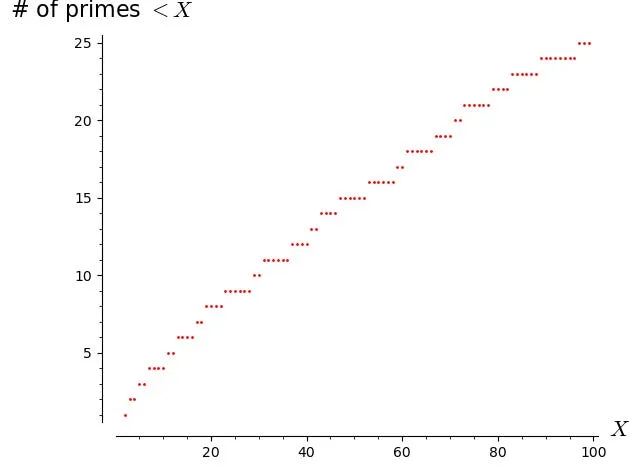
One of my favorite theorems is the Prime Number Theorem. To motivative it, let’s start with an easier question: How many primes are there? Alright, this is an easy question to answer. It’s been known since ancient times that there are infinitely many primes. But I’m really asking a more quantitative question: how many primes are there, quantitatively speaking? Here’s a good place to start. It's a famous fact that the sums of reciprocals of squares converges: However, the sum of reciprocals of the primes diverges! This means, heuristically speaking: There are “more” primes than squares. How does this help us? The number of squares less than X is (approximately) the square root of X. So we would expect the number of primes less than X to be (roughly) more than the square root of X. This is already a non-obvious fact about primes. Enter: analytic number theory The above heuristic discussion gave us a start: the number of primes less than X is “more than” the sqrt(X). This gives us a lower bound. But what is the answer exactly? This question is very hard to answer because the primes are chaotically distributed. The prime counting function is hard to predict. Here’s a graph: It seems to grow somewhat steadily but it is not a straight line. The Prime Number Theorem (PNT) gives a good approximation for how this function grows. What is the Prime Number Theorem? Roughly, the Prime Number Theorem (PNT) says that if X is large, roughly X / log X of the integers less than X are prime. Precisely, the PNT says: This squiggle means "asymptotic to". It’s defined as follows. In other words, define the prime counting function as follows: The PNT says that Here is a graph of this function: This function goes to 1 as X gets larger. (But as you can see, it converges very slowly!) Problem of the Week Here is the challenge problem for this week: The vertices and midpoints of the faces are marked on a cube, and all face diagonal
The prime number theorem, explained
Aleph 0
2 min read