


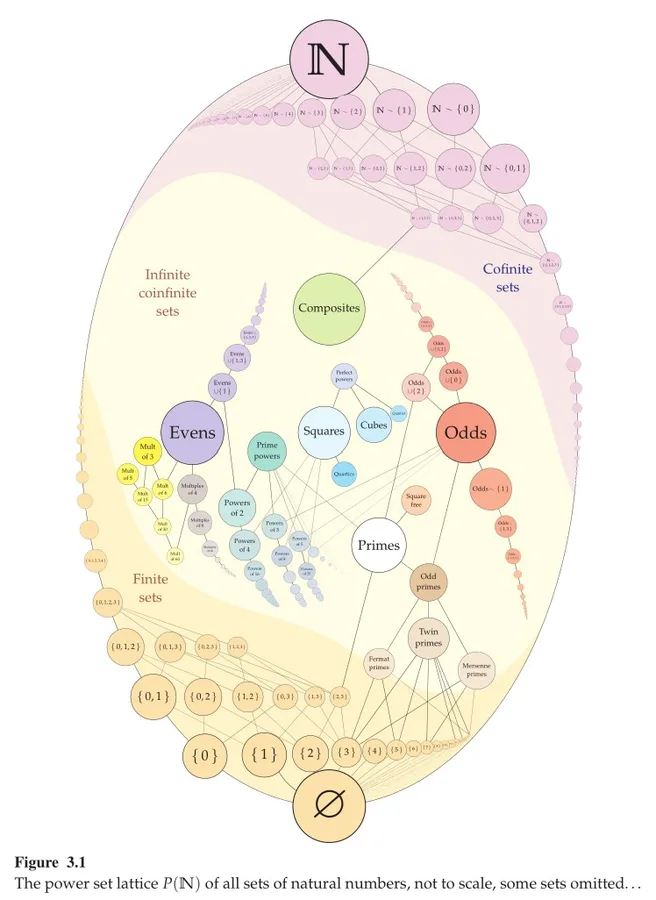
\newcommand\of{\subseteq}\newcommand\N{\mathbb{N}}\newcommand\R{\mathbb{R}}\def\<#1>{\left\langle#1\right\rangle}\newcommand\Z{\mathbb{Z}}\newcommand\Q{\mathbb{Q}}\newcommand\ltomega{{{<}\omega}}\newcommand\unaryminus{-}\newcommand\intersect{\cap}\newcommand\union{\cup}\renewcommand\emptyset{\varnothing}Let us explore the vast and densely populated expanses of the lattice of all sets of natural numbers—the power set lattice . We find in this lattice every possible set of natural numbers , and we consider them with respect to the subset relation . This is a lattice order because the union of two sets is their least upper bound with respect to inclusion and the intersection is their greatest lower bound. Indeed, it is a distributive lattice in light of , but furthermore, as a power set algebra it is a Boolean algebra and every Boolean algebra is a distributive lattice. The empty set is the global least element at the bottom of the lattice, of course, and the whole set is the greatest element, at the top. The singletons are atoms, one step up from , while their complements are coatoms, one step down from . One generally conceives of the finite sets as clustering near the Earthly bottom of the lattice, finitely close to , whereas the cofinite sets soar above, finitely close to the heavenly top. In the vast central regions between, in contrast, we find the infinite-coinfinite sets, including many deeply interesting sets such as the prime numbers, the squares, the square-free numbers, the composites, and uncountably many more. Question. Which familiar orders can we find as suborders in the power set lattice of all sets of natural numbers? We can easily find a copy of the natural-number order in the power set lattice , simply by considering the chain of...
The lattice of sets of natural numbers is rich
Joel David Hamkins
10 min read