The singular cardinals hypothesis, henceforth SCH, states that if $\kappa$ is a singular strong limit cardinal (i.e., cf($\kappa$) < $\kappa$ and for all $\lambda < \kappa, 2^\lambda < ...
Fix some uncountable cofinality regular cardinal $\alpha$. Let $M$ be the set of all strictly increasing continuous (i.e. normal*) functions $\alpha \rightarrow \alpha$ modulo the club filter, i.e. $f ...
mathematical logic
deduction system, natural deduction, sequent calculus, lambda-calculus, judgment
type theory, simple type theory, dependent type theory
collection, object, type, term, set, element
equality, judgmental equality, typal equality
universe, size issues
higher-order logic
This page is to record the reference:
William Lawvere, Robert Rosebrugh:
Sets for Mathematics
Cambridge Universi…
Working internally in an elementary topos $\mathcal{E}$, let $X$ be an object of $\mathcal{E}$, $\mathcal{P}(X)$ its power object and consider a morphism $S: \mathcal{P}(X) \to \mathcal{P}(X)$ which ...
The set of all finite subsets of the naturals is, of course, a set of finite sets. However, I am interested in a stronger notion. I call a set $S$ of finite sets, "finitely bounded" if there ...
Previously: Ordinal numbers and basic set theory Ordinals as nim-heaps Nim always ends, even with infinite ordinals Infinite Nim as a coin-moving game Coin-moving games without the coins Previously we saw how to interpret the difficult-seeming ordinal as a particular ordering of the set of finite sequences of
numbers, revealing what seemed like a scary monster as gentle and
straightforward. Now w…
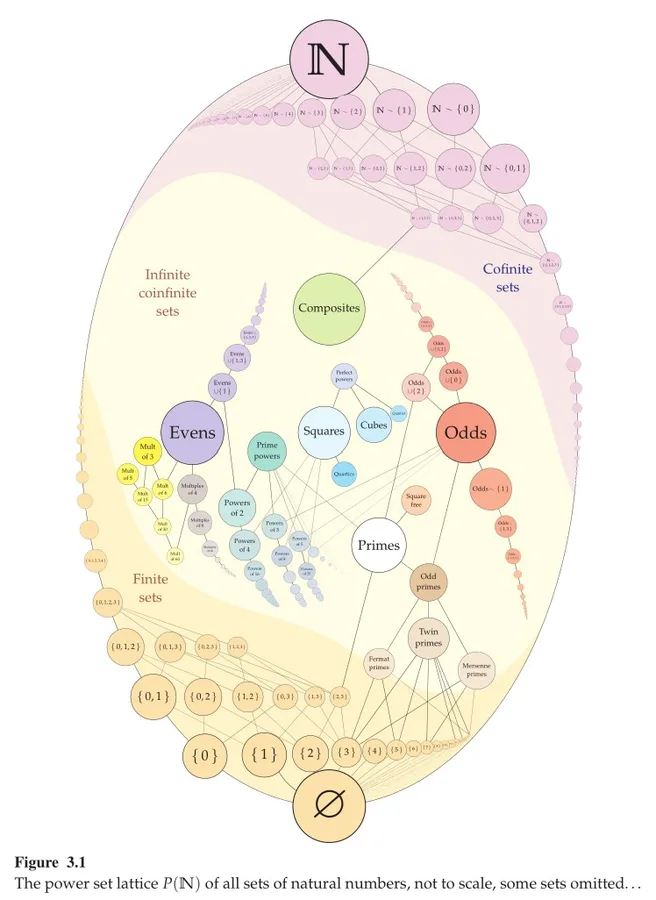
$\newcommand\of{\subseteq}\newcommand\N{\mathbb{N}}\newcommand\R{\mathbb{R}}\def\<#1>{\left\langle#1\right\rangle}\newcommand\Z{\mathbb{Z}}\newcommand\Q{\mathbb{Q}}\newcommand\ltomega{{{<}\omega}}\newcommand\unaryminus{-}\newcommand\intersect{\cap}\newcommand\union{\cup}\renewcommand\emptyset{\varnothing}$Let us explore the vast and densely populated expanses of the lattice of all sets of natural…
Previously: Ordinal numbers and basic set theory Ordinals as nim-heaps Nim always ends, even with infinite ordinals Infinite Nim as a coin-moving game In the previous article we saw how to interpret Nim heaps of up to beans as coins on a quarter-infinite array: The coin here represents a heap of beans. The heap can be
reduced to any smaller number of beans. In the coin version of the
game, this…
One reason I find set theory appealing as a foundation is that the axioms of ZFC feel clearly true based on the "iterative" concept of sets. More specifically, the axioms are true when the ...
Is it possible to kill a $\kappa$-Suslin tree by a ${<}\kappa$-strategically closed forcing? Note that the answer is negative for $\kappa$-strategic closure and (in particular) for ...
transfinite arithmetic, cardinal arithmetic, ordinal arithmetic
prime field, p-adic integer, p-adic rational number, p-adic complex number
arithmetic geometry, function field analogy
The cardinal numbers (or just cardinals) constitute a generalisation of natural numbers to numbers of possibly infinite magnitudes. Specifically, cardinal numbers generalise the concept of ‘the number of …’. In parti…
This post is going to be about what infinite ordinal numbers are, and
about is in particular. I had a brainwave a while back (18
months now, wow, I have definitely not been blogging enough) and
suddenly understood much better than I did before. I have
several related ideas here and I am going to try to write one blog
post about each of them, instead of one gigantic blog post about all
of them t…
Here I discuss definition of set, subset, proper subset, de Morgan’s law, Associative law, Cartesian product with theory and solve two maths problem. set theory with problem. problems with set theory. set theory problems and solutions. set theory sample problems. what is the problem with set theory. set theory problems and solutions pdf. group theory […]
A Bernstein set is a subset of the real line that meets every uncountable closed subset of the real line but that contains none of them.
The standard construction given here proceeds by transfinite ...
The axiom of choice and the existence of Reinhardt cardinals are mutually inconsistent. Is anything known whether fragments of choice are consistent with it? I am thinking of those of a ...


 research.io