


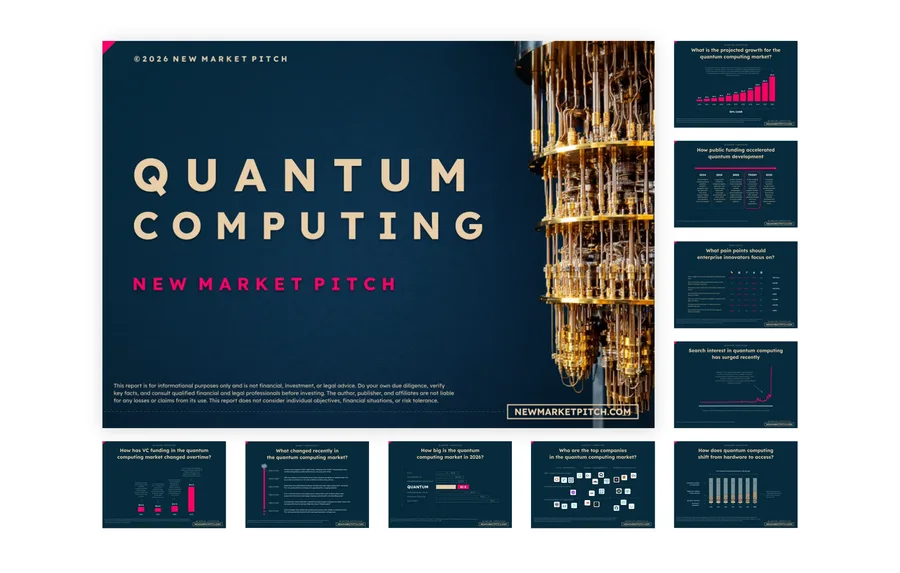
Is China already leading quantum tech? Last updated: 31 July 2026 In our quantum computing market deck , you will find everything you need to understand the market SUMMARY China is not yet leading quantum technology overall, but it now leads quantum communications and has reached the scientific frontier in computing, networking and precision measurement. The old division of labor—China dominating secure links while the United States dominated quantum computing—no longer fits. China’s recent progress spans photonic processors, superconducting error correction, quantum memories and optical clocks. The comparison depends heavily on what counts as leadership. China is strongest when the test is national deployment and coordinated infrastructure; the United States is strongest when the test is commercial breadth, outside access and the number of competing technical approaches. Raw qubit counts do not settle the race. A photonic sampling record, a programmable superconducting processor and a set of logical qubits measure different things, and reliability often matters more than size. China’s paper volume is now enormous, but publication totals mostly prove research capacity. The United States still leads in internationally protected quantum patent families and attracts far more recorded private funding. Jiuzhang 4 is a genuine Chinese lead in photonic boson sampling, not a general-purpose computing victory. Its four-generation progression matters more than the headline classical-speed comparison because it shows repeatable engineering rather than a one-off stunt. Zuchongzhi 3.2 is arguably the more consequential computing result. By demonstrating distance-seven surface-code error correction below threshold, China reached a milestone previously associated most clearly with Google’s Willow program. China’s clearest advantage remains quantum communications. It has the world’s largest deployed quantum-secure network, satellite experience, integrated photonic trials and roughly a decade of operational learning that rivals cannot reproduce quickly. That network is not yet a full quantum internet. Most of it still relies on quantum key distribution and trusted nodes, although recent work on long-lived remote memories moves China closer to repeater-based entanglement networks. Quantum sensing is harder to score nationally, but China is now firmly in the top tier. Its optical-clock work at the 10 -19 level is strong enough to influence the future definition of the second, even though other countries remain ahead in some sensing instruments and patent portfolios. The decisive gap is commercialization. American researchers and customers can access several hardware architectures, software stacks and cloud platforms, while China’s strongest systems remain concentrated in a smaller group of laboratories and state-supported suppliers. Our conclusion is that the United States still leads quantum technology overall, but the margin is no longer comfortable. China would have a credible claim to first place if it can turn its frontier experiments into reproducible logical computing, broader outside access and a larger international customer base. This market map, featured in our quantum computing market deck , highlights top companies and startups in the quantum computing market Why does China look like the quantum leader right now? Right now, China looks closer than ever to overall quantum leadership because its newest advances cover computing, networking and precision measurement at the same time. China’s reputation used to rest mainly on quantum communications. The Micius satellite and the country’s huge fiber network were impressive, yet the United States still had the stronger claim in programmable quantum computing. That separation has become much harder to defend. China has lately produced four advances that reach well beyond one niche. A new photonic processor increased the maximum detected photon count by more than tenfold. A superconducting processor reached below-threshold error correction with a distance-seven surface code. A Chinese-led team kept remote quantum memories entangled long enough to cross an important quantum-repeater threshold. Another USTC team reported an optical clock operating at the 10 -19 level. Taken together, those advances show China reaching the frontier in several branches at once. The old picture of China dominating secure links while chasing American computers is out of date. If you want more recent data on this point, please see our latest quantum computing market report . What would “leading quantum tech” actually mean? China already leads one major part of quantum technology, while the United States leads the wider contest when we count computing platforms, commercial access, private capital and internationally protected inventions. The phrase “quantum tech” bundles together three different industries. Quantum computers process information. Quantum communications distribute keys or entanglement. Quantum sensors measure time, gravity, magnetic fields and motion with extreme precision. A country can dominate one of these fields and remain behind in another. Leadership also changes depending on what we measure. Publishing the most papers shows research capacity. Running the largest network shows deployment capacity. Building a machine that outside researchers can use shows engineering and commercial capacity. A spectacular experiment may move science forward without producing a useful product. For this article, we treat a country as the overall leader only when it combines frontier science, repeatable engineering, broad deployment and a strong commercial ecosystem across several quantum fields. That definition gives China a clear win in communications, a place in the top group for computing and sensing, and second place overall. Area Leader today Why Quantum communications China Largest deployed network, two satellites and repeated long-distance experiments Frontier quantum experiments China and the U.S. Leadership changes by hardware platform and benchmark General-purpose quantum computing United States More architectures, cloud access, software and outside users Quantum sensing No single leader China is top-tier, but leadership changes by instrument Commercial ecosystem United States More funding, firms, customers and internationally protected inventions As this chart shows, and as featured in our quantum computing market deck , search interest in quantum computing has grown significantly Can qubit counts settle the China–U.S. quantum race? Qubit counts cannot settle whether China leads quantum technology, because today’s headline numbers describe different machines and different kinds of progress. A large photonic sampling event, a superconducting processor with more than 100 qubits and 50 error-detected logical qubits belong to three separate scoreboards. Photons can travel through a large optical circuit for one specialized calculation. Superconducting qubits can run programmable gates but lose information quickly. Logical qubits combine several physical qubits so errors can be detected or corrected. The quality of operations often tells us more than the raw total. A smaller machine with cleaner two-qubit gates may finish deeper circuits than a larger noisy system. A protected logical qubit may be more valuable than dozens of physical qubits if it can keep working reliably. “Quantum advantage” records need the same care. The machine beats classical computing on a puzzle chosen to suit its hardware. That result can be scientifically extraordinary while saying little about drug discovery, factory scheduling or financial modeling. Classical researchers also improve their algorithms after a quantum claim appears, sometimes cutting the original speed gap by many orders of magnitude. Qubit records show that a country can build difficult hardware. The wider winner depends on reliability, programmability and useful workloads. Do China’s quantum papers and patents prove it already leads? China’s huge paper and patent totals show the world’s largest quantum research output, but they fall short of proving overall technological leadership. MERICS found that China has published more quantum papers annually than the United States since 2022. The lead has lasted long enough to reflect a huge research base rather than a short burst of activity. China can support large teams across universities, national laboratories and state-backed companies, then keep them focused on long projects such as satellites, photonic processors and superconducting chips. Patent totals require more care. Chinese applicants file heavily at home, while American inventions are much more likely to be protected across several markets. The latest OECD–European Patent Office mapping places the United States first in international quantum patent families and describes it as the aggregate leader in innovation and funding. China ranks among the largest patenting countries, yet its domestic numbers create a much stronger impression than its internationally protected portfolio. Research influence also remains uneven. Earlier large-scale citation studies found that the United States produced more of the highly cited work in quantum computing and sensing, while China’s strongest concentration was quantum communications. China’s recent results suggest that this gap is narrowing, though paper volume alone cannot tell us how much. Measure China United States What the comparison tells us Annual quantum-paper volume Leads since 2022 Second China has greater research throughput International quantum patent families Behind Leads U.S. inventions are protected more broadly Share of recorded company funding Much smaller About 60% U.S. firms attract far more private capital Strongest historic research concentration Communications Computing and sensing National strengths developed in different areas This chart, included in our quantum computing market deck , illustrates yearly VC funding for quantum computing startups Is China leading quantum computing today? The United States still leads quantum computing today, although China has moved close enough to the research frontier that the American advantage no longer looks comfortable. China can now compete in both superconducting and photonic hardware. Its best laboratories have demonstrated quantum-advantage experiments, high-fidelity processors and genuine progress in error correction. Origin Quantum is also building a commercial layer around domestic machines and cloud access. The American lead comes from breadth. IBM and Google pursue superconducting systems. Quantinuum and IonQ use trapped ions. QuEra and Atom Computing work with neutral atoms. Microsoft develops error-correction software and a separate topological route. Amazon and Microsoft distribute several machines through cloud platforms. If one architecture disappoints, the U.S. ecosystem has several serious alternatives. China’s effort remains more concentrated around USTC, the Chinese Academy of Sciences, Origin Quantum and a smaller group of state-supported suppliers. Concentration can move a national program quickly, especially when the government chooses a technical goal. It also leaves fewer independent teams testing rival hardware and fewer outside customers putting systems through ordinary workloads. If you want more recent data on this point, please see our latest quantum computing market report . Did China’s Jiuzhang 4 put it ahead in quantum computing? China’s Jiuzhang 4 puts the country clearly ahead in photonic boson-sampling experiments, while the wider quantum-computing lead remains with the United States. USTC built the machine with 1,024 squeezed-light inputs and an 8,176-mode optical circuit. The team reported events involving as many as 3,050 detected photons. Its most complex sample took 25 microseconds, compared with more than 10 42 years for El Capitan using the best classical method considered by the researchers. The four-generation climb is more convincing than the latest record alone. The first generation reached 76 photons in 2020, followed by 113, 255 and now 3,050. Even allowing for changes in architecture and measurement, four successive generations rule out the idea of one lucky result. Jiuzhang runs Gaussian boson sampling, a mathematical task designed around the strengths of optical hardware. General-purpose quantum computers need to accept a much wider range of circuits and keep information alive through long sequences of operations. Jiuzhang cannot simply be redirected tomorrow toward any chemistry or logistics problem a customer chooses. This chart, included in our quantum computing market deck , looks at IonQ’s strategy in quantum computing Has China’s Zuchongzhi 3.2 caught Google in quantum error correction? China has caught Google on one of quantum computing’s hardest milestones: distance-seven error correction below the surface-code threshold. Google reached that point first with Willow. Later in the same year, USTC’s 107-qubit Zuchongzhi 3.2 showed the same basic effect: as the researchers enlarged the error-correcting code, the logical error rate fell instead of rising. Its reported suppression factor was 1.4. In plain English, adding more protection finally made the answer more reliable. Error correction adds extra qubits and operations, which can introduce more mistakes than they remove. Crossing the threshold means the physical hardware has become clean enough for a larger code to improve the answer. Without that behavior, scaling toward a fault-tolerant machine goes nowhere. USTC used an all-microwave method to control leakage, where a qubit escapes the two energy levels used for computation. The Chinese team argues that this route could simplify the cryogenic wiring needed at much larger scales. That engineering claim needs to survive bigger chips and longer computations, but the design follows its own technical route with different trade-offs from Google’s. No team has a large fault-tolerant computer today. Distance seven remains an early milestone, and useful machines will need many logical qubits performing huge numbers of reliable operations. China can no longer be placed a full tier below Google on superconducting error correction. Who has the stronger general-purpose quantum ecosystem, China or the United States? The United States currently has the stronger general-purpose quantum ecosystem by a wide margin. IBM’s 120-qubit Nighthawk is already available to paying cloud users and is designed for circuits of roughly 5,000 two-qubit gates, with higher targets on its roadmap. Quantinuum sells access to Helios, which the company says supports 50 error-detected logical qubits and has run a better-than-break-even encoded simulation. Microsoft and Atom Computing have entangled 24 logical qubits and performed computation with error detection and correction on 28. Amazon Braket gives researchers one interface for superconducting, trapped-ion and neutral-atom machines. Those systems use different definitions and company-reported benchmarks, so a neat ranking would mislead. American customers can already test several hardware types, software stacks and error-correction methods without joining the laboratory that built them. China’s commercial access is improving. Origin Quantum says its Wukong-180 processor has 180 computational qubits. Chinese government sources report that the earlier Origin Wukong platform received about 50 million remote visits from more than 160 countries. Visits are a loose engagement metric, yet the platform shows that Chinese quantum computing is moving beyond closed academic prototypes. The gap comes from breadth: the United States supports more independent companies, more architectures and more enterprise relationships than China currently does. This chart, included in our quantum computing market deck , illustrates yearly funding for quantum computing startups Is China already leading quantum communications? China is already the world leader in deployed quantum communications; no other part of the comparison is as clear. China launched Micius, the first dedicated quantum-science satellite, in 2016. It then linked satellites, metropolitan networks and long-distance fiber into an infrastructure that MERICS estimates at more than 12,000 kilometers, with nodes across most major Chinese cities and two satellites connecting distant parts of the system. The program has kept moving. The smaller Jinan-1 satellite helped establish quantum keys between Beijing and Stellenbosch, around 12,900 kilometers apart. Chinese teams have also moved more equipment onto chips. A recent experiment produced secure keys across a 540-kilometer fiber link using integrated photonic components, while another network design connected 20 client chips through a central server chip. No rival country currently combines that scale, operational history and range of fiber, satellite and chip-based experiments. Europe, the United States, Japan and Singapore all run serious quantum-network programs, but their public deployments remain smaller or more fragmented. China’s lead also has institutional depth. The country has spent roughly a decade training operators, integrating quantum links with conventional telecom systems and giving banks, government bodies and other state-linked users experience with the technology. A competitor could buy similar components; recreating the accumulated operating experience would take longer. If you want more recent data on this point, please see our latest quantum computing market report . Has China built a real quantum internet yet? China has built the world’s largest quantum-secure communications network, but a full quantum internet remains beyond reach. Most of China’s deployed system uses quantum key distribution with trusted nodes. Each section of the route creates a key, and an intermediate station helps pass the secure connection onward. The quantum channel can reveal eavesdropping, while the stations themselves require strong physical and digital protection. A quantum internet would go further. It would distribute entanglement between distant endpoints and eventually allow quantum states to move between computers, sensors or users. That requires memories capable of holding fragile quantum information while neighboring links are established, followed by repeaters that join those links together. A Chinese-led Nature experiment recently crossed an important threshold. Two trapped-ion memories, connected through 10 kilometers of fiber, preserved entanglement for longer than the average time needed to create it. The same work demonstrated device-independent quantum key distribution over 10 kilometers and calculated a positive asymptotic key rate beyond 100 kilometers. That experiment supplies one of the missing building blocks. A finished network would require many connected repeaters, higher success rates and reliable operation outside tightly controlled laboratories. China is closer than before, while its current national system remains advanced QKD infrastructure. This chart, included in our quantum computing market deck , compares the main business model options for quantum computing hardware startups Does China’s QKD lead give it a real security advantage? China’s lead in quantum key distribution gives it a genuine advantage for a limited group of high-security links; everyday cybersecurity will mostly follow another route. QKD can expose attempts to observe quantum states while keys are being exchanged. That feature is valuable for fixed government, defense, banking or energy connections where dedicated fiber, satellites and carefully guarded equipment are affordable. The rest of the security chain remains conventional. Attackers can target software, endpoints, authentication systems, trusted relay stations or the people operating them. They can also disrupt the quantum channel and
Is China already leading quantum tech?
NewMarketPitch Team