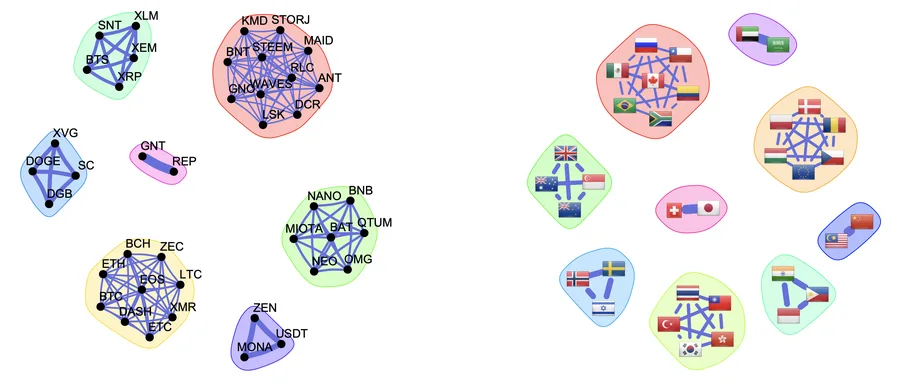
Financial markets generate high-dimensional, non-Gaussian, and time-varying data that challenge classical statistical models. Graph-based representations offer a principled way to capture the dependency structure among assets — stocks, cryptocurrencies, FX rates — and to reveal market sectors, risk propagation channels, and crisis dynamics that are invisible to traditional analysis. Our research develops methods for learning financial graphs in three interconnected settings: static structured graph learning , which jointly estimates the precision matrix and graph topology by exploiting graph stationarity and spectral Laplacian constraints, yielding robust sparse, k-component, and bipartite graphs that reflect market sector structure; heavy-tailed graphical models , where Student-t likelihoods replace Gaussian assumptions to handle fat-tailed financial returns; and time-varying graph learning , which combines temporal priors with heavy-tailed likelihoods to track market dynamics, detect crises, and improve portfolio performance. Throughout, connections to graph signal processing — shift operators, graph filters, and stationarity — provide both theoretical grounding and computational tools. Software GitHub software webpage Book Daniel P. Palomar, Portfolio Optimization: Theory and Application , Cambridge University Press, 2025. Book chapters José Vinícius de M. Cardoso, Jiaxi Ying, and Daniel P. Palomar, “ Learning Graphs from Heavy-Tailed Data ,” in Elliptically Symmetric Distributions in Signal Processing and Machine Learning , Eds. J.-P. Delmas, M. N. El Korso, S. Fortunati, F. Pascal, Springer, Jul. 2024. José Vinícius de M. Cardoso, Jiaxi Ying, and Daniel P. Palomar, “ Nonconvex Graph Learning: Sparsity, Heavy-tails, and Clustering ,” in Signal Processing and Machine Learning Theory , Digital Signal Processing Series, Elsevier, Dec. 2022. 📕 Papers Amirhossein Javaheri, Jiaxi Ying, Daniel P. Palomar, and Farokh Marvasti, “ Time-Varying Graph Learning for Data with Heavy-Tailed Distribution ,” IEEE Trans. on Signal Processing , vol. 73, pp. 3044-3060, 2025. Andrei Buciulea, Jiaxi Ying, Antonio G. Marques, and Daniel P. Palomar, “ Polynomial Graphical Lasso: Learning Edges from Gaussian Graph-Stationary Signals ,” IEEE Trans. on Signal Processing , vol. 73, pp. 1153-1167, 2025. Amirhossein Javaheri, Arash Amini, Farokh Marvasti, and Daniel P. Palomar, “ Learning Spatio-Temporal Graphical Models From Incomplete Observations ,” IEEE Trans. on Signal Processing , vol. 72, pp. 1361-1374, 2024. Jian-Feng Cai, José Vinícius de M. Cardoso, Daniel P. Palomar, and Jiaxi Ying, “ Fast Projected Newton-like Method for Precision Matrix Estimation under Total Positivity ,” Advances in Neural Information Processing Systems (NeurIPS) , New Orleans, LA, USA, Dec. 2023. [26.1% acceptance rate] [ video ] [ slides ] [ poster ] Xiwen Wang, Jiaxi Ying, and Daniel P. Palomar, “ Learning Large-Scale MTP2 Gaussian Graphical Models via Bridge-Block Decomposition ,” Advances in Neural Information Processing Systems (NeurIPS) , New Orleans, LA, USA, Dec. 2023. [26.1% acceptance rate] [ video ] [ slides ] [ poster ] Jiaxi Ying, José Vinícius de M. Cardoso, and Daniel P. Palomar, “ Adaptive Estimation of Graphical Models under Total Positivity ,” in Proc. of the International Conference on Machine Learning (ICML) , Honolulu, HI, USA, July 2023. [27.9% acceptance rate] José Vinícius de M. Cardoso, Jiaxi Ying, and Daniel P. Palomar, “ Learning Bipartite Graphs: Heavy Tails and Multiple Components ,” Advances in Neural Information Processing Systems (NeurIPS) , New Orleans, LA, USA, Dec. 2022. [25.6% acceptance rate] [ video ] [ slides ] [ poster ] [R package bipartite ] Rui Zhou, Jiaxi Ying, and Daniel P. Palomar, “ Covariance Matrix Estimation Under Low-Rank Factor Model with Nonnegative Correlations ,” IEEE Trans. on Signal Processing , vol. 70, pp. 4020-4030, Aug. 2022. José Vinícius de M. Cardoso, Jiaxi Ying, and Daniel P. Palomar, “ Graphical Models for Heavy-Tailed Markets ,” Advances in Neural Information Processing Systems (NeurIPS) , Virtual, Dec. 2021. [26% acceptance rate] [ video ] [ supplemental material ] [ slides ] [ poster ] [R package fingraph ] Jiaxi Ying, José Vinícius de M. Cardoso, and Daniel P. Palomar, “ Minimax Estimation of Laplacian Constrained Precision Matrices ,” in Proc. of the 24th International Conference on Artificial Intelligence and Statistics (AISTATS) , vol. 130, pp. 3736-3744, April 2021. [29.8% acceptance rate] [ R package ] Jiaxi Ying, José Vinícius de M. Cardoso, and Daniel P. Palomar, “ Nonconvex Sparse Graph Learning under Laplacian Constrained Graphical Model ,” Advances in Neural Information Processing Systems (NeurIPS) , Dec. 2020. [ 2-min video ] [ slides ] [ poster [ R package ] Sandeep Kumar, Jiaxi Ying, José Vinícius de M. Cardoso, and Daniel P. Palomar, “ A Unified Framework For Structured Graph Learning Via Spectral Constraints ,” Journal of Machine Learning Research (JMLR) , 21(22): 1-60, Jan. 2020. Sandeep Kumar, Jiaxi Ying, José Vinícius de M. Cardoso, and Daniel P. Palomar, “ Structured Graph Learning Via Laplacian Spectral Constraints ,” Advances in Neural Information Processing Systems (NeurIPS) , Dec. 2019. [ 2-min video ] [ slides ] [ poster ] [ arXiv ] [ R package ] Licheng Zhao, Yiwei Wang, Sandeep Kumar, and Daniel P. Palomar, “ Optimization Algorithms for Graph Laplacian Estimation via ADMM and MM ,” IEEE Trans. on Signal Processing , vol. 67, no. 16, pp. 4231-4244, Aug. 2019. [ R package spectralGraphTopology ]