


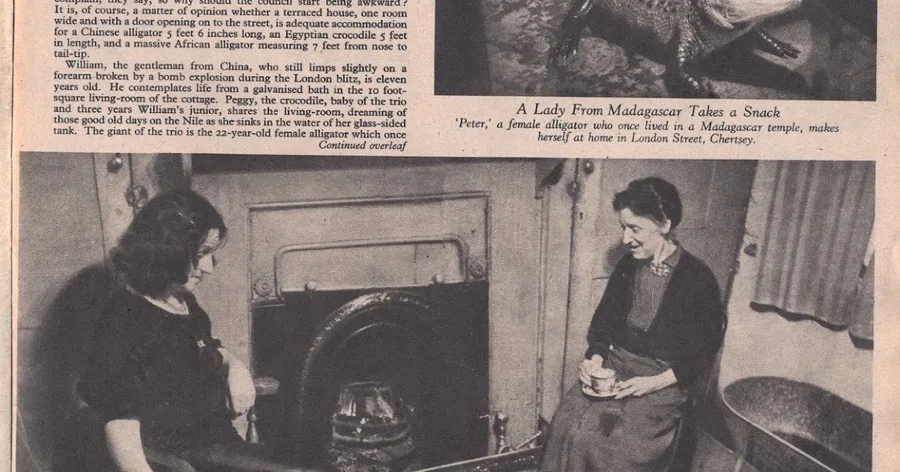
This article is a follow up to two I posted in 2022: STRANGE CARGO, the 1952 film: 'Riding the Alligator' and' Hatching the Tortoise'...and its return to the Densham family The ‘Alligator Ladies’ of Hammersmith and Chertsey. Who were they and what became of them? I would suggest the reading of those two before this one since they provide a complete background to why I was left wondering who Thelma Roberts and Enid Davis—the ‘Alligator Ladies’ who kept large crocodiles and alligators in their houses in Hammersmith, London, and in Chertsey in Surrey in the 1950s. My searches then had hit a brick wall in trying to identify who these two women were, where they had come from and what had happened next. I could find nobody of those names in the register of births, marriages and deaths of around the right age. Still curious in 2026 I tried again. The initial breakthrough to the mystery came by searching for old newspaper articles that have appeared in online archives since 2022. In short these articles showed that I was on the right lines in 2022 but the reason I could not find either of the two women is that they both used aliases. In addition events at 346 King Street, Hammersmith in London proved important in linking people to place. Further searches provided the prequel to my previous article which began in the late 1940s and ended in the mid-1950s. Using search terms I could use from the prequel I then found an online article from 2024 that revealed what had happened to the Alligator Ladies in the 1960s and 70s and their role in creating a film star—the sequel. The 2024 article was written by Elizabeth Dale who has a blog under the title of The Cornish Bird ; I shall refer to by that name since it looms large in later tales of the ladies and their crocodilians. Although the author made several what we now know to be misinterpretations with regard to the name of Miss Roberts she has provided an invaluable source of information on what happened in the 1960s and 70s. The key finding to unravelling the life story of the two women was that Thelma Roberts was an alias which she used for decades before reverting to one of her real forenames. After her tragically brief marriage she also alternated her surname. The Sunday Mirror of 28 June 1955 provided that key under the heading, Her Croc was Sick: A little elderly woman and her four pet crocodiles were happy last night. The crocs live in a cottage in Windsor-street, Chertsey, with Miss Guinvere [sic] Roberts. Some months ago one of the crocs became very ill. Miss Roberts thought Peggy would die. And where to bury her? After many enquiries Miss Roberts found that the P.D.S.A. cemetery at Ilford might help. THEN Peggy suddenly got better. “we’re a happy family again,” Miss Roberts said yesterday. Then I found newspaper accounts of her using a stage name, ‘Katrina’. Miss Roberts was a reptile entertainer who also hired-out of her animals to the film and entertainment industry. Having done all the searches of the genealogical sites and newspapers available online, I have a considerable information on who the two women were and what they did. However, there are still come unanswered questions as will be evident as their life history emerges. Picture Post 10 January 1948 Flora Guinevere Roberts was born on 9 October 1890 at Richmond, then in Surrey, to Robert Owen Roberts (1867-1958) and his wife Flora Marian Gill (1868-1947). At her christening on 30 August 1891 her forenames were reversed to Guinevere Flora. Robert is described as ‘beer retailer’ of the Princess of Wales, Red Lon Street, Richmond. In other words he was a publican. For some reason her name seems to have been omitted completely from the 1891 Census. The 1901 Census shows the family had moved to Hampton Lodge, High Street, Hampton, Middlesex. Robert had changed his occupation to builder (jobbing). A son, Robert Owen Gordon, had been born in 1897. The family was still there in 1911 (with Robert shown as a builder and employer) but Guinevere was not. However Thelma J Roberts, aged 20 and born in Richmond, was living ‘over the shop’ as an assistant of Elizabeth Godfrey Weaver, ‘shopkeeper, draper and milliner’ at 107 Kew Road, Richmond. This is the first use I have traced of Miss Roberts under her alias of Thelma. Just to be sure it was her I did check that there were no matching births of a Thelma in Richmond over a ten-year period around 1890. 346 King Street From Google Earth It is in the 1921 Census that things turn even more odd. There have been several amendments. Initially answered ‘M’ for male, the entries have been changed to ‘F’. ‘Tenant’ has been changed to ‘Head’ possibly by the enumerator. The address is 346 King Street, Hammersmith and the occupants were Thelma F. Roberts and W. J. Davies aged 26 and 28 respectively. Miss Roberts was a dressmaker working at home on her own account and Miss Davies her assistant. for the places of birth Hampton Hill was incorrect for Miss Roberts and correct as Manchester for Miss Davies. Although not asked for those born in UK, Miss Roberts was ‘Irish, English’ and Miss Davies ‘Welsh’. Knocking a few years off the age at marriage for example was a common ploy of women at the time but why was Miss Roberts doing so here? And why was she calling herself Thelma—and Irish? I cannot help but wonder if she was trying to conceal her identity, if she was hiding or if she simply did not like the names her parents had given her. Did she fill in the census form or did some other occupant of the building? From 1929 and throughout the 1930s the electoral registers show both or one of the two living at 346 King Street, along with other occupants. I noted in a previous article that Miss Roberts was a piano teacher, advertising in the local newspapers for pupils in 1931. When it came to which name being used by Miss Roberts Thelma was used in advertisements and some census returns but for events like births, marriages and deaths the real name had to be given. Thus we find a marriage certificate from 2 September 1938. Guinevere Flora Roberts, aged 39 (she was still 37), a spinster of 346 King Street, Hammersmith, the daughter of Robert Owen Roberts and of independent means, married Finlay Matheson, aged 51, a widower, an electrical engineer, also of 346 King Street, the son of Finlay Matheson (deceased) a livestock auctioneer, at Hammersmith Register Office. The witnesses were J.H. Orchard and W.M. Davies. Sadly, the marriage was followed only 12 weeks later, on 17 November, by Finlay Matheson’s death at Fulham Hospital of myocardial degeneration with chronic bronchitis as a secondary cause. On the death certificate the informant was his ‘widow Thelma Matheson’—final confirmation when I first found it that Guinevere and Thelma were the same person. Guinevere must have known little about Finlay’s family in Scotland because she inserted an advertisement in the Aberdeen Evening Express of 17 April 1939: Will Any Relatives of FINLAY MATHESON, resident of 458 Clifton Road, Woodside, Aberdeen (1929,) recently deceased, or Any Person ever having known him, please communicate with GUINEVERE MATHESON, 346 King Street, Hammersmith, London. Given this tragedy in her life it is not surprising that at the emergency census taken on the outbreak of war in September 1939 Guinevere was with her parents. It was not the first tragedy of the family in the 1930s. Guinevere’s brother, Gordon, had died on 25 March 1934 of rectal carcinoma at 50 Thornton Avenue, Chiswick, which his father, the informant of the death to the registrar, also gave as his address. Gordon was an electrical engineer (retired) according to his death certificate and his usual residence was given as The Manor House, Lee near Ilfracombe in Devon. At some stage the father, who had clearly made a bob or two as a builder in London, and mother retired to that address which came with tenanted land and it was there that Guinevere can be found in September 1939, giving her status as a widow and her occupation as housekeeper in private service. At the same time the Roberts family were together in Devon, ‘Winifred Margaret Davis’ as written by the enumerator and born on 6 October 1889 was in the flat at King Street, Hammersmith, listed as ‘housekeeper’. At this stage it is worth pointing out that Guinevere’s parents lived in Devon until their deaths. Her mother died on 10 November 1947; her father on 16 August 1953 at Warcombe Farm, a short distance from his home of the Manor House, Lee. He left £37,604, the equivalent of nearly £1 million in 2026. However, the will of Robert Owen-Roberts (note the hyphen which had been inserted), described as Lord of the Manor of Lee, made the William Hickey column of the Daily Express of 2 February 1954. He offered £1,000 “to such person, institution, or society instrumental in bringing about and accomplishing the abolishing of the cruel use of the steel (or gin) trap used for catching rabbits”. He left £5,000 each to St. Dunstan’s (for blind war veterans), the RAF Widows and Orphans Fund, and to the Royal Institute for the Blind. In addition he made bequests to tenants on his land. The total bequeathed exceeded the £37,604 and each bequest had to be scaled down in proportion. I do not know if Guinevere received anything. If she did it would have been a small fraction of what she might have expected as sole heiress. It would seem that Guinevere/Thelma was soon back in London since in 1941 a note in a newspaper stated that the alligator she used to help promote war bonds ‘came into her possession ‘soon after war broke out’. The Weekly News of 30 August: Miss Thelma Roberts, who lives in Hammersmith, London, has kept and trained her ten-year-old Mississippi alligator, 4 ft 3 in. long. He now shakes hands with visitors and hisses at intruders, and politely takes tit-bits from the fingers of givers. Peter is going to assist War Savings in the district—by shaking hands with investors in Savings Certificates. The syndicated story appeared in newspapers throughout the USA. As we shall see Peter looms large in later accounts and with a name change came stardom. On 10 May 1947 the Middlesex Independent & West London Star contained a hilarious account, worthy of a Victorian melodrama, of a reporter’s visit to 346 King Street. I am reproducing it in full: Our reporter has a horrible experience ALONE (IN A SMALL ROOM) WITH A 7-FOOT ALLIGATOR. He cleaned the teeth of a crocodile—and gave it a cigarette My stomach has returned more or less to its accustomed position, and I can write and talk about it all now, writes our reporter. At least, I can write about It, but to talk about it......Well, I've tried, but the polite smiles of incredulity of my friends have dried me completely up. Even the Editor has queried my sobriety. I've not even dared risk the laughter of the family, but maybe your intrepid reporter's story, in cold print, will convince my sceptics. If only I had taken photographer along... Let's get It over with. Let's get this awful sentence out while the pencil performs only semi-gyrations. Here goes..... I HAVE BEEN ALONE • IN A SMALL ROOM WITH A SEVEN - FOOT 15-STONE ALLIGATOR. There goes my stomach again! You are wrong quite wrong. It was ALIVE. It was LOOSE. It was FREE, free as the air I wasn't breathing for long periods. The alligator squirmed round my feet. I squirmed too. It flopped, if alligators perform that movement, this way and that along the carpet, getting all tangled up in chairs and furniture. And that tall, that curled tall! One lash and I knew I'd be spending the rest of my life walking on my hands. Oh, my stomach, will ye no come back again? How fearfully It turns over when I think of cleaving an alligator's teeth, of lighting and placing & cigarette be-ween a crocodile's lips. What a morning! -and I'm no Dick Barton. "This is your storyteller, the man in... appointment with fear, appointment with fear.... I must keep calm, keep calm - thank you Harry, for the aspirins—and try to explain with a true reporter's detachment. Alone with Peter I ASCENDED the stairs of a house which lies Just over the Chiswick border, in King Street, completely at ease, full of sang froid. I chatted merrily to my hostess, "Katrina." Then beard a thud that shook the stairs. "That's Peter getting out of his bath," explained "Katrina" "Must be a portly fellow this ablutionist," I thought. "Katrina" opened a door, told me to enter and wait, and closed it. Now if that door had been only slightly on the flimsy side 1 should have shot straight through it and out. I was with Peter. He made no move, just looked at me, and for once I did not regret the impoliteness of the host in not coming forward to greet me because my host was a seven foot alligator. Then Peter started moving round that small front room. I started moving round as well, keeping one eye on the tall, and jogging the memory to breathe every five minutes At Last Katrina entered, and I retrieved my stomach exiting through the window. "You two friends?" she wondered. I muttered I hoped so. The sun had momentarily departed as, from the maximum distance away. I saw Peter take his morning constitutional round the room, then clamber dexterously into his water tank. And, so help me, he grinned. "Katrina" had left me again, but I was now more at home with Peter more at home, and almost nonchalantly I peered into the tank of the second occupant of the room, that of s docile young Egyptian crocodile named Peggy. However, my inspection was somewhat abrupt what with Peter between me and the door. “Katrina" called, and I mounted another flight of stairs to see William. Our introduction as I entered the room was, I thought, not too happily phrased. "This is William, he's dynamite." The 'stuffed' crocodile I WENT into the room cautiously, stepped over a stuffed crocodile fitting most of the carpet space near the door, and glanced around. I was about to conclude that I’d been directed to the wrong room when I saw the "stuffed" crocodile, which was brushing my feet, move. I doubt whether William saw me move. I moved up and across. I can still vouch for the fact that I moved up. There's still plaster from the celling in my hair. When "Katrina" had stilled my whimperings I hurriedly took refuge in a cigarette. Which was a silly thing to do. for "Katrina" Informed me that William liked cigarettes and would I like to give him one. "Give him one!" Hours later (or so it seemed) I was still saying "No. I had another appointment" and "Katrina" was still smiling and challenging. And all the while William was peregrinating round the room and I was ready to take a flying leap at any moment. But what s a so-called male to do? With hands that were anything but firm I it a cigarette, “Katrina" opened William's mouth... and that set me back another twenty minutes. Finally, wondering whether my successor would also die on the Job, I placed a cigarette in his mouth. The jaws closed and William puffed away contentedly at my tuppenny gasper. I was witness to the fact that not once did the cigarette drop out, that it burned evenly. and that Willem actually puffed. The door closed on William and gradually I became the reporter again, on to a good story—and "Katrina's" fascinating tale of herself and Peter, and William and Peggy was unfolded. Temple was his home WE’VE all read and heard of strange beliefs and rituals and rites that go on in darkest Africa. Certain species of alligator are regarded as gods there, and Peter is one. In those far-off days Peter's name was Nattakina; he was kept in a holy temple where he was worshipped and adored. What happened nobody knows but for some reason the temple was suddenly abandoned and Nattakina, only three feet long at the time and wearing phosphorous paint, was given to "Katrina" by a young Mahomedan. I saw Peter's distinctive and beautiful markings, his human-like “hands", characteristics "Katrina" assured me, of the alligator gods. Some years ago, said "Katrina," attempts were made to steal Peter from her, probably (she thinks) by African worshippers, and at that time she sought police protection from burglary. (Peter would be a tough proposition to elope with now, and he's still growing. He should double his present length during the next two hundred years, if he is scheduled to live that long). There are spiritualists who insist that Peter is a reincarnation, and "Katrina," whilst not really superstitious, is ready. to admit the existence of black magic. Man kicked him, died SHE told me how, early in the blitzes she realised that no harm could befall the sacred alligator, and she instanced occasions when she and Peter remained unharmed with bombs falling all round. And she told how, soon, people were begging to stay the night with her pet during raids. (Are they the alternatives to-day?-being obliterated by atom bombs or sojourning with an alligator. If so. you'd better get your name down quickly on Peter's waiting list.) She told me how, during the war years Service personnel came to visit and stroke the alligator for good luck and "Katrina" has heard of no-one who did so who failed to return. There was, too, an occasion when a man kicked Peter viciously in the head and (said "Katrina") "Peter did not move, but gave that man a long, Indescribable look. Next day that man was killed." "Katrina," dark, soft-volced and half-Egyptian, and used to the ways of reptiles set about training this African killer. Now she claims Peter to be tine tamest and cleverest alligator in Europe. She says, quite simply that Peter, (who, incidentally is a "she") has the most remarkable brain an animal ever had, and understands every word she utters. Peter eats from her hand, and she even cleans his teeth. I've performed this last myself. Of course, I had to be persuaded just a little and I admit that my eyes were glued shut, and that "Katrina's" hand steadied mine, and that I started and finished on only one molar. But the size of those molars! (A well-known Brentford firm produce Peter's dentifrice. This is a tip-off for their publicity department to get cracking.) Fussy about food Peter is fussy about his food. He eats heatings, but turns up his snout at whiting. His best menu item is rooks sent by farmers. Shopkeepers also send along bits and pieces for him. Perhaps you are inured to surprise by now. Perhaps you will only raise the eyebrows slightly when I tell you Peter wears on his "hand," an "engagement" ring, of which he is inordinately proud. Who the lucky bride, (or should it be bridegroom?) is I did not discover. Peter has a sense of humour too. At Christmas time a mince pie was offered to him. He screwed up his eyes, and laughed. And his laugh resembled the sound of twenty bulls. It he has a vice it is jealousy. Ignore Peter, and speak. to Peggy first when you enter his room, and then hurriedly stand back to escape a drowning from Peter's flailing and lashing of water. But lately he has been suffering from bad eyes, hence the wearing of bed socks, so that he won't scratch them. "Katrina" acts as medical officer. There is no love lost between Peter and William, which is why they are kept in separate rooms. In. fact, William has even forgotten himself with "Katrina." Recently he nearly took off her thumb, and on another occasion left a nasty scar on her ankle. Peggy was the cause of the first accident. She went too near William's tank, and he made a grab at her. In separating them "Katrina" got her thumb badly gashed by William. William. from China, is twelve years old. He has not the food fads of Peter, and will eat anything. In fact, his delicacy la a "parson's nose." Alligators as pets WHY does "Katrina" keep these strange companions? Because she is a reptile entertainer who travels the country with her act. People told her she was crazy in attempting the task of taming crocodiles and alligators. "But I have, and why not?" she says. "People seem to forget that
The ‘Alligator Ladies’ of Hammersmith and Chertsey. Who they were and what came next
Malcolm Peaker (noreply@blogger.com)