


During a period of his life when he publicly shared political opinions, Dylan Marron encountered a lot of online hate. The old comments section in his YouTube channel contains horrific, dehumanizing comments like “You should kill yourself.”
Imagine receiving a comment like that—how would you respond? A possible—and tempting—response is to volley the vitriol right back, wishing death in return, giving back the hatred that had been communicated to you first. After all, in certain corners of the online world, many people do exactly that, publicly engaging in rhetoric so toxic and disturbing that it sends chills down your spine.
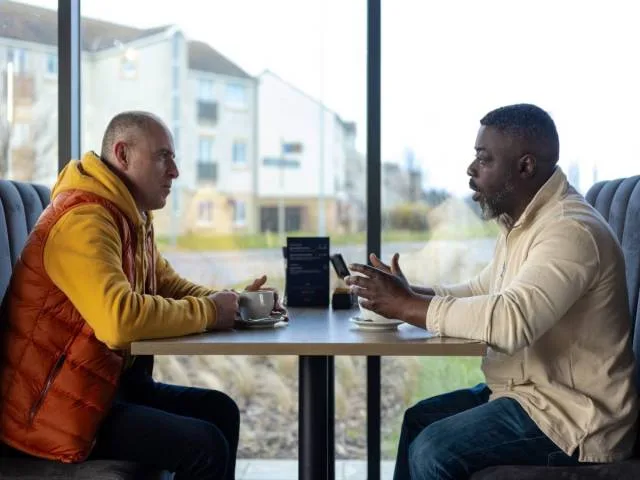
But Marron did not behave like most people. Instead, he did something that most people would probably question. He reached out to the person who wrote “you should kill yourself” and asked if they would have a spoken conversation with him.
As a psychologist who studies conflict conversations, this is the sort of incredible psychology study that I wish I could run—but no Institutional Review Board would ever approve.
What happened when Marron reached out to his online haters is not what you might have expected. First, you might expect that none of the commenters would respond, let alone agree to have a conversation. But instead, dozens of them agreed to talk to Marron (and even be part of a later-produced podcast that he created, aptly called “Conversations With People Who Hate Me”).
Second, even more shocking than their willingness to talk, the conversations were sort of…good. Over the course of the conversations (some lasting up to an hour), both communicators experience moments when they acknowledge each other’s viewpoints, moments when they not just listen to each other but seem to understand each other, even moments when they possibly find just a tiny bit of common ground. They almost never reach real agreement, but they also don’t sound like they hate each other by the end, much less want to kill each other.
By inviting his haters to a spoken conversation, Marron did something brilliant. He removed them from a context that is fundamentally dehumanizing—an anonymous, text-based, engagement-optimized, algorithm-driven environment—in other words, an online comment section. The very design of most online platforms brings out the worst in us, eliciting a level of vitriol rarely observed in the offline world. Having a spoken conversation allowed Marron and the person who thought they hated him to re-humanize each other, recognizing and consequently treating each other as people who have faces and families and rich, complex opinions instead of as nameless adversaries defined by idiotic, strawmen positions.
Marron’s case study illustrates something I’ve been researching for almost 20 years now: why certain types of conversational structures—specifically, spoken versus written conversations—seem to fundamentally change the constructiveness of communication. In 2017, I published a paper called “The Humanizing Voice.” It posited that hearing what a person says, compared to reading even the same words in text form, can humanize the communicator. For example, in one experiment, hearing a political opponent’s statement caused observers to attribute more “uniquely human” traits (e.g., greater rationality and thoughtfulness) to their opponent than reading the opponent’s same words. As another example in a different experiment, hearing a script spoken by a voice actor, compared with reading the same script, made observers assume the original creator was more likely a human than an AI program.
In my latest published research, my coauthors Burint Bevis and Mike Yeomans and I put the “humanizing voice hypothesis” to a different type of test. Rather than having observers form evaluations of previously recorded statements that they either heard or read, we asked real political opponents to have hundreds of live conversations. By changing the medium of the entire conversation (from speaking to writing, for instance), we could test how the medium influenced both which language people used—language production—as well as the way people’s opinions were understood—language consumption. Changing the conversation medium also let us directly test how constructively disagreement conversations unfold, specifically how much communicators feel understood and how much conflict they experience.
Before we collected real conversations, we first examined people’s preferences and predictions. What we found underscored the appeal of the online comments section. In a survey of 200 adults, respondents strongly preferred to write to a disagreeing stranger than talk to them (84% vs. 16% preference, respectively). Why? They thought it would be more comfortable and easier, and also lead to better conversations (e.g., less conflict).
We think these predictions—and everyone who believes writing vitriol in online comment sections will be a good use of time—are mostly wrong, based on the experiments we ran next.
We conducted a series of experiments at universities across the U.S. to test the real effect of conversation medium on disagreement conversation outcomes. Our final analysis set for our paper included 1,842 conversations. In all experiments, communicators were randomly assigned to either speak or write to each other, typically for short (e.g., nine-minute) conversations about their topic of disagreement.
For example, in one experiment, we identified some topics that would be controversial among a sample of UC Berkeley students (e.g., California government reparations for slavery). We first asked participants to tell us their own opinions on the designated topics, then assigned them to talk or write to a disagreeing partner, and finally asked them in private surveys how the conversations went.
The talkers reported having more constructive conversations than the writers—specifically, greater understanding, less conflict, more liking and positive impressions, and more openness to changing their attitudes toward their partner’s attitudes. They didn’t even have to see each other to accrue the positive benefits of speaking; talking to each other without video on sufficed.
We found that the effect of medium persisted even when we made the conversations a bit shorter or longer (e.g., six minutes or 12 minutes), changed their synchronicity (enforced pauses or no pauses), and changed it from a dialogue to an exchange of monologues (only one chance each to communicate). Further, these other structural changes (conversation length, synchronicity, and interactivity) did not have as much impact as the conversation medium on the reported constructiveness of the ensuing conversation.
We partnered with an organization called “Bridge USA” to run conversation events on multiple college campuses, including Minnesota State University, Mankato, and Arizona State University. We selected a topic that would be polarizing for the community (e.g., for Arizona State University, we selected the U.S./Mexico border wall being built) and advertised the events as opportunities to discuss this topic. We randomly assigned attendees to sit at a “speaking” or “writing” table, where they either spoke or wrote with a partner about the topic.
After each short conversation (six to 10 min), attendees completed a survey about their experience and then rotated and moved to another conversation. Most attendees had at least five conversations during the event. The conversation events showed the same results: Speakers reported having more constructive conversations, liking each other more, and finding more attitude alignment, than writers. This was even true when they largely agreed at the outset.
At Arizona State University, we also asked communicators to predict their partner’s actual attitudes after the conversation ended, and speakers were more accurate than writers. This suggests that they didn’t just feel more understanding in the spoken than written conversations, they actually had more understanding.
To understand changes in the production of language, we analyzed the laboratory conversations for which we had clean recordings (699 in total). The structure of language among pairs who had been assigned to speak was very different than pairs assigned to write. For instance, speakers produced shorter, quicker exchanges than writers, with more overlapping words. They also tended to use less formal and more agreeable language.
Particularly interesting to us was that speakers used more receptive language—language that signaled their openness to opposing views, like more subjectivity (e.g., “in my opinion” or “I believe”) and fewer negative emotions (e.g., “this is terrible”)—than writers did. We found that the more receptive language in the spoken (versus written) conversations was also associated with more constructive outcomes, like greater reported understanding in the post-conversation surveys.
Marron understood the intuition of my results before they were published. Not only did he avoid the ultimately unconstructive allure of getting into online arguments, he leveraged the humanizing value of a spoken conversation. By engaging constructively with his antagonizers, he lived the research while providing a powerful example for all of us.
Let’s follow Marron’s example and try living the research. The next time a disagreement is brewing, instead of replying over text, try talking. Ten minutes of speaking could save you a lifetime of misunderstanding.