

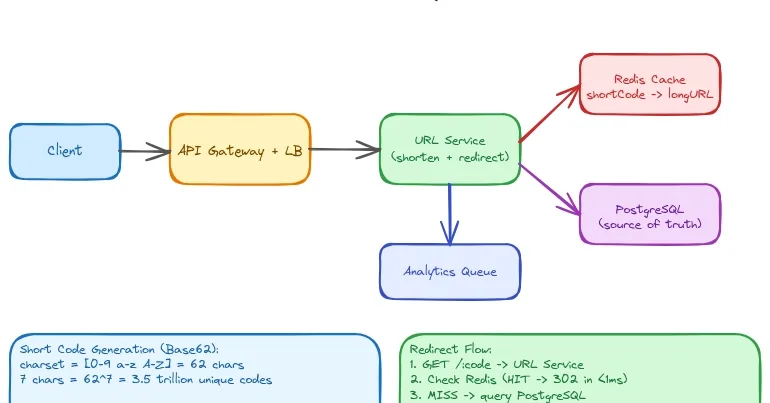

Design a system that takes a long URL and returns a short URL, and redirects short URLs to their originals. 1️⃣ Clarify Requirements Functional Requirements Given a long URL, generate a short URL Given a short URL, redirect to the original long URL (Optional) Custom aliases: short.ly/my-brand (Optional) URL expiration (Optional) Analytics: click count, referrer, location Non-Functional Requirements High availability — downtime = broken links everywhere Low latency redirects — < 10ms (cached) Durability — shortened URLs should work for years Reads >> Writes (100:1 read-to-write ratio typical) 2️⃣ Estimate Scale Write QPS: 10M URLs shortened per day = 10M / 86,400 ≈ 115 writes/sec
Read QPS (100:1 ratio): 100 × 115 = 11,500 reads/sec Peak: ~50,000 reads/sec
Storage: Each record: shortURL(7B) + longURL(200B) + metadata(100B) ≈ 307 bytes 10M URLs/day × 10 years = 36.5B URLs 36.5B × 307 bytes ≈ 11 TB (very manageable)
Cache: 80% reads on 20% of URLs (Pareto principle) Cache 20% of daily URLs: 10M × 0.2 × 307B ≈ 600 MB/day 3️⃣ API Design # Create short URL POST /api/shorten Body: { "longUrl": "https://...", "customAlias": "optional", "expiresAt": "optional" } Response: { "shortUrl": "https://short.ly/abc1234" }
Redirect
GET /:shortCode Response: 301/302 Redirect to longUrl
Analytics (optional)
GET /api/stats/:shortCode Response: { clicks: 1000, topCountries: [...] } 301 vs 302: 301 Permanent → browser caches redirect → fewer server hits → can't update 302 Temporary → browser always checks server → can update/expire → use this for analytics 4️⃣ Short Code Generation Option A: Hash + Truncate MD5(longURL) = "1a79a4d60de6718e8e5b326e338ae533" Take first 7 chars: "1a79a4d" shortURL: short.ly/1a79a4d Problem: Collisions — different URLs can produce same 7-char prefix. Option B: Base62 Encoding (Recommended) Character set: [0-9a-zA-Z] = 62 characters 7 characters × 62^7 = 3.5 trillion unique codes ✅
ID: 123456789 Base62(123456789) = "8M0kX" shortURL: short.ly/8M0kX Where does the ID come from? Auto-increment DB ID — simple, but reveals volume/sequence UUID — random, no collision, but long → truncate carefully Snowflake ID — distributed, time-sortable, unique (Twitter's approach) Option C: Counter Service A dedicated service generates unique IDs: Counter Service: ID = 1, 2, 3, ... (globally unique) URL Service: Base62(ID) → short code 5️⃣ High-Level Design [Cache (Redis)] │ Client ──► [API Gateway + LB] ──► [URL Service] ──► [DB (PostgreSQL)] │ [Analytics Queue] │ [Analytics DB]
Redirect flow: Client ──GET /abc1234──► [URL Service] │ ┌─── Redis HIT → 302 Redirect ──► Client │ └─── Redis MISS → DB query → cache → 302 Redirect 6️⃣ Database Schema CREATE TABLE urls ( id BIGSERIAL PRIMARY KEY , short_code VARCHAR ( 10 ) UNIQUE NOT NULL , long_url TEXT NOT NULL , user_id BIGINT , created_at TIMESTAMP DEFAULT NOW (), expires_at TIMESTAMP , click_count BIGINT DEFAULT 0 ); CREATE INDEX idx_short_code ON urls ( short_code ); -- Analytics table CREATE TABLE clicks ( id BIGSERIAL PRIMARY KEY , short_code VARCHAR ( 10 ), clicked_at TIMESTAMP DEFAULT NOW (), country VARCHAR ( 2 ), referrer TEXT , user_agent TEXT ); 7️⃣ Caching Strategy Key: short_code ("abc1234") Value: long_url TTL: 24 hours (refresh on hit if needed)
Cache-aside:
- Check Redis for short_code
- MISS → query PostgreSQL → store in Redis with TTL
- HIT → return long_url immediately
Cache hit rate target: >95% (80/20 rule — most traffic on top URLs) 8️⃣ Scalability Deep Dive Read Scaling Redis cache handles ~95% of redirect traffic Read replicas for the remaining DB reads CDN for the redirect response itself (if 301) Write Scaling Writes (new URLs) are much rarer — primary DB + async replication is fine If needed: hash short_code → route to shard High Availability Redis Sentinel or Cluster for cache HA DB: Primary + read replicas + automated failover Multiple URL service instances behind LB 9️⃣ Custom Aliases & Expiry def shorten ( long_url , custom_alias = None , expires_at = None ): if custom_alias : if db . exists ( custom_alias ): raise ConflictError ( " Alias taken " ) short_code = custom_alias else : id = db . insert ( long_url ) short_code = base62_encode ( id ) db . store ( short_code , long_url , expires_at ) return f " https://short.ly/ { short_code } " def redirect ( short_code ): url_data = cache . get ( short_code ) or db . get ( short_code ) if not url_data : raise NotFoundError () if url_data . expires_at and url_data . expires_at < now (): raise GoneError () # 410 Gone return url_data . long_url 🎨 Diagram The diagram shows: Full system: Client → LB → URL Service → Redis → PostgreSQL Shorten flow vs redirect flow (separate paths) Cache hit vs miss paths Analytics async flow via queue DB schema with indexes highlighted ✅ Trade-offs Summary Decision Choice Trade-off 301 vs 302 302 More server hits, but analytics & expiry work ID generation DB auto-increment + Base62 Simple but sequential — use Snowflake for privacy Cache TTL 24hr Stale entries for expired/deleted URLs SQL vs NoSQL PostgreSQL Simple queries, ACID for uniqueness