


Utopia is analysed as a rhetorical work characteristic of humanism that demands an active and interpretative reading. Its meaning is constructed through paradoxes that challenge conventional wisdom, in line with Erasmus of Rotterdam's proposal in a letter addressed to Ulrich von Hutten, and depends on both the historical context and the author's biographical details for a proper understanding. Finally, a brief section will be included linking utopia, science fiction and artificial intelligence as tools for reflecting on social organisation. From this perspective, Utopia can be understood as a theoretical framework that remains relevant today, whilst science fiction and artificial intelligence appear as contemporary manifestations of that same utopian impulse.
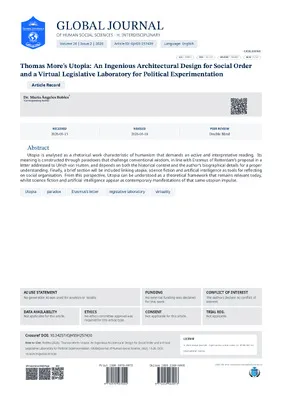
Thomas More's Utopia: An Ingenious Architectural Design for Social Order and a Virtual Legislative Laboratory for Political Experimentation
Dr. María Ángeles Robles