


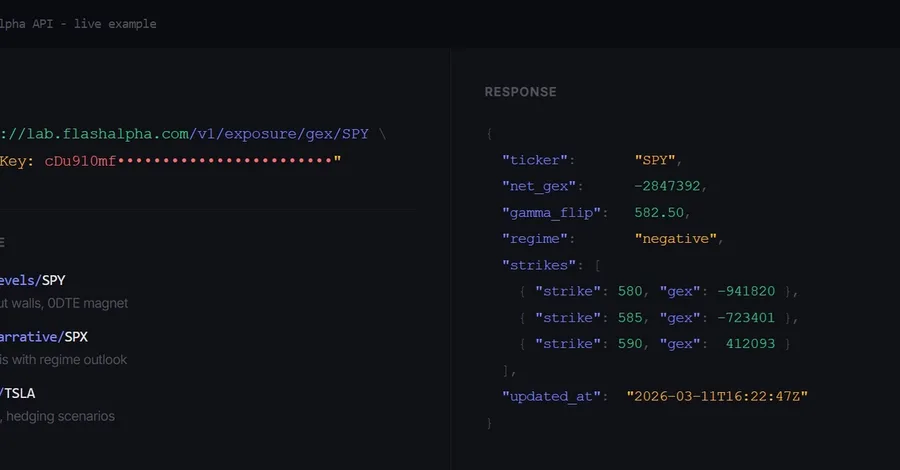
Originally published at flashalpha.com . If you are comparing these two, you are probably not choosing between them. Most desks that run FlashAlpha also have Bloomberg in the building. The useful question is narrower: can the terminal you already pay for feed your systematic options research? Usually it cannot, and the reason is quotas rather than quality. Full disclosure: I built FlashAlpha. Bloomberg is a far larger and broader product than mine, and I will be specific about where it wins, because pretending otherwise would waste your time. The TL;DR Bloomberg Terminal FlashAlpha Primary consumer A person reading a screen A model reading an API Asset class breadth Everything: equities, rates, FX, credit, commodities, news, chat, execution US equity / ETF / index options and CME futures options only Options analytics Per-contract greeks, vol surfaces, pricers (OMON, OVDV, OVME) Aggregated dealer positioning: GEX, DEX, VEX, CHEX, gamma flip, call / put wall, max pain, regime Programmatic access BLPAPI bundled with the seat, quota-metered; firm-scale access is a separate product (B-PIPE, Data License) REST, commercial WebSocket streaming, MCP server; SDKs for Python, JS, C#, Go, Java Published usage limits Not disclosed by Bloomberg; no programmatic way to check remaining quota Published per-tier request limits, returned in response headers Point-in-time replay Historical prices yes; the derived analytics layer, no 51 analytics routes replayable at any minute in the symbol's window; longest run back to 2017-01-03 via ?at= List price 28,320 / seat / year multi-seat, 2-year minimum Free tier, self-serve to 2,500 / mo, Enterprise custom Permanent self-serve free tier No. Trials and demos are sales-led Yes. 5 requests / day, no card, no expiry The quota problem, which is the whole argument This is the part that decides it, so it goes first rather than last. A Bloomberg seat bundles BLPAPI, the programmatic interface you can drive from Excel or Python. That sounds like it solves systematic access, and for modest jobs it does. But the seat is metered, and the meter is built for a human's incidental data pulls rather than for a research pipeline. The limits consistently documented by university library guides, which are the most reliable public source because Bloomberg itself does not publish them, are: Roughly 500,000 data points per day , where one "hit" is a single security / field pair. No more than 3,500 real-time fields open concurrently. A monthly limit on unique securities derived from a proprietary model. Published university guidance disagrees on the number, ranging from roughly 2,500 to 7,000 unique identifiers per month depending on which institution's guide you read, which is itself the clearest evidence that Bloomberg does not publish it. Intraday data is weighted more heavily than end-of-day. Now put a real research job against that. A single day of per-strike analytics on the US options market touches far more than 5,000 unique contracts, because each strike and expiry is its own identifier . One liquid underlying alone can carry several thousand live contracts across the chain. A cross-sectional study over a few hundred names does not brush the monthly limit, it exhausts it in an afternoon. The second problem is worse, and it is the one quants underrate: Bloomberg does not state the explicit limits, and there is no programmatic way to discover what your limits are or how much of them you have consumed. To be fair to Bloomberg, the failure is not silent: Excel and the API return explicit codes, #N/A Limit for the concurrent-subscription ceiling, #N/A Daily Capacity for the daily cap, #N/A Mth Lmt for the monthly one. You will know when you hit it. The problem is that you can only find the ceiling by hitting it. There is no counter to read before you start, so a large backfill cannot be planned against its own budget: it runs until it stops, and the stop lands mid-job. A study that ran in March can fail in April because a colleague on the same licence spent the shared allowance first. That is not a data quality problem, it is an operational one, and no amount of budget fixes it while the access model stays per-seat. Scoped precisely: market-wide, high-volume options-chain backfills are operationally unreliable on the Desktop API. Smaller and more predictable jobs are fine, and plenty of desks run them happily. This is not a criticism of Bloomberg's design. The terminal is licensed to a person, and the quota exists precisely to stop a seat becoming a firm-wide data feed. Bloomberg sells that separately, and openly, which is the next section. What Bloomberg does offer for firm-scale access It would be wrong to say Bloomberg has no programmatic path. It has two, and they are real products: B-PIPE : the consolidated, normalised real-time market data feed, licensed for internal applications including non-display and black-box use. This is the correct product if you need Bloomberg's real-time prices inside your own systems. Data License : bulk and REST enterprise delivery for trading, risk, compliance and operations workflows. Both are negotiated separately from the terminal seat, priced on data fields, exchanges, redistribution rights and consuming applications, and both require a signed licensing agreement. Neither is included in the 1,499 / mo (or 31,980 / year (about 2,500 / mo, dedicated node Multi-seat 4,500 / mo, commercial WebSocket Commitment Two-year minimum, billed quarterly in advance Monthly or annual The comparison people reach for is "2,500 a month, roughly the same". That framing is wrong in both directions. A Bloomberg seat buys a person every asset class on earth plus news, chat and execution. A FlashAlpha node buys your models one analytics layer with no per-user meter. They are not substitutes, and the per-month similarity is a coincidence. Who should not use each Do not buy FlashAlpha if you need multi-asset coverage, news, execution, pre-2017 history, non-US options, or your consumer is a discretionary trader who wants a screen. Buy or keep Bloomberg. Do not rely on a Bloomberg seat if your consumer is a model, you need aggregated dealer positioning, you need to replay derived analytics point-in-time, or you need a data access path whose limits you can actually see. The seat will not do it, and the enterprise products solve the access problem without solving the analytics one. The realistic answer: both Nearly every desk running FlashAlpha keeps Bloomberg. The split that works in practice: Bloomberg for discretionary work, cross-asset context, news, counterparty comms, execution, and as the reference number when someone disputes a mark. FlashAlpha as the machine-readable positioning layer feeding models, backtests, screens and alerts, where the quota is published and the history replays. There is a second, underrated benefit: two independent computations that agree is a much stronger position than one you cannot verify. Reconciling a FlashAlpha surface against OVDV surfaces real problems in both. Try it against your Bloomberg screen Single-expiry GEX on a single-name equity is a Free-tier request, so this runs on a new key with no card: curl "https://lab.flashalpha.com/v1/exposure/gex/AAPL?expiration=2026-09-18" \ -H "X-Api-Key: YOUR_KEY" Compare that to the same expiry on OMON and check the per-strike gamma agrees. To pull the whole chain in one call, drop the ?expiration= filter. That is full-chain GEX and needs Growth. ETFs and index symbols such as SPY, QQQ and SPX need Basic or above: curl "https://lab.flashalpha.com/v1/exposure/gex/SPY" \ -H "X-Api-Key: YOUR_KEY" # full chain + ETF: Growth tier Point-in-time replay is Alpha tier and lives on a separate host. This is the call that has no Bloomberg equivalent: curl "https://historical.flashalpha.com/v1/exposure/gex/SPY?at=2026-04-07T14:30:00" \ -H "X-Api-Key: YOUR_KEY" # Alpha tier Methodology and its stated limitations are in the whitepaper , and the institutional datasheet is at /institutional . Sources All figures are as of August 2026. Where a vendor does not publish pricing, the figure is marked as reported rather than stated. NeuGroup, Bloomberg Terminals: How Much More You'll Pay Next Year Columbia University Libraries, Bloomberg data download limits Bloomberg, API Library Bloomberg is not the competitor a computed-analytics API displaces, and any page claiming otherwise is selling you something. The terminal wins on breadth, news, the network and institutional standing, and it is the right tool when a human is the consumer. It loses when the consumer is a model, for one structural reason: a per-seat licence with an undisclosed, unqueryable quota cannot underwrite a research pipeline. That is a licensing shape, not a quality gap, and it is why the two sit next to each other on most desks rather than replacing one another.
FlashAlpha vs Bloomberg Terminal 2026 - Options Analytics for Quants
tomasz dobrowolski