


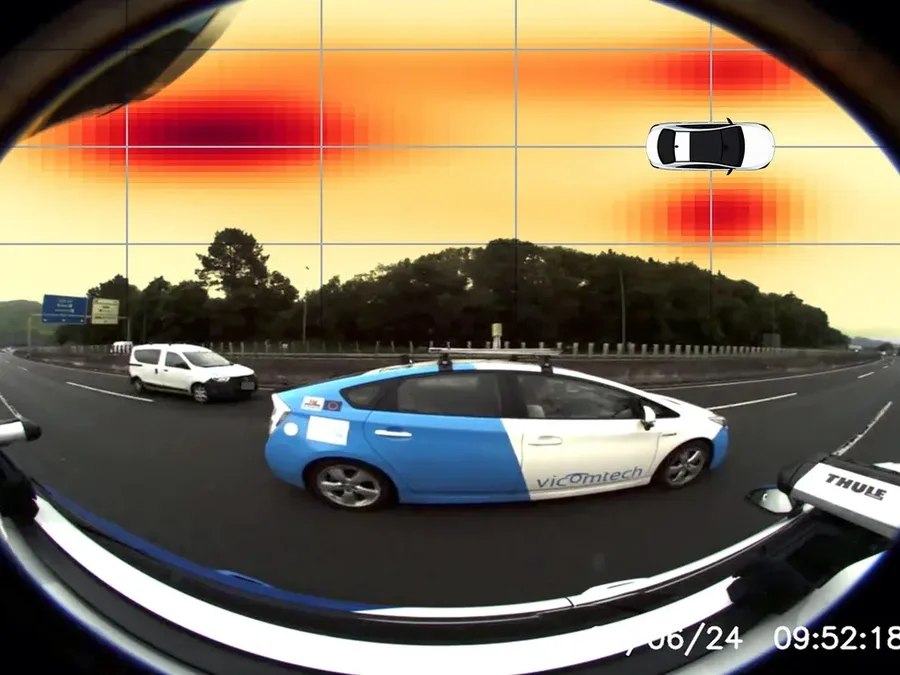
This article is part of our exclusive IEEE Journal Watch series in partnership with IEEE Xplore . In June 2024, two cars casually traveled along a stretch of highway in Basque, Spain, weaving in and out of traffic just like any other vehicles on the road. But this trip was more than just a joyride through green, rolling, scenic mountains. Scientists were analyzing how well the vehicle could, under natural highway conditions, send and receive data with other vehicles and dedicated infrastructure along the sides of the road—a process known as “collective perception.” “The primary objective of collective perception is to provide vehicles with an extended situational awareness that reaches beyond the physical limitations of their onboard sensors,” explains Jon Ander Iñiguez de Gordoa , a researcher with the transport and security division of Fundación Vicomtech , who was involved in the study. For example, if an object on the road is partially occluded to a car’s sensors, the vehicle could use data from smart infrastructure and other vehicles positioned alongside the highway to “see” the object more clearly. This type of communication—called vehicle-to-everything, or V2X, technology—has been a topic of research for several years, and some automakers and cities have already begun deploying it. However, Iñiguez de Gordoa says it has mostly been studied in urban areas, where traffic is slower. “In highway environments, where vehicles travel at high speeds and reaction times are severely limited, the rapid and precise exchange of data is critical,” he emphasizes. The results of the study , published in the August issue of IEEE Transactions on Vehicular Technology , reveal key latency and distance limitations in high-speed environments. A high-speed test The experiment, funded by the Provincial Council of Bizkaia, took place on the council’s Bizkaia Connected Corridor , a stretch of highway in Spain that’s equipped with V2X communication infrastructure to support development and testing of connected mobility systems. Along the winding highway are dedicated roadside units, which exchange collective perception messages (CPMs) with passing vehicles. These data packets may contain information such as vehicles’ positions and velocities, as well as environmental data, which alerts vehicles to issues such as road obstacles or slippery conditions. The researchers drove a Toyota Prius, equipped with a chipset designed to transmit and receive CPM messages, through traffic at speeds between 80 kilometers per hour and 120 km/h. During the drive, they studied the car’s ability to detect objects, process the data into CPMs, and transmit the data to the roadside units. A second car driving alongside the Prius was equipped with a highly accurate monitoring system, to confirm the first car’s ground truth positioning throughout the experiment. The results reveal several challenges with exchanging CPMs under highway conditions, particularly when it came to detecting objects further away. “The main limitation that we saw was that we were unable to detect objects that were farther than 50 meters,” Iñiguez de Gordoa explains. While the system achieved high precision in detecting the distance to other vehicles, it frequently failed to detect them at all. For example, when a vehicle passed within 30 meters of the primary car, the system successfully detected it 65.7 percent of the time. This success rate dropped to 20.5 percent at distances between 30 and 50 meters, and plunged to just 0.1 percent for objects between 50 and 100 meters away. Latency challenges The researchers also pinpointed when latencies were occurring, both during object detection and data transmission. They found that the perception system of the car could take up to 132 milliseconds to detect objects. Iñiguez de Gordoa notes this delay could be reduced somewhat by more sophisticated sensors—but these sensors would come with higher costs and computing demands. Separately, the researchers identified significant delays in communication between the vehicles and roadside units, in part due to European data transmission standards. For V2X communication, transmission frequency is restricted to a maximum of 10 messages per second, to avoid “message congestion.” In this experimental setup, the vehicle’s perception system and data transmission system also operated asynchronously, meaning messages were sent at a fixed rate independent of when the perception system finished its analysis. This resulted in worst-case buffering delays up to 100 milliseconds. The researchers estimate that these end-to-end delays could be reduced by as much as 33 percent by synchronizing the systems, ensuring that data transmission is triggered the exact moment object detection is complete. Iñiguez de Gordoa notes that while 100-millisecond delays may not seem so critical in an urban environment, such a delay can have more significant consequences in high-speed scenarios. Next, Iñiguez de Gordoa says the research team is interested in exploring ways to ensure that the data vehicles are receiving during collective perception communications are trustworthy. For example, miscalibration of sensors or a failing GNSS system could result in inaccurate data being exchanged with surrounding smart vehicles and infrastructure.
Highway Test Reveals Limits for Connected Vehicle Communication
Michelle Hampson