synthetic-biology

Nature, Published online: 04 May 2026; doi:10.1038/d41586-026-01410-1 By accelerating the identification of DNA sequences that control gene expression, assays are revealing the hidden grammar of the regulatory genome — and giving scientists the means to rewrite it
Nature Communications, Published online: 04 May 2026; doi:10.1038/s41467-026-72397-6 CNS injury disrupts neural circuits, with poor regeneration due to HDAC retention and hostile environments. Here, the authors show a nanosystem with LMK-235 that forms electroactive scaffolds and promotes regeneration and enhances synaptic reconnection
Mechanically fine-tuning the microenvironment enables researchers to bioprint different types of musculoskeletal tissues. The post Novel bioprinting method lays the foundation for personalised regenerative medicine appeared first on Advanced Science News .
Advance could suggest new ways to synthesize proteins with bespoke functions in medicine and biotechnology
Nature Nanotechnology, Published online: 29 April 2026; doi:10.1038/s41565-026-02164-7 Modular RNA nanostar motifs spontaneously assemble into programmable synthetic condensates in the nucleus and cytoplasm, with RNA design controlling localization, sequence-specific target recruitment and orthogonal assembly.
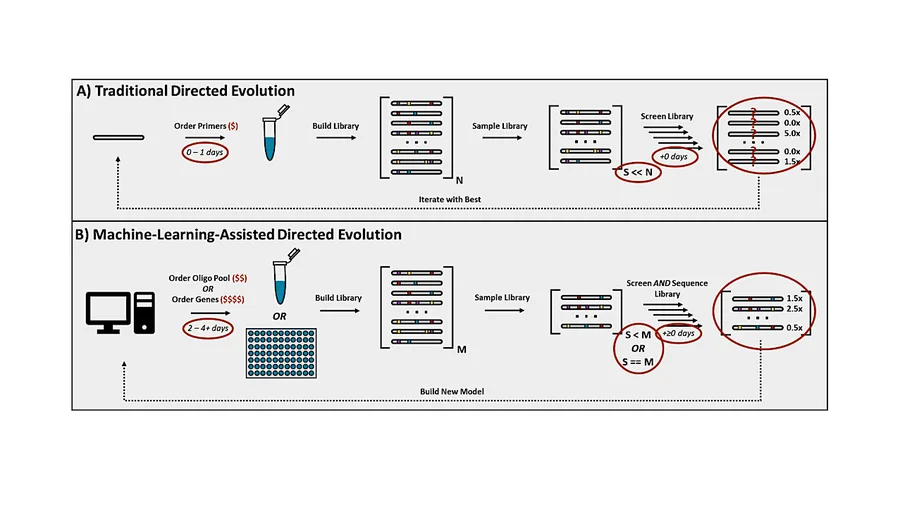
Nature Microbiology, Published online: 01 May 2026; doi:10.1038/s41564-026-02346-y The lytic selection and evolution (LySE) system uses a plasmid-encoded, hypermutagenic T7 DNA polymerase and T7 phagemid-encoded target genes to enable controllable, near-continuous directed evolution of large gene clusters.
American scientists have announced plans to resurrect an extinct antelope species using Jurassic Park technology. Dallas-based Colossal Biosciences has revealed the bluebuck, which vanished more than two centuries ago, will become the sixth creature in its de-extinction programme. The company is already working to revive three other mammals: the woolly mammoth, the dire wolf and the thylacine, co…
Paramecium bursaria is widely cultured using undefined plant-based infusions such as lettuce extract, yet the variable composition of these media remains a major obstacle to experimental reproducibility and microbiome research. Here, we tested whether a chemically defined synthetic algal medium (AF-6) can replace conventional lettuce infusion while maintaining host physiology and associated micro…
Using AI tools, the team reworked part of the ribosome to need one less amino acid.
Nature, Published online: 30 April 2026; doi:10.1038/d41586-026-01396-w AI-guided redesign of protein alphabet in bacteria could unlock new ways to build synthetic organisms.
An engineered E. coli strain survived after one amino acid was designed out of many of its ribosomal proteins—an early test of whether life’s chemistry can be simplified
Systematic perturbation of cultures of K. phaffii by carbon co-feeding show gene signatures associated with production of recombinant proteins Acharya, Raghav; Hinckley, Joshua; Barry, Rachel; Cha, Eugenie; Narayanan, Harini; Sunday, Brittney C; Ford, Hayley; Whittaker, Charles A; Love, J Christopher Background Demand for recombinant proteins is rapidly growing, driven by their use as biotherapeu…
Nature, Published online: 30 April 2026; doi:10.1038/d41586-026-01226-z Venter redrew the boundaries of biology — sequencing DNA at unprecedented speed, engineering synthetic life and charting ocean microbes.
Craig Venter has died aged 79. He was at the forefront of sequencing the human genome and of synthetic biology, but divided opinion in how he went about it
Nature Communications, Published online: 30 April 2026; doi:10.1038/s41467-026-72499-1 Lipid nanoparticle formulation requires a mixing step which can impact performance. Here, the authors report on a study into the differences different mixing techniques have showing that hand pipetting and microfluidic mixers produce different lipid nanoparticles to commercial turbulent flow mixers
Human systems immunology is using multi-omics, single-cell tools, spatial technologies, and AI to decode immune responses across real-world human cohorts. The review highlights major opportunities for biomarker discovery and precision medicine, while stressing the need for rigorous study design, validation, and careful interpretation.
New technology enables the insertion of a large segment of DNA into a genome, potentially expanding gene therapy treatment from cancellation of disease-causing mutations to replacement of an entire gene, scientists say.

On March 27–29, the 2026 edition of the iGEM Startups BioHackathon brought together 330 participants across 30 teams for a weekend of ideation, collaboration and pitching.

Fermeate has closed a $2 million Seed round led by Newfund Capital, with participation from SOSV, Ajinomoto Group Ventures, Ki Tua Fund, Heuristic Capital Partners, Momentum Capital, Plug & Play, Tesserakt Ventures, and Ag Startup Engine. The post Fermeate Raises $2 Million Seed Round to Deploy Optogenetic and AI-Powered Control for Industrial Precision Fermentation appeared first on iGrow News .
research.ioSign up to keep scrolling
Create your feed subscriptions, save articles, keep scrolling.