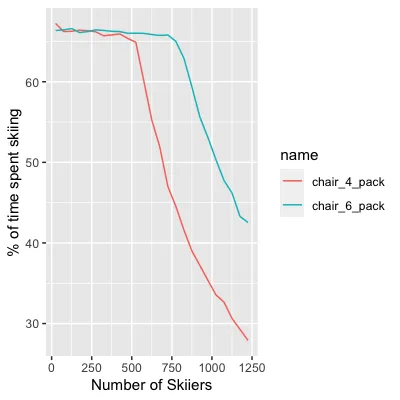
Simple Simulations for System Builders Even the most basic numerical methods can lead to surprising insights. It’s no secret that I’m a big fan of formal methods. I use P and TLA+ often. I like these tools because they provide clear ways to communicate about even the trickiest protocols, and allow us to use computers to reason about the systems we’re designing before we build them 1 . These tools…
The Case Against Formal Verification, 50 Years Later
Engineers are getting excited about software verification! This may come as a surprise, since verification has long been considered useful only in very niche cases (at best; and impractical, useless or a complete waste of time at worst). Yet, the hype around it is clearly here: Google Trends shows a large spike in searches for formal verificati…
Why verify agent governance at all? Multi-agent systems are hard to reason about. A circuit breaker that "should" kick in, a state machine that "should" never skip a state — these are the kind of things you can prove, not just hope. Over the past year we've built multi-agent systems on CrewAI, AutoGen, and LangGraph. Getting agents to do things was never the hard part. The hard part was the quest…
Nearly every discipline in this cluster has an expensive verification step, and that is what limits how much a model can help. Mathematics is the exception: a formal proof can be checked mechanically, in seconds, with certainty. That single property changes what a language model is allowed to be used for. What makes mathematics unusual An ordinary mathematical paper is a proof written for a human…
Galois’s mission is to help make the critical systems that the world relies on more secure and trustworthy. Over the years, we’ve put our team’s deep expertise in software correctness, cryptography, digital engineering, and machine learning to work, providing formal assurance for complex systems in high stakes contexts for both government and commercial clients. From militaries to financial insti…
At Galois, we’re always looking for better ways to build reliable systems. A big part of that is doing our own research. At 130 people, we’re one of the world’s largest formal methods research teams! But another part of our work is understanding new tools and techniques from the research community. We’re interested in solving problems using any approach that works, including learning from other f…
Rust's ownership type system prevents memory errors in safe code, but certain desirable properties remain orthogonal to compilation: the soundness of unsafe operations (e.g., raw pointer dereferences), functional correctness, and absence of runtime panics. We present Kani, an open-source model checker for Rust that pushes bounded model checking beyond bug-finding to provide correctness guara…
OpenAI has published Ten Advances in Mathematics and Theoretical Computer Science , a release that combines a 249-page manuscript of ten claimed results with Lean 4 certificates and model-generated reasoning walkthroughs. The package is notable not only for its range of mathematical and computer-science topics, but for making formal verification artifacts available alongside the written arguments…
Researchers from MIT, Google, and University of Washington published a technical paper titled “Granite: A Modular Methodology for Foundational Verification of Hardware-Software Leakage Contracts.” Abstract Excerpt: “Granite is a methodology for modular verification of both functional correctness and nonleakage of RTL processors against ISA contracts. We prove that the cycle-by-cycle timing of a p…
I saw this question on the Software Engineering Stack Exchange: What are the barriers that prevent widespread adoption of formal methods? The question was closed as opinion-based, and most of the answers were things like “its too expensive!!!” or “website isn’t airplane!!!” These are sorta kinda true but don’t explain very much. I wrote this to provide a larger historical picture of formal method…
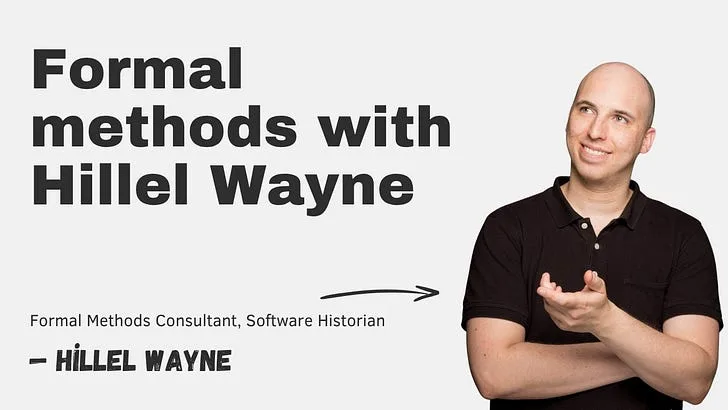
Hillel Wayne explains why formal methods like TLA+ matter, how they help build reliable software, and whether AI will finally bring formal verification into the mainstream.
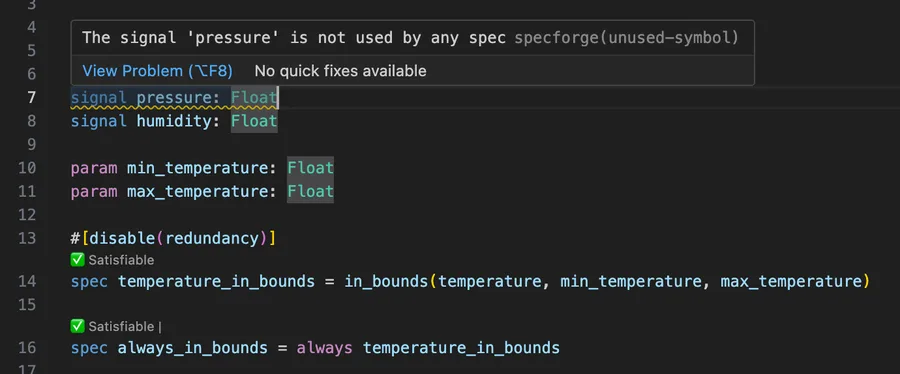
This section is a quick introduction to SpecForge’s main capabilities through a hands-on example. We’ll explore how to write specifications in the Lilo language and analyze them using SpecForge’s VSCode extension.
Lilo is an expression-based temporal specification language designed for hybrid systems. Here are the key concepts:
Primitive Types: Bool, Int, Float, and String
Operators: Standard ari…
Software specifications and their implementations tend to drift apart over time. A specification is written once; the implementation is built, maintained, and modified separately — and the two slowly diverge. This gap is a routine source of costly failures, compliance issues, and audit findings, not just a documentation nuisance. TRIEL is an open specification language that treats specification-t…
Your type checker may be wrong - an introduction to formal proof verification and the Curry-Howard Correspondence
Contents
When writing code many of us have been saved time and time again by type checkers: the useful piece of software that ensures you aren’t adding a string to an integer 1 or returning a reference to a value instead of the owned value. However, while useful, and sometimes annoyin…






 research.io