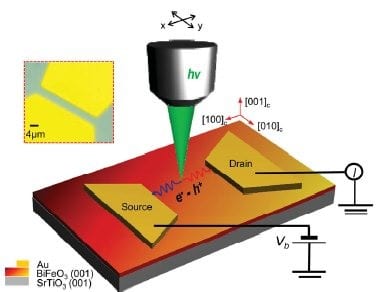
Nature Electronics, Published online: 12 August 2026; doi:10.1038/s41928-026-01680-7 The emergence of two-dimensional ferroelectrics has challenged established theories of ferroelectricity and offered routes to novel devices. However, distinguishing ferroelectric behaviour from artefacts remains an experimental challenge.
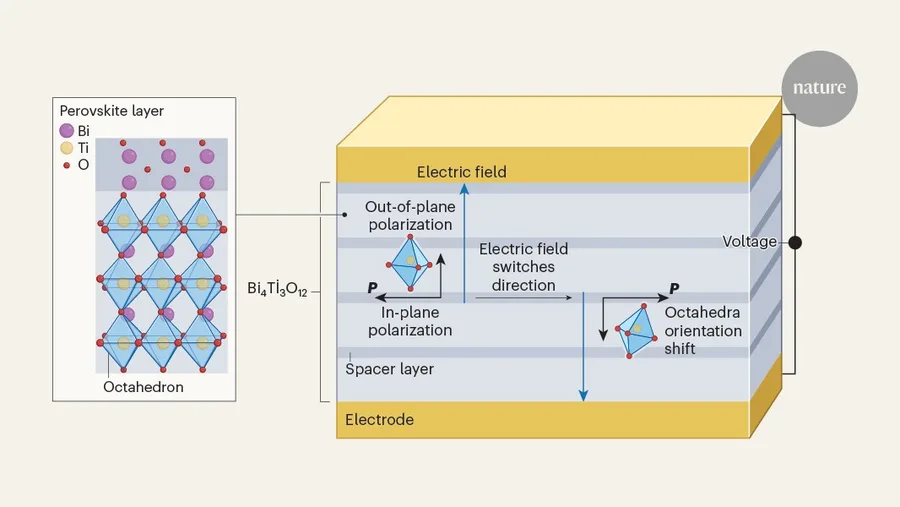
Nature, Published online: 29 July 2026; doi:10.1038/d41586-026-02127-x Coupling between horizontal and vertical electric polarization enables an unconventional ferroelectric material to be controlled using standard device geometry.
Nature, Published online: 29 July 2026; doi:10.1038/s41586-026-10839-3 Perpendicular switching of the polarization state in the layered ferroelectric Bi4Ti3O12 is demonstrated by means of trilinear coupling, allowing manipulation of the in-plane polarization component with an out-of-plane electric field.
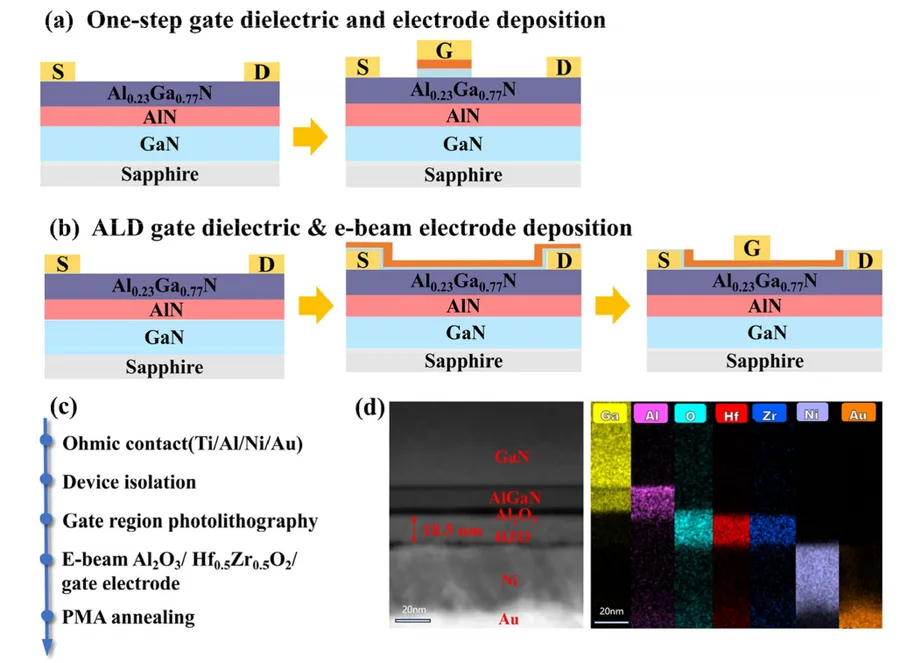
Nature Electronics, Published online: 21 July 2026; doi:10.1038/s41928-026-01673-6 A ferroelectric capacitor with a 3-nm-thick hafnium zirconium oxide layer
Nature Communications, Published online: 20 July 2026; doi:10.1038/s41467-026-75708-z The authors construct tungsten bronze–perovskite composites with a SiO₂ coating, forming a dual-core-shell architecture. This design yields a high energy density of 23.2 J/cm³ and 92.8% efficiency in multilayer ceramic capacitors, due to enhanced polarization and breakdown strength, alongside excellent thermal a…
Nature Electronics, Published online: 06 July 2026; doi:10.1038/s41928-026-01665-6 By breaking the symmetry of a Ruddlesden–Popper ferroelectric material, an out-of-plane dielectric material with high tunability and low loss can be fabricated.
Nature Chemistry, Published online: 28 May 2026; doi:10.1038/s41557-026-02168-9 Organic ferroelectrics typically exhibit modest polarization and high coercive fields, which limit their performance. Now a donor–acceptor cocrystal in which V-shaped donor molecules assemble into a gear-like packing motif has been developed; this architecture enables low-barrier in-plane molecular rotations that enha…
Nature Communications, Published online: 27 May 2026; doi:10.1038/s41467-026-73750-5 There are several examples of ferroelectric altermagnetic materials; however, it remains an active question as to whether an electric polarization can be induced by altermagnetic spin ordering. Here, Guo, Xu and coauthors demonstrate a link between the electric polarization vector and the altermagnetic Néel order…
A long-standing mystery in materials science is beginning to unravel as researchers directly probe the hidden atomic complexity of relaxor ferroelectrics. Relaxor ferroelectrics have been used for decades in technologies such as ultrasound equipment, microphones, and sonar systems. Their unusual behavior is rooted in their atomic structure, but researchers have long been unable to measure [...]
Nature Communications, Published online: 22 April 2026; doi:10.1038/s41467-026-71802-4 A room-temperature ferroelectricity with out-of-plane polarization is disclosed in chemical vapor deposition synthesized two-dimensional α-MnS, which exhibits large tunneling electroresistance, high endurance, and long retention time.
Nature Communications, Published online: 14 April 2026; doi:10.1038/s41467-026-71823-z Cylindrical ferroelectric/dielectric capacitors show tunable capacitance, shifting from positive to infinite or negative by varying layer thickness. Models and simulations reveal curvature boosts capacitance via stray-field energy effects.
At the ultimate scaling limit, electronic memory would store bits of information by shifting atoms back and forth inside individual crystalline unit cells. Ferroelectric materials exhibit the electronic hysteresis required to realize this ideal. However, despite the perfect alignment between a material class and an economically important application, ferroelectric computer memory has almost zero …
Antiferroelectric materials have electrical properties that make them advantageous for use in high-density energy storage applications. Researchers have now discovered a size threshold beyond which antiferroelectrics lose those properties, becoming ferroelectric. The post Make Them Thin Enough, and Antiferroelectric Materials Become Ferroelectric appeared first on Semiconductor Digest .
We are delighted to share with you our latest collection of recently published articles focusing on Ferroelectric and Multiferroic Materials, handpicked by Associate Editor Donna Arnold. Ferroelectric and multiferroic materials continue to attract extensive attention within the literature due to the potential of these materials to have an increased impact in our everyday lives. Research […]
The existence and impact of persistent ferroelectric domains in MAPbI3 Lauren M. Garten1,*, David T. Moore1, Sanjini U. Nanayakkara1, Shyam Dwaraknath2, Philip Schulz1,3, Jake Wands4, Angus Rockett4, Brian Newell5, Kristin A. Persson2,6, Susan Trolier-McKinstry7 and David S. Ginley1,* Science Advances 25 Jan 2019: Vol. 5, no. 1, eaas9311 DOI: 10.1126/sciadv.aas9311 Abstract Methylammonium lead io…
The existence and impact of persistent ferroelectric domains in MAPbI3 Click for link Lauren M. Garten1,*, David T. Moore1, Sanjini U. Nanayakkara1, Shyam Dwaraknath2, Philip Schulz1,3, Jake Wands4, Angus Rockett4, Brian Newell5, Kristin A. Persson2,6, Susan Trolier-McKinstry7 and David S. Ginley1,* 1National Renewable Energy Laboratory, Golden, CO 80401, USA. 2Lawrence Berkeley National Laborato…
Ferroelectrics have already found applications in non-volatile random access memory (RAM) and so far the Fujitsu company has made more than 1 billion FeRAM devices (if you open up a Playstation 2, for example, you’ll find one inside). One critical, yet often overlooked, problem with ferroelectrics is leakage in which the material has a measurable dc conductivity. Leakage is tolerated to a certain…



 research.io