Curious Kids is a series for children of all ages. If you have a question you’d like an expert to answer, send it to CuriousKidsUS@theconversation.com.
Can we generate a way to interact with dark matter with current technology? – Leonardo S., age 13, Guanajuato, Mexico
That’s a great question. It’s one of the most difficult and fascinating problems right now in both astronomy and physics, because…
The 2025 Nobel Prize in physics honors three quantum physicists – John Clarke, Michel H. Devoret and John M. Martinis – for their study of quantum mechanics in a macroscopic electrical circuit.
Since the prize announcement, cheers and excitement have surrounded the home institutions of these laureates in Berkeley, Santa Barbara and New Haven.
The award of this prestigious prize to pioneering rese…
A clever mathematical tool known as virtual particles unlocks the strange and mysterious inner workings of subatomic particles. What happens to these particles within atoms would stay unexplained without this tool. The calculations using virtual particles predict the bizarre behavior of subatomic particles with such uncanny accuracy that some scientists think “they must really exist.”
Virtual par…
Why didn’t the universe annihilate itself moments after the big bang? A new finding at Cern on the French-Swiss border brings us closer to answering this fundamental question about why matter dominates over its opposite – antimatter.
Much of what we see in everyday life is made up of matter. But antimatter exists in much smaller quantities. Matter and antimatter are almost direct opposites. Matte…
Physicists are always searching for new theories to improve our understanding of the universe and resolve big unanswered questions.
But there’s a problem. How do you search for undiscovered forces or particles when you don’t know what they look like?
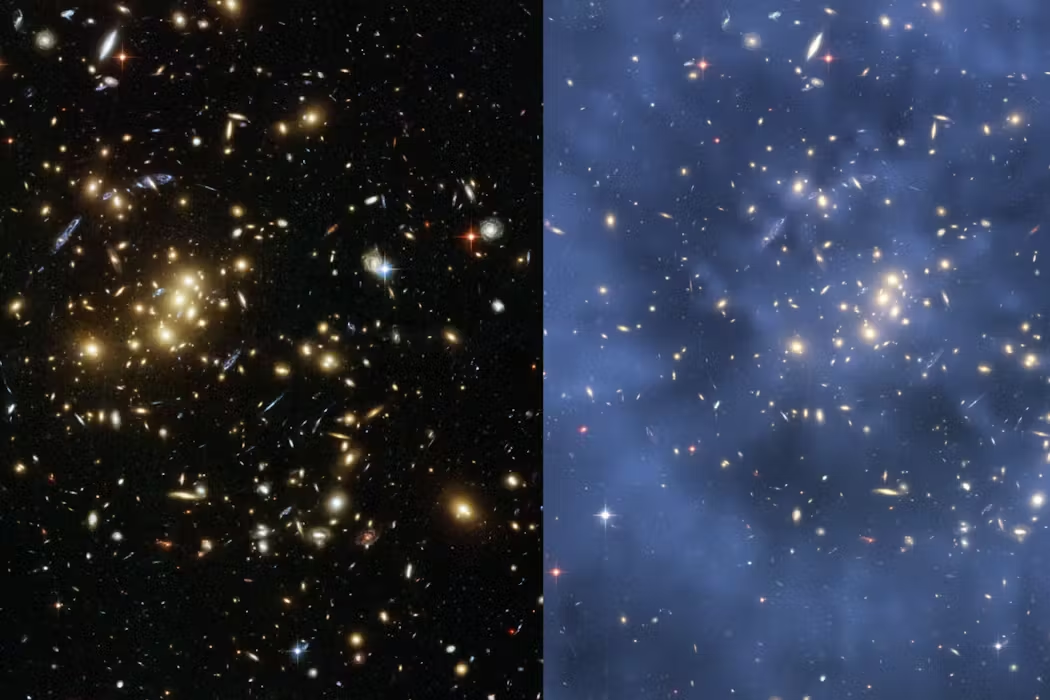
Take dark matter. We see signs of this mysterious cosmic phenomenon throughout the universe, but what could it possibly be made of? Whatever it is, …
Medieval alchemists dreamed of transmuting lead into gold. Today, we know that lead and gold are different elements, and no amount of chemistry can turn one into the other.
But our modern knowledge tells us the basic difference between an atom of lead and an atom of gold: the lead atom contains exactly three more protons. So can we create a gold atom by simply pulling three protons out of a lead …
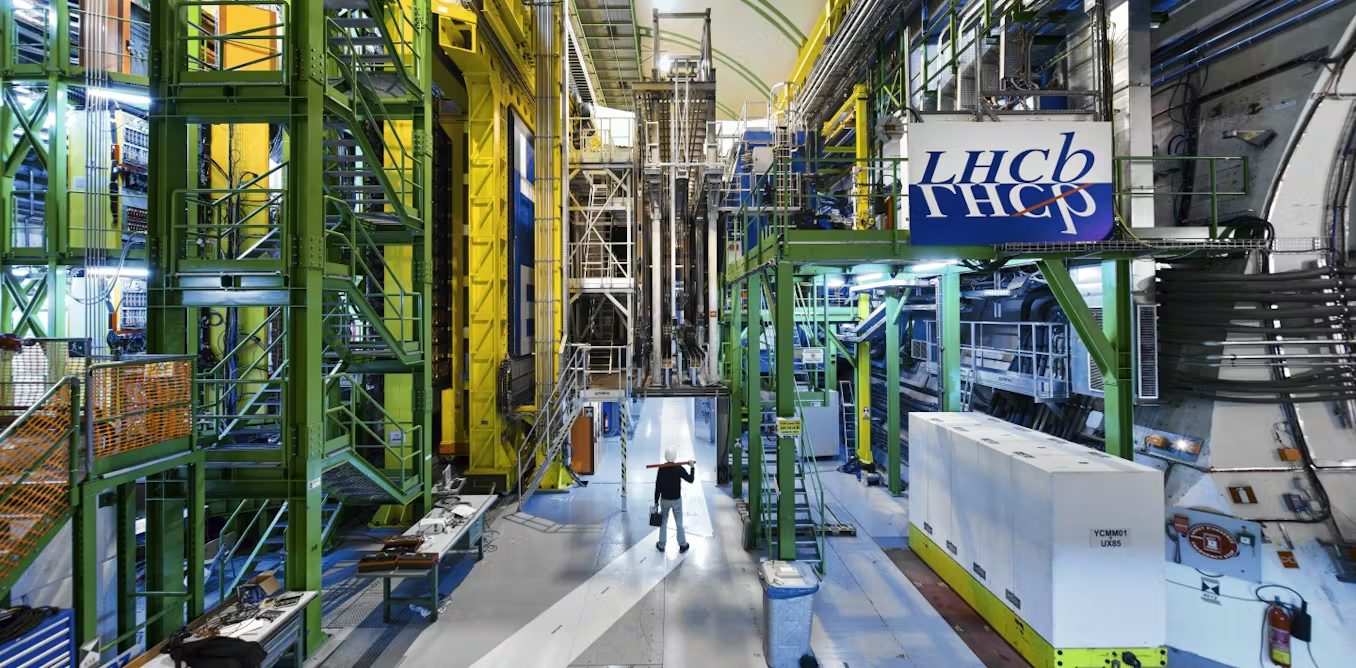
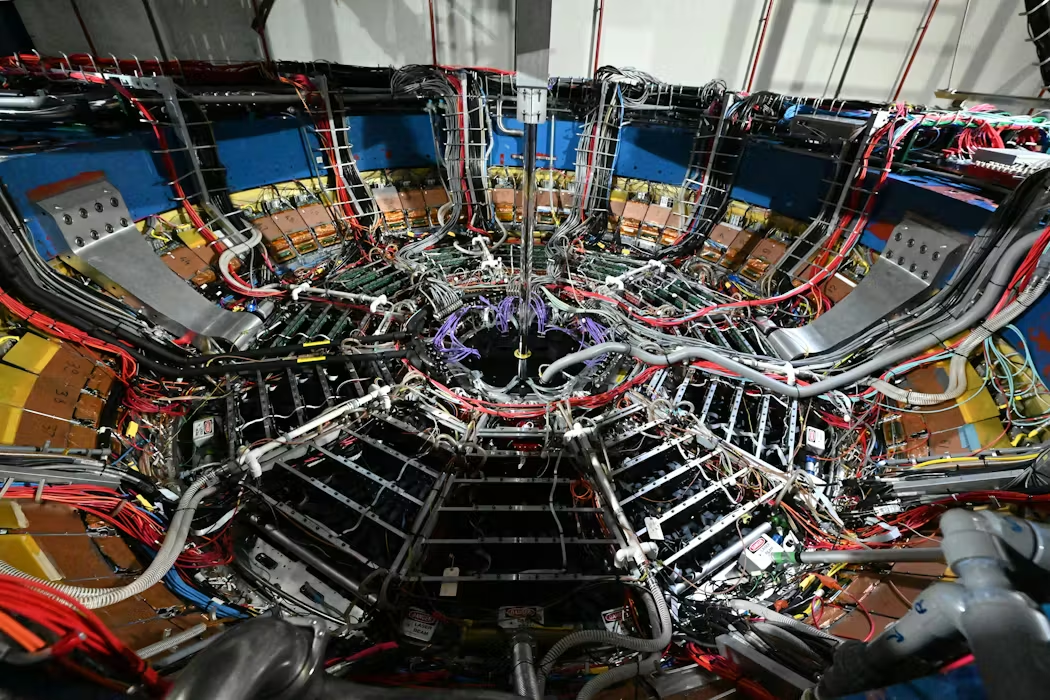
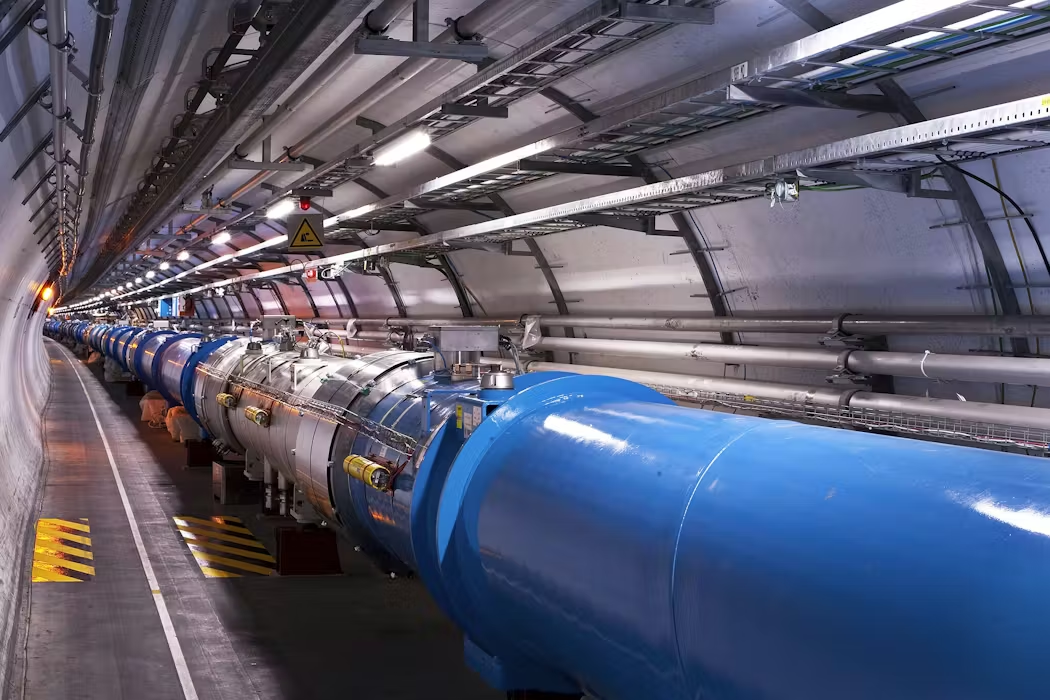
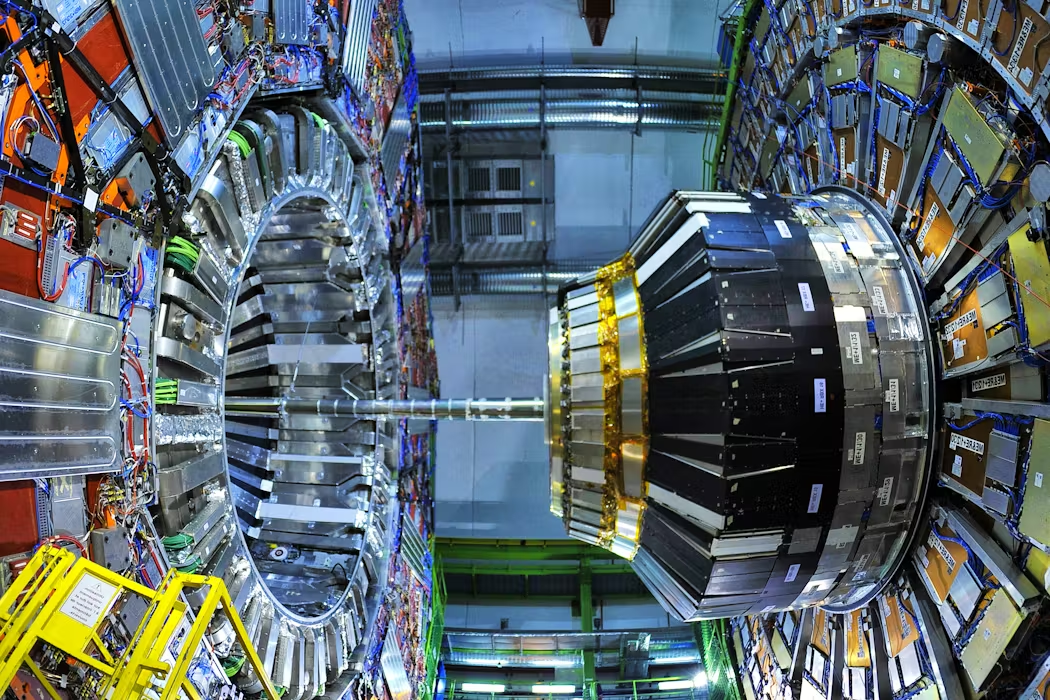
The Large Hadron Collider has been responsible for astounding advances in physics: the discovery of the elusive, long-sought Higgs boson as well as other new exotic particles, possible hints of new forces of nature, and more.
Located at the European Organization for Nuclear Research (CERN) on the border of France and Switzerland, the LHC is expected to run for another 15 years. Nevertheless, phys…
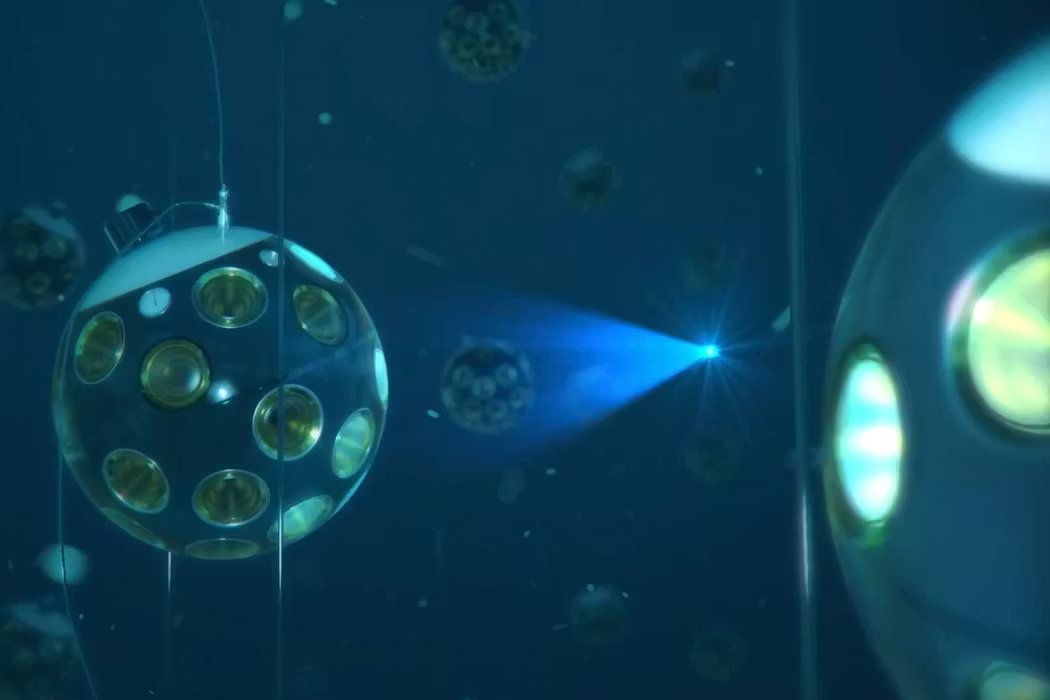
Three and a half kilometres beneath the Mediterranean Sea, around 80km off the coast of Sicily, lies half of a very unusual telescope called KM3NeT.
The enormous device is still under construction, but today the telescope’s scientific team announced they have already detected a particle from outer space with a staggering amount of energy.
In fact, as the team report in Nature, they found the most…
One of the most surprising predictions of physics is entanglement, a phenomenon where objects can be some distance apart but still linked together. The best-known examples of entanglement involve tiny chunks of light (photons), and low energies.
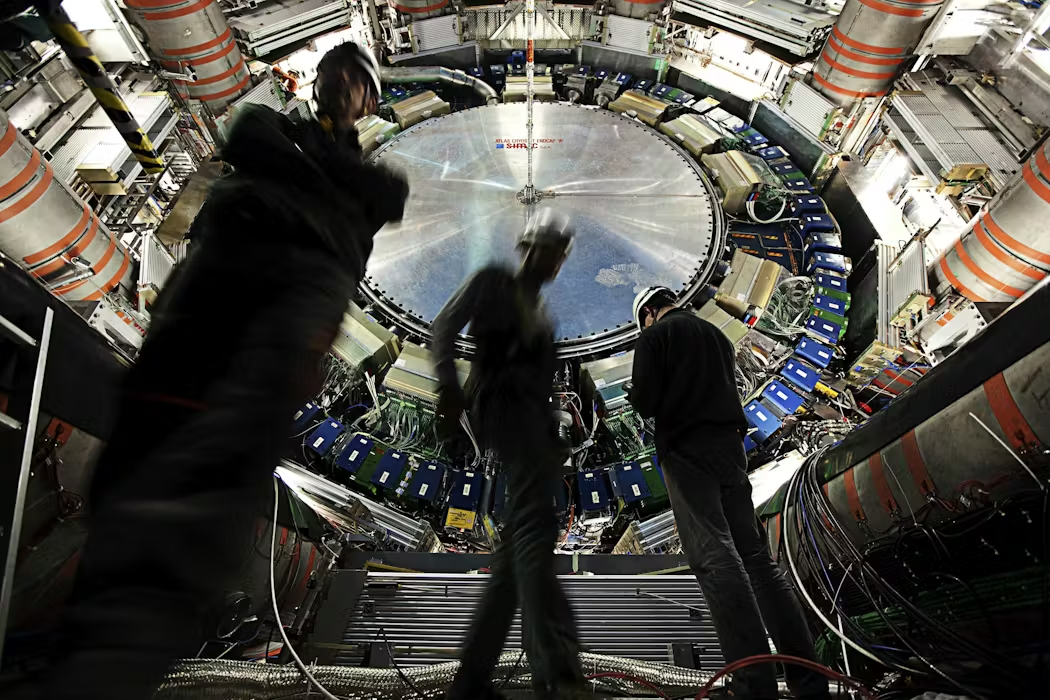
At the Large Hadron Collider in Geneva, the world’s largest particle accelerator, an experiment called ATLAS has just found entanglement in pairs of top …
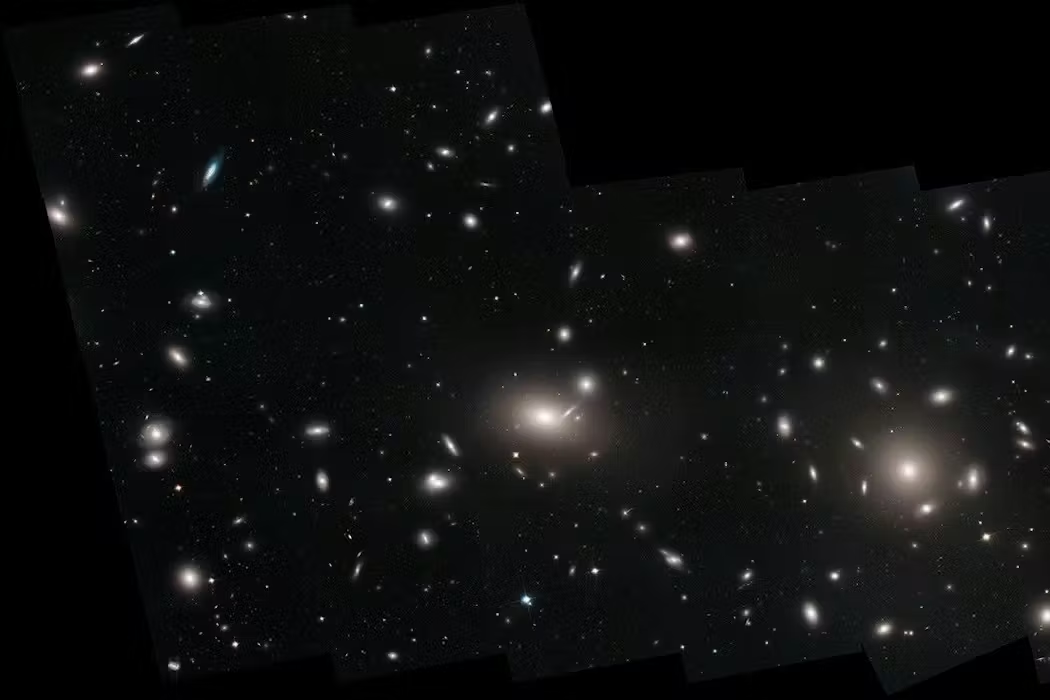
Most of the matter in the universe is missing. Scientists believe around 85% of the matter in the cosmos is made of invisible dark matter, which has only been detected indirectly by its gravitational effects on its surroundings.
My colleagues and I – a team of some 250 scientists from around the world working on a dark matter experiment called LUX-ZEPLIN (or LZ) – today report our latest findings…
In experiments at the Brookhaven National Lab in the US, an international team of physicists has detected the heaviest “anti-nuclei” ever seen. The tiny, short-lived objects are composed of exotic antimatter particles.
The measurements of how often these entities are produced and their properties confirms our current understanding of the nature of antimatter, and will help the search for another …
Riccardo Maria Bianchi·...·University of Pittsburgh
7/17/2024
When you push “start” on your microwave or computer, the device flips right on – but major physics experiments like the Large Hadron Collider at the European Organization for Nuclear Research, known as CERN, don’t work that way. Instead, engineers and physicists need to take a few weeks every year to carefully reset the collider and all the experiments on it.
I’m a CERN physicist who worked with …
A ghost is haunting our universe. This has been known in astronomy and cosmology for decades. Observations suggest that about 85% of all the matter in the universe is mysterious and invisible. These two qualities are reflected in its name: dark matter.
Several experiments have aimed to unveil what it’s made of, but despite decades of searching, scientists have come up short. Now our new experimen…
About a trillion tiny particles called neutrinos pass through you every second. Created during the Big Bang, these “relic” neutrinos exist throughout the entire universe, but they can’t harm you. In fact, only one of them is likely to lightly tap an atom in your body in your entire lifetime.
Most neutrinos produced by objects such as black holes have much more energy than the relic neutrinos floa…
A giant of particle physics, Peter Wade Higgs, passed away at his home in Edinburgh on April 8 2024, having lived to 94 years. His unparalleled legacy, epitomised by the discovery of the Higgs boson, continues to profoundly shape the future of particle physics like no other discovery before it. This is the story of his legacy.
When Higgs was born in 1929, our understanding of matter was completel…
Peter Higgs, who gave his name to the subatomic particle known as the Higgs boson, has died aged 94. He was always a modest man, especially when considering that he was one of the greats of particle physics – the area of science concerned with the building blocks of matter.
In 1964, a few years after arriving from London to take up a position at the University of Edinburgh, Higgs read a paper by …
Just over a week ago, European physicists announced they had measured the strength of gravity on the smallest scale ever.
In a clever tabletop experiment, researchers at Leiden University in the Netherlands, the University of Southampton in the UK, and the Institute for Photonics and Nanotechnologies in Italy measured a force of around 30 attonewtons on a particle with just under half a milligram…
Astronomers have known for decades that the universe is expanding. When they use telescopes to observe faraway galaxies, they see that these galaxies are moving away from Earth.
To astronomers, the wavelength of light a galaxy emits is longer the faster the galaxy is moving away from us. The farther away the galaxy is, the more its light has shifted toward the longer wavelengths on the red side o…
Dennis V. Perepelitsa·...·University of Colorado Boulder
10/17/2023
One way physicists seek clues to unravel the mysteries of the universe is by smashing matter together and inspecting the debris. But these types of destructive experiments, while incredibly informative, have limits.
We are two scientists who study nuclear and particle physics using CERN’s Large Hadron Collider near Geneva, Switzerland. Working with an international group of nuclear and particle p…
nuclear-physicsparticle-physicsphysics
research.io
Sign up to keep scrolling
Create your feed subscriptions, save articles, keep scrolling.




 research.io