Burcu Coskunsu; Juha Riippi; Alexandre Halbach; Valtteri Lahtinen; Asser Lähdemäki; Andrew Tweedie
4/2/2026
This advancement in quantum algorithms could help accelerate some of the most computationally intensive simulations used in engineering today.
Helsinki, Finland - April, 2, 2026
Researchers from Quanscient, a leader in cloud-based multiphysics simulation technology and quantum algorithms, and Haiqu, a leading developer of quantum middleware, today announced a new algorithm that can significantly …
Juha Riippi; Alexandre Halbach; Valtteri Lahtinen; Asser Lähdemäki; Andrew Tweedie
3/27/2026
If you look at what is happening with AI right now in industries like law, medicine, or software development, the contributions are massive.
But those industries all share one underlying trait: the data they process is primarily text-based or code-based. AI is an expert at handling that.
Hardware engineering is different.
Historically, we have relied on siloed, proprietary CAD and computer-aided …
Burcu Coskunsu; Juha Riippi; Alexandre Halbach; Valtteri Lahtinen; Asser Lähdemäki; Andrew Tweedie
3/5/2026
Key takeaways
-
AI-driven simulation enables engineers to explore far more design possibilities than traditional simulation workflows.
-
Surrogate models make it possible to evaluate thousands of design configurations in milliseconds.
-
Visualizing the full design space helps engineers better understand trade-offs between competing performance objectives.
-
Faster simulations allow teams to exper…
Burcu Coskunsu; Juha Riippi; Alexandre Halbach; Valtteri Lahtinen; Asser Lähdemäki; Andrew Tweedie
2/13/2026
Key takeaways
-
Quantum computing does not yet replace classical HPC in engineering simulation, but it is driving meaningful research into new computational methods and hybrid workflows
-
The most realistic near-term value lies in algorithm development, benchmarking, and quantum-ready simulation strategies rather than immediate performance advantage
-
Aerospace, maritime, and automotive industrie…
Juha Riippi; Alexandre Halbach; Valtteri Lahtinen; Asser Lähdemäki; Andrew Tweedie
1/29/2026
What is inside?
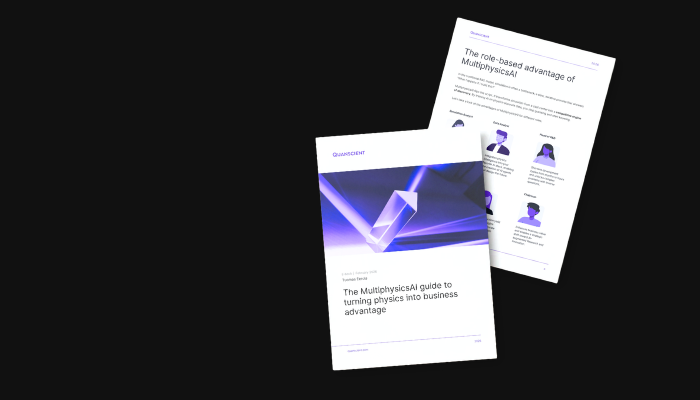
This book outlines how MultiphysicsAI can drive measurable business impact by modernizing engineering workflows and business decision-making in fast growing industries, such as automotive, aerospace, consumer devices, and medical devices.
Who is this for?
MultiphysicsAI e-book presents a practical path from traditional digital product development to scalable, democratized multiphy…
Pietro Zanotta; Juha Riippi; Alexandre Halbach; Valtteri Lahtinen; Asser Lähdemäki; Andrew Tweedie
1/27/2026
Technical contributors
Dr. Ljubomir Budinsky, Dr. Çaǧlar Aytekin, Dr. Valtteri Lahtinen
Key takeaways
-
Physics-Informed Neural Networks offer a flexible way to solve PDEs, but scalability remains a challenge
-
Separable PINNs reduce the dimensionality burden, yet dense matrix operations still dominate cost
-
Quantum Orthogonal SPINNs use quantum circuits as orthogonal quantum layers in the netwo…
Juha Riippi; Alexandre Halbach; Valtteri Lahtinen; Asser Lähdemäki; Andrew Tweedie
1/27/2026
Key takeaways
-
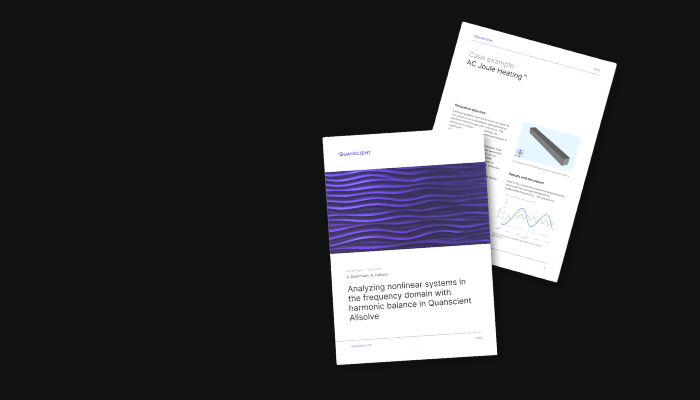
Nonlinear systems are common in real-world applications and are often hard to analyze with traditional transient methods, which can be slow and noisy.
-
The harmonic balance method provides a faster, more accurate way to analyze these systems by breaking their behavior into simple, periodic patterns, including those caused by system complexity.
-
Cloud-based multiphysics simulatio…
Juha Riippi; Alexandre Halbach; Valtteri Lahtinen; Asser Lähdemäki; Andrew Tweedie
1/25/2026
Key takeaways
-
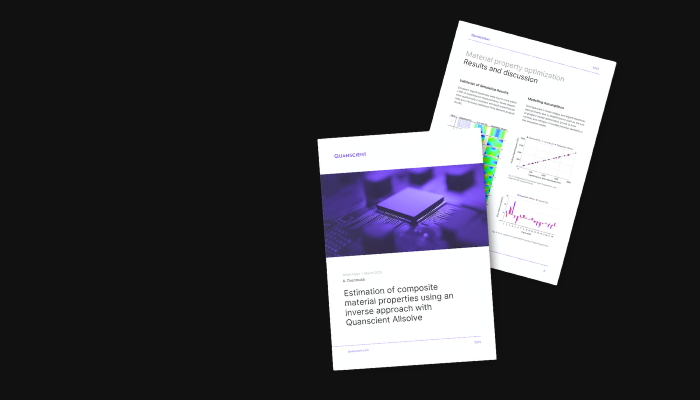
Inverse problems help estimate material properties by minimizing the difference between simulations and experimental data.
-
With an API-driven workflow, Quanscient Allsolve automates this process, reducing manual work and speeding up optimization.
-
Quanscient Allsolve runs simulations in the cloud with parallel computing, significantly reducing processing time.
-
The optimized m…
Juha Riippi; Alexandre Halbach; Valtteri Lahtinen; Asser Lähdemäki; Andrew Tweedie
1/24/2026
Key takeaways
-
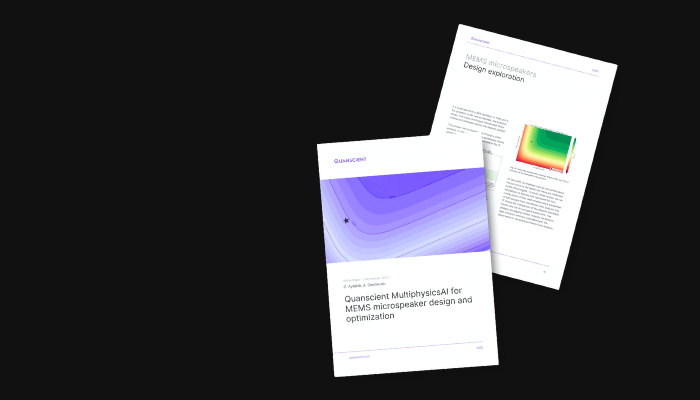
Quanscient Allsolve MultiphysicsAI integrates high-performance multiphysics simulation with AI to accelerate inverse design.
-
Thousands of simulations and a highly accurate surrogate enable near-instant exploration of design trade-offs.
-
Engineers gain clear visibility into feasible performance boundaries and maintain full control over design choices.
-
AI-generated results are …
Juha Riippi; Alexandre Halbach; Valtteri Lahtinen; Asser Lähdemäki; Andrew Tweedie
1/24/2026
Key takeaways
-
MultiphysicsAI integrates neural surrogate models with conventional multiphysics solvers to accelerate engineering design workflows.
-
Neural surrogates allow rapid evaluation of large numbers of design configurations at minimal computational cost.
-
Candidate designs identified by surrogates are verified with full solvers to ensure physical accuracy.
-
The approach enables explor…
Burcu Coskunsu; Juha Riippi; Alexandre Halbach; Valtteri Lahtinen; Asser Lähdemäki; Andrew Tweedie
1/16/2026
Guest Author
Pietro Zanotta
Quantum Engineering Intern
Introduction
Last summer, Pietro Zanotta joined Quanscient as a Quantum Engineering Intern. At the time, he had just completed his bachelor’s degree and was preparing to start his PhD, making the internship a natural transition point in his academic and professional journey.
During his time at Quanscient, Pietro worked with the Quantum Algori…
Burcu Coskunsu; Juha Riippi; Alexandre Halbach; Valtteri Lahtinen; Asser Lähdemäki; Andrew Tweedie
11/25/2025
Quanscient has released MultiphysicsAI, a new approach that turns high-quality simulation data into AI-driven insights, allowing engineers to explore design options faster and more confidently. By generating proprietary datasets from Quanscient Allsolve simulations, the system enables AI models to map trade-offs and identify the most promising designs across complex engineering spaces.
Traditiona…
Juha Riippi; Alexandre Halbach; Valtteri Lahtinen; Asser Lähdemäki; Andrew Tweedie
11/18/2025
Most teams still run simulations to check what one design will do.
But product decisions aren’t made one design at a time, they’re made across trade-offs, timelines, and constraints.
The missing piece has been fast, trustworthy data to illuminate the entire design space, not just a handful of points.
Today, we’re changing that.
The problem we kept hearing
Traditional tools tell you what a design …
Juha Riippi; Alexandre Halbach; Valtteri Lahtinen; Asser Lähdemäki; Andrew Tweedie
11/17/2025
AI + Multiphysics: Introducing the new paradigm for engineering simulation
Join the exclusive launch and see how natively coupled multiphysics algorithms, cloud computing, and AI enable a new way to simulate.
Nov 17, 2025
3 pm GMT, 10 am US East · 60 minutes
Juha Riippi Co-founder & CEO & Dr. Andrew Tweedie Co-founder & co-CTO · Quanscient
AI + Multiphysics
Introducing the new paradigm for engine…
Juha Riippi; Alexandre Halbach; Valtteri Lahtinen; Asser Lähdemäki; Andrew Tweedie
11/1/2025
Simulating quench behavior in superconducting films at Wihuri Physical Laboratory
Quanscient Allsolve is a very intuitive and comprehensive simulation tool that can help to tackle the difficult non-linear properties of superconductors.
Superconductors / Materials science research
The research group at Wihuri Physical Laboratory needed to simulate quench behavior in superconducting YBCO thin films…
Juha Riippi; Alexandre Halbach; Valtteri Lahtinen; Asser Lähdemäki; Andrew Tweedie
10/21/2025
Accelerating nonlinear MEMS simulations with the harmonic balance method
See how harmonic balance is leveraged for solving nonlinear periodic problems in frequency domain for quicker, more precise results without transient analysis.
Trusted by both industry and academia
The key benefits presented
Stop waiting on endless runs
When a single simulation takes more than a week, everything else gets st…
research.io
Sign up to keep scrolling
Create your feed subscriptions, save articles, keep scrolling.









 research.io