Botany Professor
No, yes, maybe. A species is typically defined as a population, or group of populations, that can be recognized and distinguished from other such populations by a distinctive set of characteristics, and which is reproductively isolated from other such populations. Whether two populations of related organisms are classified as belonging to a single species or to two separate species is a decision …
Wednesday, February 12, 2025 The Problem with Wookiees When making up alien creatures, imagination has no bounds. Alien characters in sci-fi stories are most commonly human-like, but with animal features. But be they scary, funny, or loyal comrades-in-arms, they exist purely for entertainment. We might laugh at the absurdity of a giant slug-like creature with a human face slithering around on a d…
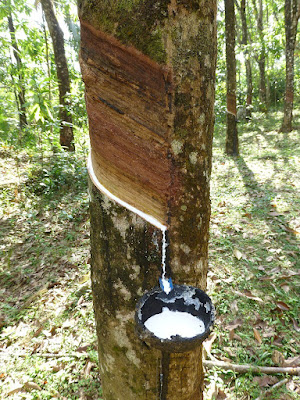
Kicking the plastic habit - What about Silicone or Rubber? In my previous post, I neglected to mention two other materials that might replace some plastic use - silicone and rubber. Are they any better? The short answer is yes, but with some important qualifications. Neither is made from fossil fuels, and so that is a plus. Both are less toxic to us and our environment, and neither breaks down in…
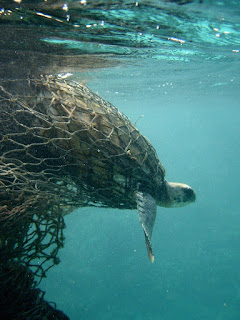
I was recently on the expedition class Viking Octantis for a cruise along the Chilean coast. The ship staff included a team of scientists and naturalists who were actively investigating environmental changes in the oceans while engaging and educating the ships passengers. One lecture dealt with the issue of plastics in the oceans, which now pollute even Antarctic waters and coastlines. That sober…
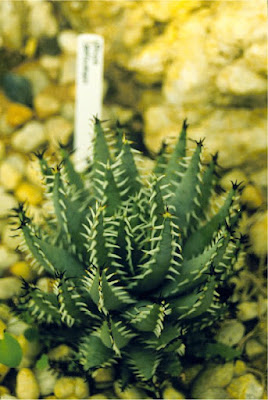
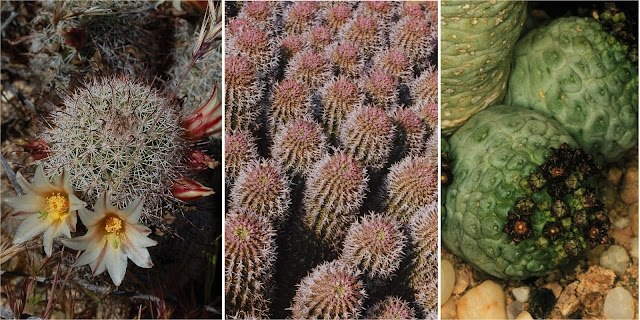
I've spoken of this a number of times on this site, as succulents in general are a spectacular example of convergent evolution and the all-important process of adaptation. I've been retired for a number of years, but if were to go back into the biology classroom again today, I would walk up to the front and write ADAPTATION on the board (or powerpoint screen!). I would then proceed to show how ev…
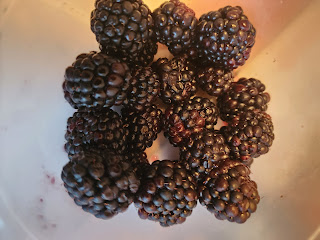
In terms of the teaching of botany and evolution, however, the similarities and differences between the two berries tell a powerful story. Though they function the same way in natural fruit dispersal, they are not related at all. Blackberries are members of the the very fruitful family, Rosaceae, which includes raspberries, strawberries, plums, cherries, peaches, apricots, apples, pears, rose hip…
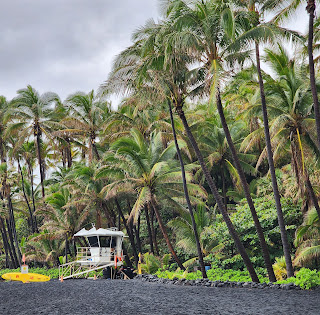
While these factors may contribute somewhat to the ultimate shape of the mature palms, I'd like to point to a more fundamental factor: the phase of development that all palms go through after germination called establishment growth. This is something peculiar to tree-like monocots, which have neither a taproot system nor layered secondary growth. In dicotyledonous trees, stem thickness increases …
As plant life evolved, several major breakthroughs allowed them to greatly expand their footprint across the globe. These breakthroughs were major macroevolutionary shifts brought about by a series of small microevolutionary adaptations. The essential characteristics of Plants are each associated with one or more of these major breakthroughs. Such events are described in more detail in Plant Life…
A weed is sometimes defined as a plant out of place - or more often an overwhelming mass of plants popping up where we don't want them. It's a definition based on our futile attempts to to remake a landscape into something a human vision of tidiness. To be fair weeds are often exotic plants - invasive species from another continent freed from their usual constraints of competitors and predators. …
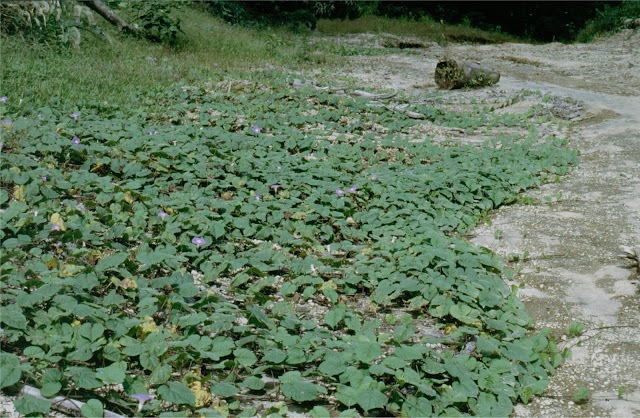
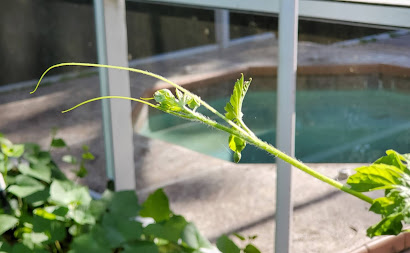
Tuesday, August 4, 2020 Grasping at Straws Vining plants have an amazing ability to grab onto a trellis, fence, or a twig on another plant by curling around it. It's an adaptation that allows the vine to grow rapidly upward using other objects for support. This gives them a distinct advantage over tree or shrub saplings that need to build their own woody support as they grow upwards. But how does…
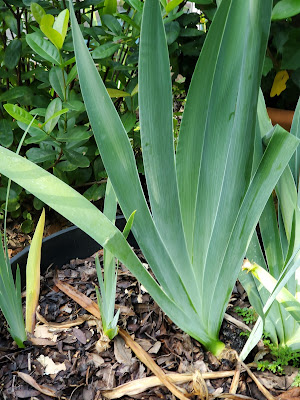
But what's most interesting in the Iris is that the leaves are folded, with the two sides fused together into a seemingly simple structure. It's as if someone has taken a hot iron and pressed the whole clump of leaves into a flat sheet in preparation for mounting in a herbarium. You can see such leaves in many members of Iris, Gladiolus, and related genera. It has evolved independently in unrelat…
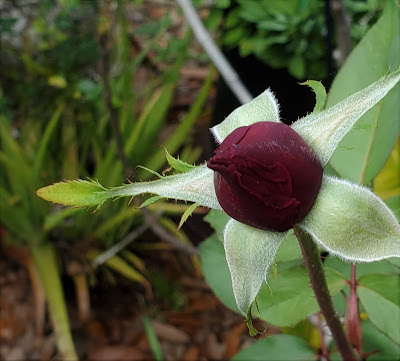
Sunday, May 3, 2020 The Leafy Origins of Sepals From an evolutionary point-of-view, it is generally accepted that the parts of the flower originated as modified leaves. Though there is controversy about the nature of the earliest carpels and stamens, the leaf-like nature of petals and sepals is abundantly evident. Sepals are generally the most leaf-like, no doubt because they are the most recentl…
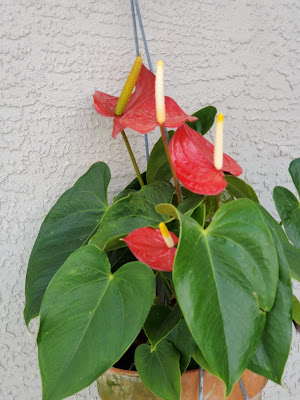
It has been speculated that the red to orange spathes in wild plants help birds find the ripe fruits, which they would eat, fly off, and thereby disperse the seeds. It's a common dispersal adaptation, found even in the most archaic of angiosperms (e.g. Amborella), and it may very well be true in this species, as well as many other species of Anthurium. In all members of the Aroid family, flowers …
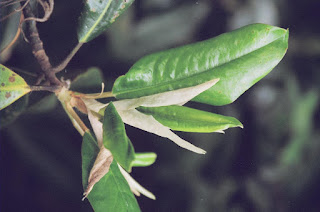
to result in a mind-boggling variety of shapes. Through evolution via adaptive modification, leaves form an endless array of light-gathering antennas, from the giant fronds of palms to the tiny scales of a juniper twig, but beyond that, have adapted into tendrils, insect-catching traps, and even the parts of the flower. Today, I'm talking about leaves, or parts of leaves, that form wrappers aroun…
So it is surprising to hear for the first time that wildfires are natural and necessary in many ecosystems. They become bad basically only because of our own interference. Ecosystems in which fires are a normal part of maintenance or renewal are those in which there are distinct wet seasons and dry seasons. During the wet season, there is abundant growth of trees, shrubs, grasses, and other herbs…
In both cases, these lineages branched off very early, over 100 million years ago, but have left no fossils, and have no close living relatives. The Amborella branch is the earliest surviving lineage of angiosperms in general, while the Acorus branch is the earliest surviving lineage of monocots. Expressed in a different way, Amborella is the sister group to all other angiosperms, and Acorus is t…
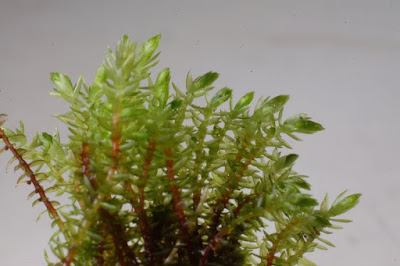
Wednesday, September 18, 2019 Guide to the mosses of central Florida I have spent much time in the past few years studying the mosses of central Florida and posting portraits of the common species. This work has culminated in a Guide and Interactive key, which has now been posted as part of the Atlas of Florida Plants..You can find the link on the Atlas home page, in the right column. The guide i…
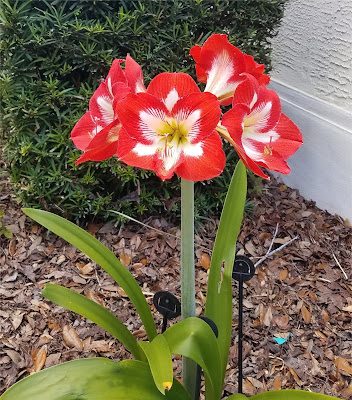
the marvelous family to which they belong, and how nicely they represent a fascinating aspect of plant evolution. The Amaryllis family is known and beloved worldwide, even by people unfamiliar with its technical name or taxonomy, for it provides us with a variety of unique spring-flowering bulbs and perennials, from daffodils to subtropical amaryllis and tropical Crinums. As presently defined, Am…
The species characteristically forms tiny reproductive tubers or bulbils along the rhizoids in the soil or in the axils of the leaves. Bulbils are brown, pear-shaped, and 40-80 µm long. I have not yet seen spore capsules in our area. Gemmabryum apiculatum is probably to be found throughout the state, as it is found in coastal regions of other southeastern states, though our documented specimens a…
research.ioSign up to keep scrolling
Create your feed subscriptions, save articles, keep scrolling.