I was curious how people got into neuroscience. Random happenstance? A lifelong love of gap junctions? So I asked about it on twitter and got hundreds of responses.
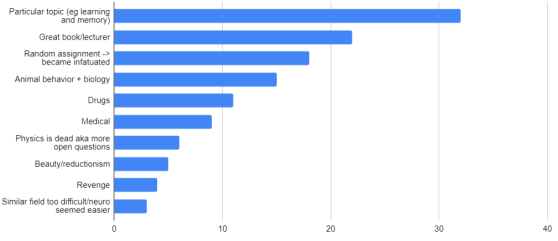
I did a quick analysis of about half the responses, putting them in different categories. It quickly became clear that certain themes were popping up again and again:
It doesn’t surprise me too much that a lot of people became interes…
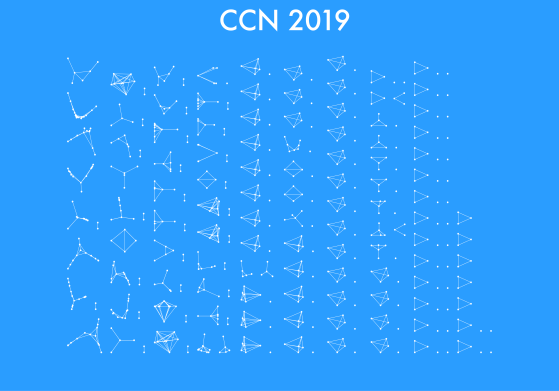
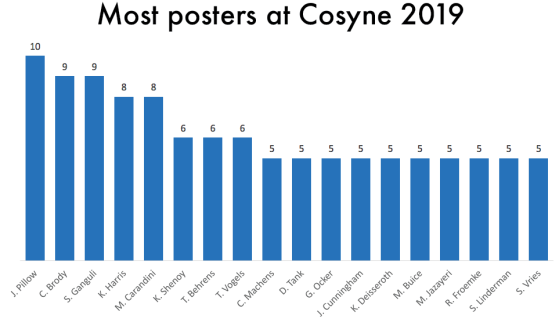
I am in Berlin for the Cognitive Computational Neuroscience (CCN) conference. It is an interesting collection of people working on more human (though some animal) cognitive neuroscience, often using neural network models. In its third year, CCN is an interesting contrast to Cosyne, a conference more focused on traditional systems neuroscience along with computational modeling.
While I’m here, I t…
At a meeting in New York last week [edit: many months ago by the time I got around to posting this], we were discussing the recent push in neuroscience for more naturalistic behaviors. One of the problems, someone pointed out, is that they are difficult to analyze. But surely there must be whole fields devoted to understanding natural behaviors? Why do we, as neuroscientists, not interact with th…
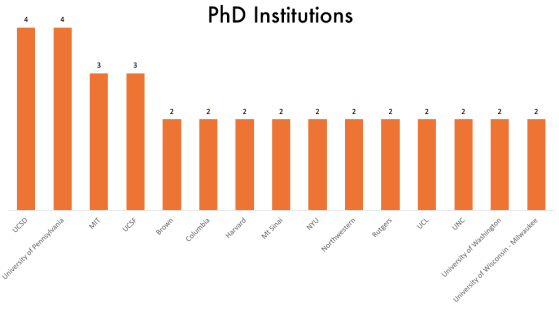
For the past two years, I tried to crowd-source a complete list of everyone who got hired into a neuroscience faculty job over the previous year. I think the list has almost everyone who was hired in the US… let’s see if we can do better this year?
I posted an analysis of some of the results here – one of the key “surprises” was that no, you don’t actually need a Cell/Nature/Science paper to get …
As some of you might know, there’s been a lot of tumult surrounding this year’s Cosyne (Computational and Systems Neuroscience) conference. The number of submissions skyrocketed from the year before and the rejection rate went from something like 40% to something like 60% – there were over 1000 abstracts submitted! Even crazier, there is a waitlist to even register for the conference. So what has…
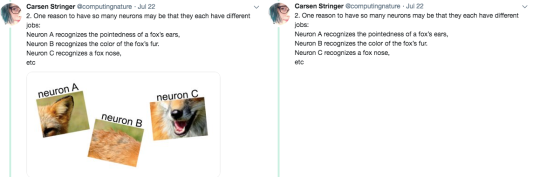
Everyone should tweet about their science. Not only will other scientists on Twitter see it, but plenty of other scientists who are not active on Twitter – but pay attention to it! – will see it as well. But the way that you write your tweet will make a huge difference in the amount of attention it gets. No matter how interesting your science is, no matter how finely crafted your paper is, if a t…
See last year’s post. As always, if you are a postdoc looking for a faculty job I maintain the neurorumblr with crowdsourced information on open jobs + helpful information. You should also add yourself to The List which lets faculty search committees contact you. … Continue reading →
Some rough notes from a personal attempt to clarify my own thinking. Consider this a work-in-progress and probably wrong. Principles underlying feeling of freedom of will (note that this is different from freedom of action or actual agency): Bayesian updating (distribution … Continue reading →
Last year, I tried to crowd-source a complete list of everyone who got hired into a neuroscience faculty job over the previous year. I think the list has almost everyone who was hired in the US… let’s see if we … Continue reading →
A few people have sent this my way and asked about it: In a paper published Monday in the journal eNeuro, scientists at the University of California-Los Angeles reported that when they transferred molecules from the brain cells of trained snails … Continue reading →
Twitter thread here. Do mice use vision much? They have pretty crappy eyesight and their primary mode of exploration seems to be olfactory/whisker-based How much is mouse cortex like primate cortex? Mouse cortex is claimed to be more multimodal than … Continue reading →
The brain represents the world in particular ways. Here are a few: 1. The visual world on the retina The retina is thought to whiten images, or transform them so that they always have roughly the same average, maximum and minimum … Continue reading →
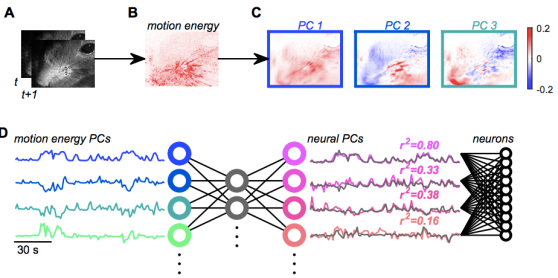
In my opinion, THE most important shift in neuroscience over the past few years has been the focus on how behavior changes neural function across the whole brain. Even the sensory systems – supposedly passive passers-on of perfectly produced pictures … Continue reading →
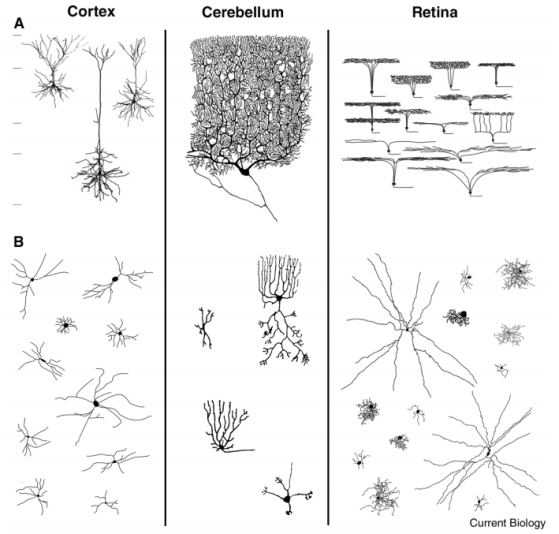
How many types of neurons are in the brain? Not just number, but classes that represent some fundamental unit of computation? I tweeted an article about this a couple days ago and (justly) got pilloried for saying it counted classes in the brain rather … Continue reading →
‘Some half-baked conceptual thoughts about neuroscience’ alert In the book Snow Crash, Neil Stephenson explores a future world that is being infected by a kind of language virus. Words and ideas have power beyond their basic physical form: they have the … Continue reading →
Janelia Farm, the research center the Howard Hughes Medical Institute recently announced their upcoming research focuses. One of them was controversial: mechanistic cognitive neuroscience. Here’s what they had to say about it: How does the brain enable cognition? We are developing … Continue reading →
One of the most accessible ways to study a nervous system is to understand how it generates behavior – its outputs. You can watch an animal and instantly get a sense of what it is doing and maybe even why it is … Continue reading →
The ear, the nose, the eye: all of the neurons closest to the environment are doing on thing: attempting to represent the outside world as perfectly as possible. Total perfection is not possible – you can only only make the eye … Continue reading →
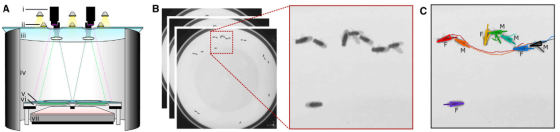
A new running theme on the blog: cool uses of behavioral quantification. One of the most exciting directions in behavioral science are the advances in behavioral quantification. Science often advances by being able to perform ever more precise measurements from … Continue reading →
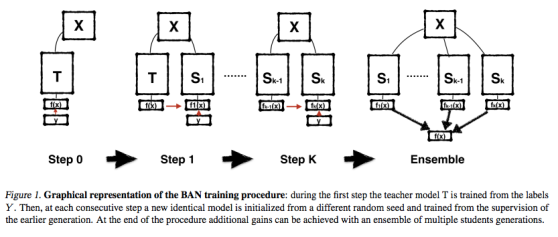
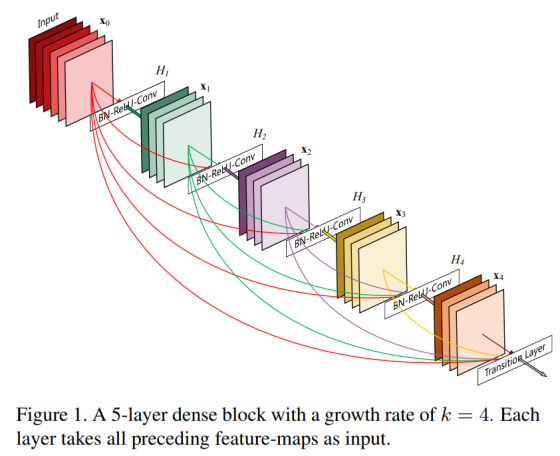
A review was published this week in Neuron by DeepMind luminary Demis Hassibis and colleagues about Neuroscience-inspired Artificial Intelligence. As one would expect from a journal called Neuron, the article was pretty positive about the use of neurons! There have … Continue reading →









 research.io