MIDiA Research Blog

The AI race is well underway, with social media companies going all-in. Meta’s triple-digit-billion investment in the space has pushed its AI developments across the board, from a recent partnership with Overview Energy to power servers with satellite solar (per Social Media Today ), to Instagram�... Source

It’s that time of year again for the definitive annual assessment of the global electronic music market: The IMS electronic music business report . Premiered at the annual IMS conference in Ibiza, this year’s report paints the picture of a healthy industry with thriving scenes but also a few war... Source

For most of recorded music history, quality was scarce. Recording, producing, and distributing a song that sounded “good” required significant investments of time, money, and skill, along with access to gatekeepers, who carefully filtered what entered the system. Source

aimusic

A lot of attention is being paid to the “rules of engagement” for podcasting: format preferences, video versus audio, and platform battles like YouTube versus Spotify. The industry is deeply focused on how and where audiences are consuming podcasts, and rightly so. Source

American poet Henry Wadsworth Longfellow once proclaimed that music is a universal language. Ironically, perhaps the only part of this universal language that isn’t universal is language itself. In the streaming era, it may seem easier than ever for musicians to reach listeners around the world, a... Source

aimusic

In today’s fragmented marketing world, artists have to promote more than just their music – they have to build dedicated fandom. To achieve this, more artists are implementing transmedia elements – that is, adapting a brand story across multiple platforms – into their marketing strategies. Source

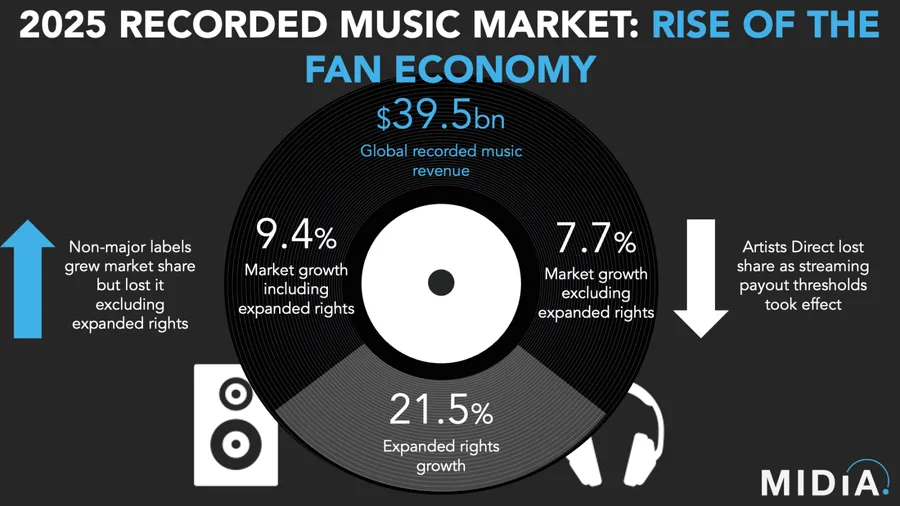
2025 was a good year for the recorded music business. After a modestly performing 2024, revenues grew by 9.4% in 2025 to reach $39.5 billion. See MIDiA’s Recorded music market 2025 | Rise of the fan economy and accompanying 12 sheet dataset for MUCH more detail. Source

History is being used to argue both for and against AI, with citations of previous cultural events and practices as evidence. Unfortunately, however, most of the historical references used are just plain wrong. Source

research.ioresearch.io

Sign up to keep scrolling

Create your feed subscriptions, save articles, keep scrolling.

Already have an account?