Functional Ecologists

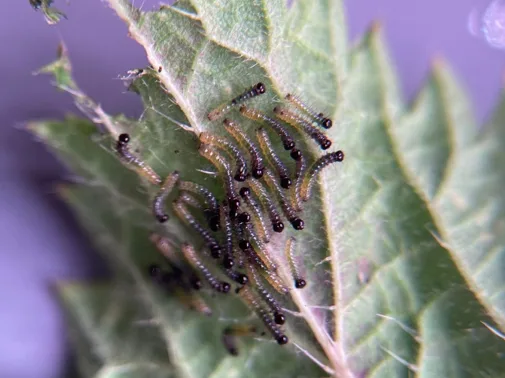
In this week’s blog post, we’re gearing up for a shift in seasons with author Grace Hirzel as we explore the behavioural changes in a temperate butterfly. Based on their paper: “Synchronous seasonal plasticity in colouration, behaviour, and visual gene expression in a wild butterfly population”, Grace shares with us how seasonal conditions impact behaviour and how animals perceive their env…

behavioral-sciencebiologyecologyzoology

In this ‘Behind the Paper’ blog post, author Anina Coetzee – a lecturer at Nelson Mandela University, George campus, South Africa – shares the ‘buzz’ about bee avoidance in bird-pollinated flowers! Discussing the research article ‘Is bee-avoidance by bird-pollinated flowers driven by nectar robbing in Erica?‘, Anina delves into the bee-avoidance hyp…

biologybotanyecology

In this week’s blog post, we’re climbing the ranks to understand strategic growth in invertebrates! Discussing their paper: “Game over: Conflict resolution through strategic growth in an invertebrate”, author Pooja Radhakrishnan reveals how a marine annelid worm establishes a size hierarchy to compete against individuals they interact with. Pooja helps us understand how social competition can dri…

biologyecologyevolutionmarine-biology

In this blog post, we hear from our newest Senior Editor, Sandra Varga! Sandra – an Associate Professor at the University of Lincoln, UK – is an evolutionary ecologist interested in understanding how plants interact with their environment. She is particularly fascinated by how plants and soil microbes interact, especially arbuscular mycorrhizal fungi. What’s the best thing about your …

biologybotanyecologyevolution

In this ‘Behind the Paper’ blog post, author Soumen Mallick – a Postdoctoral researcher at Field Station Fabrikschleichach, University of Würzburg – discusses the paper “Elevation reverses the effects of forest structure on folivory and leaf asymmetry“, which was recently published in Functional Ecology. Soumen shares how the team conducted large-scale forest e…

biologyecologyenvironmentsustainability

In this Behind the Paper blog post, author Elizabeth Telford – a postdoc at the the University of Sheffield – explores her research article N2 fixation is linked to the ability to encroach in African savanna trees. Elizabeth discusses the role of nitrogen fixation in how some trees respond to rising CO₂, how this research supported her get back into research, and her advice to …

In this ‘Behind the Paper’ blog post, author Manuel López-Aliste discusses the paper “Differential effects of agricultural expansion on wild bee taxonomic and functional diversity“, which was recently published in Functional Ecology. Manuel discusses how agricultural expansion affects the variety of bee traits, using an entomological collection to measure functional traits, and the importance of …

agriculturebiologyecology

2025 HALDANE PRIZE SHORTLIST: Xiaojing Zhang discusses her paper “Mycelium biomass and community composition impact nutrient concentration in arbuscular mycorrhizal fungi at fine spatial scale“, which has been shortlisted for Functional Ecology’s 2025 Haldane Prize for Early Career Researchers. About the paper Although AM fungi mediate nutrient exchange between plants and soil, how their own nutr…

biologyecologymycology

2025 HALDANE PRIZE SHORTLIST: Alon Rapaport discusses his paper “Rapid and chemically diverse C transfer from trees to mycorrhizal fruit bodies in the forest“, which has been shortlisted for Functional Ecology’s 2025 Haldane Prize for Early Career Researchers. About the paper Our research explores the transfer of carbon (C) from trees to ectomycorrhizal fungi (EMF) in forest ecosystems. Specifica…

biologybotanyecology

2025 HALDANE PRIZE SHORTLIST: James Mouton discusses the paper “Behavioural co-option of plant secondary compounds by a cavity-nesting bird is an adaptation against competition and predation“, which has been shortlisted for Functional Ecology’s 2025 Haldane Prize for Early Career Researchers. About the paper Plants and other organisms produce many unique chemical compounds that can be useful for …

biologybotanyecology

2025 HALDANE PRIZE SHORTLIST: Nicole Walasek discusses her paper “The evolution of sensitive periods beyond early ontogeny: Bridging theory and data“, which has been shortlisted for Functional Ecology’s 2025 Haldane Prize for Early Career Researchers. About the paper From bacteria to humans, all organisms tailor their traits to environmental demands. Such phenotypic plasticity tends to be highest…

biologydevelopmental-biology

2025 HALDANE PRIZE SHORTLIST: Michael Stemkovski discusses his paper “Ecological acclimation: A framework to integrate fast and slow responses to climate change“, which has been shortlisted for Functional Ecology’s 2025 Haldane Prize for Early Career Researchers. About the paper Our paper presents “Ecological Acclimation” as a new conceptual framework to synthesize the various ways by which ecosy…

biologyecology

2025 HALDANE PRIZE SHORTLIST: João Vitor Messeder discusses the paper “Rethinking the role of colour in avian fruit choices and foraging mechanisms“, which has been shortlisted for Functional Ecology’s 2025 Haldane Prize for Early Career Researchers. About the paper Whether in a supermarket or hiking in the tropics, you may have wondered about the amazing diversity of fleshy fruits. Similarly, ec…

biologyecology

2025 HALDANE PRIZE SHORTLIST: Kentaro Takagi discusses the paper “Realized flower constancy in bumble bees: Optimal foraging strategy balancing cognitive and travel costs and its possible consequences for floral diversity“, which has been shortlisted for Functional Ecology’s 2025 Haldane Prize for Early Career Researchers About the Paper Have you ever stopped to watch a pollinator moving among th…

biologyecologyzoology

2025 HALDANE PRIZE SHORTLIST: Marion Boisseaux, discusses her paper ‘Shifting trait coordination along a soil-moisture-nutrient gradient in tropical forests’, which has been shortlisted for Functional Ecology’s 2025 Haldane Prize for Early Career Researchers. About the paper Within the framework of the niche theory, the environment acts as a filter, and selects for species in a local community. T…

biologyecology

2025 HALDANE PRIZE SHORTLIST: Haldane Prize 2025 | Jiangnan Li discusses the paper “Linking rock outcrop size and distance to soil multifunctionality in mountain ecosystems“, which has been shortlisted for Functional Ecology’s 2025 Haldane Prize for Early Career Researchers. About the Paper In our paper, we investigate how rock outcrop size and distance influence soil multifunctionality in mounta…

biologyecology

2024 HALDANE PRIZE SHORTLIST: Lifeng Wang discusses the paper “Soil fauna trophic multifunctionality mediates the release of elements from decomposing typhoon-generated leaf litter“, which has been shortlisted for Functional Ecology’s 2025 Haldane Prize for Early Career Researchers About the paper Typhoons cause large pulse fluxes of leaves that have not undergone senescence (i.e. gre…

biologyecologysoil-science

2025 HALDANE PRIZE SHORTLIST: Jiawei Zhang discusses the paper “Spatial distribution and driving factors of microbial necromass carbon in coastal wetlands of China“, which has been shortlisted for Functional Ecology’s 2025 Haldane Prize for Early Career Researchers. About the Paper Our paper explores how microbial necromass carbon (MNC)—carbon derived from dead microorganisms—is distr…

biologyecologymicrobiology

2025 HALDANE PRIZE SHORTLIST: June Shrestha discusses her paper “Marine protection and environmental forcing influence fish-derived nutrient cycling in kelp forests“, which has been shortlisted for Functional Ecology’s 2025 Haldane Prize for Early Career Researchers About the Paper As a foundational species, kelp play an inordinately important role in providing habitat, food, and shelter for…

biologyecologyenvironmentmarine-biology

2025 HALDANE PRIZE SHORTLIST: Carolina Olguín Jacobson discusses her paper “Recovery mode: Marine protected areas enhance resilience of invertebrate species from marine heatwaves”, which has been shortlisted for Functional Ecology’s 2025 Haldane Prize for Early Career Researchers About the paper Imagine your town was suddenly hit by an extreme heatwave, not for a few days, but for months or even …

biologyecologymarine-biology
research.ioresearch.io

Sign up to keep scrolling

Create your feed subscriptions, save articles, keep scrolling.

Already have an account?